Publications
Publications by categories in reversed chronological order. Generated by jekyll-scholar.
2026
-
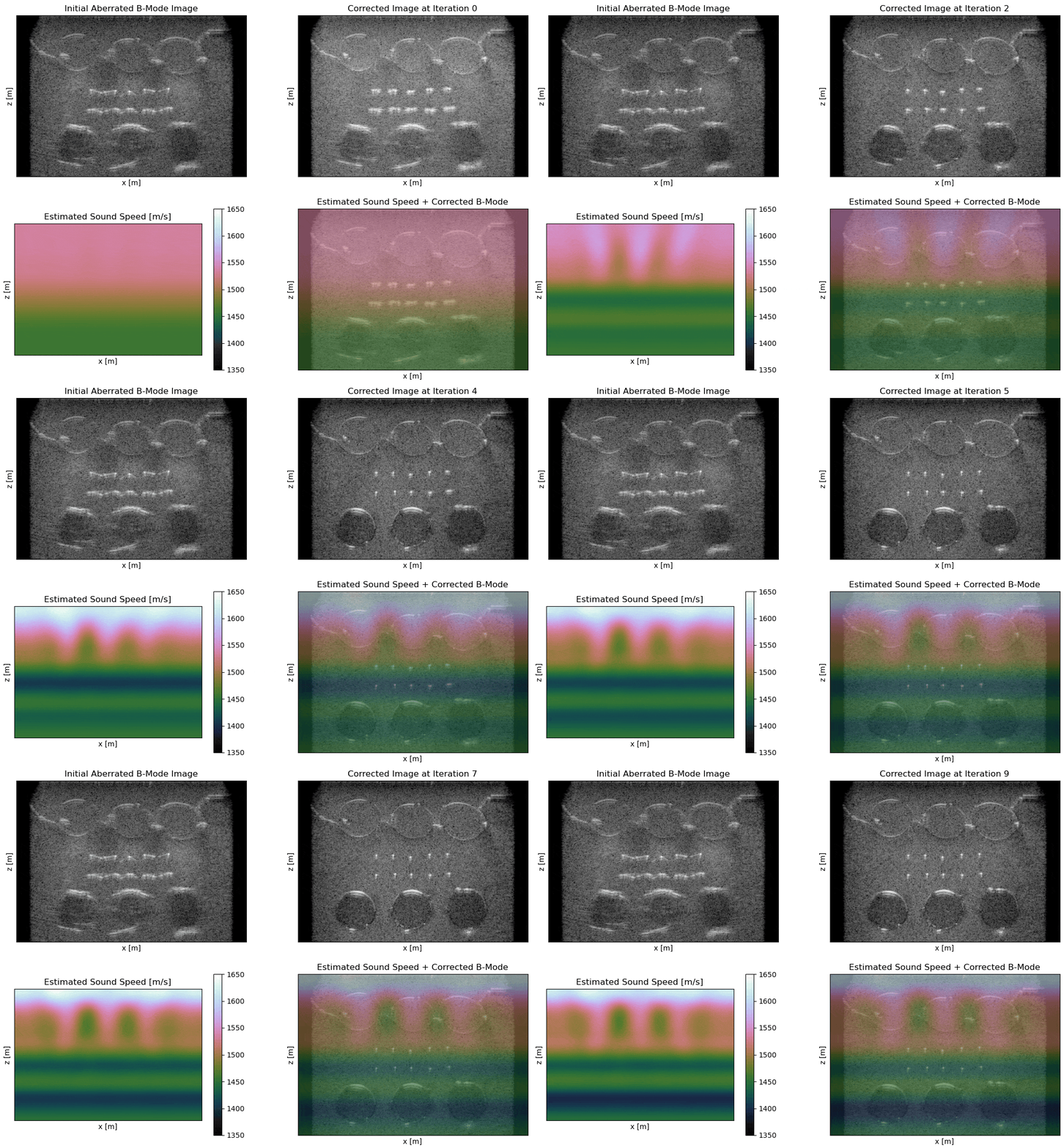 Wave-Equation Migration Velocity Analysis for Multistatic Synthetic Aperture UltrasoundRehman Ali, Trevor M Mitcham, Marvin M Doyley, and 2 more authors2026
Sound speed heterogeneities can create aberrations in B-mode ultrasound images by inducing tissue-dependent delays and diffractive effects that conventional beamforming does not incorporate. By using the Fourier split-step method to simulate pressure fields in heterogenous sound speed media, reverse-time migration (RTM) can reconstruct the B-mode image by cross-correlating transmitted and received pressure fields. As a result, RTM is differentiable with respect to sound speed. This enables the reconstruction of the sound speed profile that minimizes the aberration in the B-mode image. In seismic imaging, this form of diffraction tomography, known as wave-equation migration velocity analysis, can roughly be understood as a type of full-waveform inversion (FWI) that acts in the image domain rather than errors in the received channel data. This is the first work applying WEMVA to medical pulse-echo ultrasound imaging. Phantom experiments show dramatic improvements in image quality with measured improvements in point target resolution from 1.22±1.01 to 0.32±0.07 mm and lesion contrast from 3.05 to 4.39 dB.
@misc{Ali2026WEMVA, title = {Wave-Equation Migration Velocity Analysis for Multistatic Synthetic Aperture Ultrasound}, author = {Ali, Rehman and Mitcham, Trevor M and Doyley, Marvin M and Duric, Nebojsa and Dahl, Jeremy J}, year = {2026}, archiveprefix = {arXiv}, primaryclass = {physics.med-ph}, doi = {10.48550/arXiv.2604.27428}, url = {https://arxiv.org/abs/2604.27428}, } -
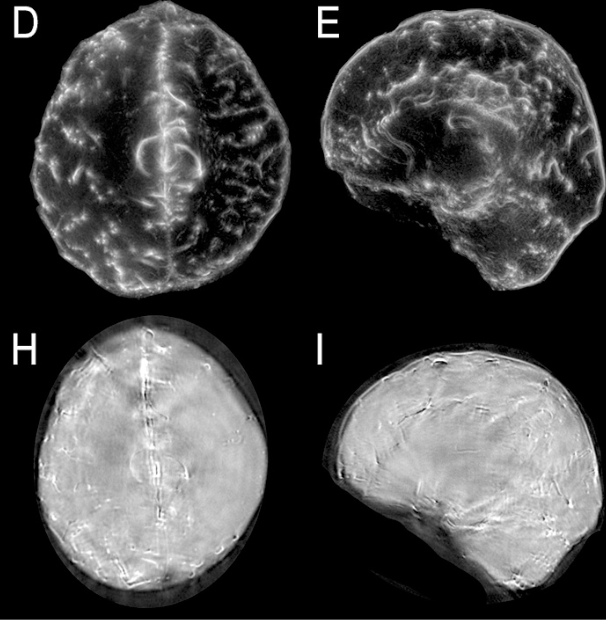 Where no sound wave has gone before: first high-resolution transcranial images of the brain using ultrasound computed tomographyThomas J Marini, Trevor Mitcham, Rehman Ali, and 8 more authorsEuropean Journal of Radiology, 2026
@article{Marini2026TranscranialUST, title = {Where no sound wave has gone before: first high-resolution transcranial images of the brain using ultrasound computed tomography}, author = {Marini, Thomas J and Mitcham, Trevor and Ali, Rehman and Owolabi, Israel and Nketia, Victoria and Bender, Matthew and Kohli, Gurkirat and Ayus, Santiago Mendoza and Lake, Marissa and Singh, Melanie and others}, journal = {European Journal of Radiology}, pages = {113193}, year = {2026}, doi = {10.1016/j.ejrad.2026.113193}, publisher = {Elsevier}, url = {https://www.sciencedirect.com/science/article/pii/S0720048X26005413}, } -
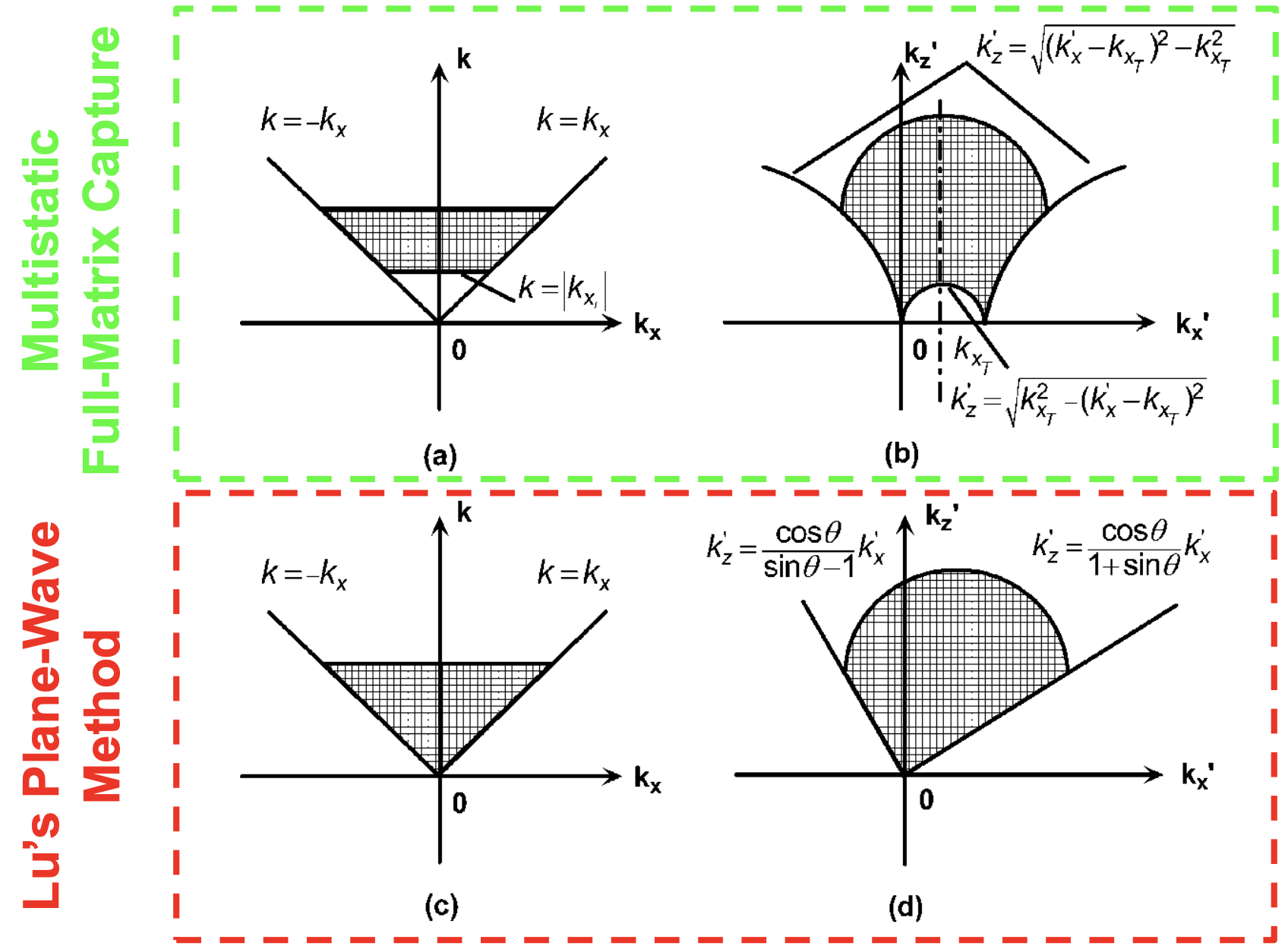 Fast Fourier Beamforming for Arbitrary Ultrasound Imaging Sequences Based on a K-Space Implementation of Reverse-Time MigrationRehman Ali and Nebojsa DuricIn Medical Imaging 2026: Ultrasonic Imaging and Tomography, 2026
The goal of Fourier beamforming is to reconstruct ultrasound images more quickly than delay-and-sum beamforming by leveraging the underlying mapping from the frequency-domain representation of the channel data to the k-space representation of the image. However, a current drawback of Fourier beamforming is its inability to generalize well to different imaging sequences. Stolt mappings have been derived for very specific imaging sequences, such as plane-wave and multistatic synthetic aperture. This work presents a generalized Stolt mapping based on reverse-time migration that can be applied to any imaging sequence. In Field II simulations of plane-wave and focused transmits, we observe that the proposed technique is comparable to REFoCUS and produces up to a 20% improvement in point target resolution compared to existing Fourier beamformers and DAS beamforming due its ability image edge waves.
@inproceedings{Ali2026FourierBeamforming, title = {Fast Fourier Beamforming for Arbitrary Ultrasound Imaging Sequences Based on a K-Space Implementation of Reverse-Time Migration}, author = {Ali, Rehman and Duric, Nebojsa}, booktitle = {Medical Imaging 2026: Ultrasonic Imaging and Tomography}, volume = {13931}, pages = {362--367}, year = {2026}, organization = {SPIE}, doi = {10.1117/12.3085601}, url = {https://www.spiedigitallibrary.org/conference-proceedings-of-spie/13931/3085601/Fast-Fourier-beamforming-for-arbitrary-ultrasound-imaging-sequences-based-on/10.1117/12.3085601.full}, } -
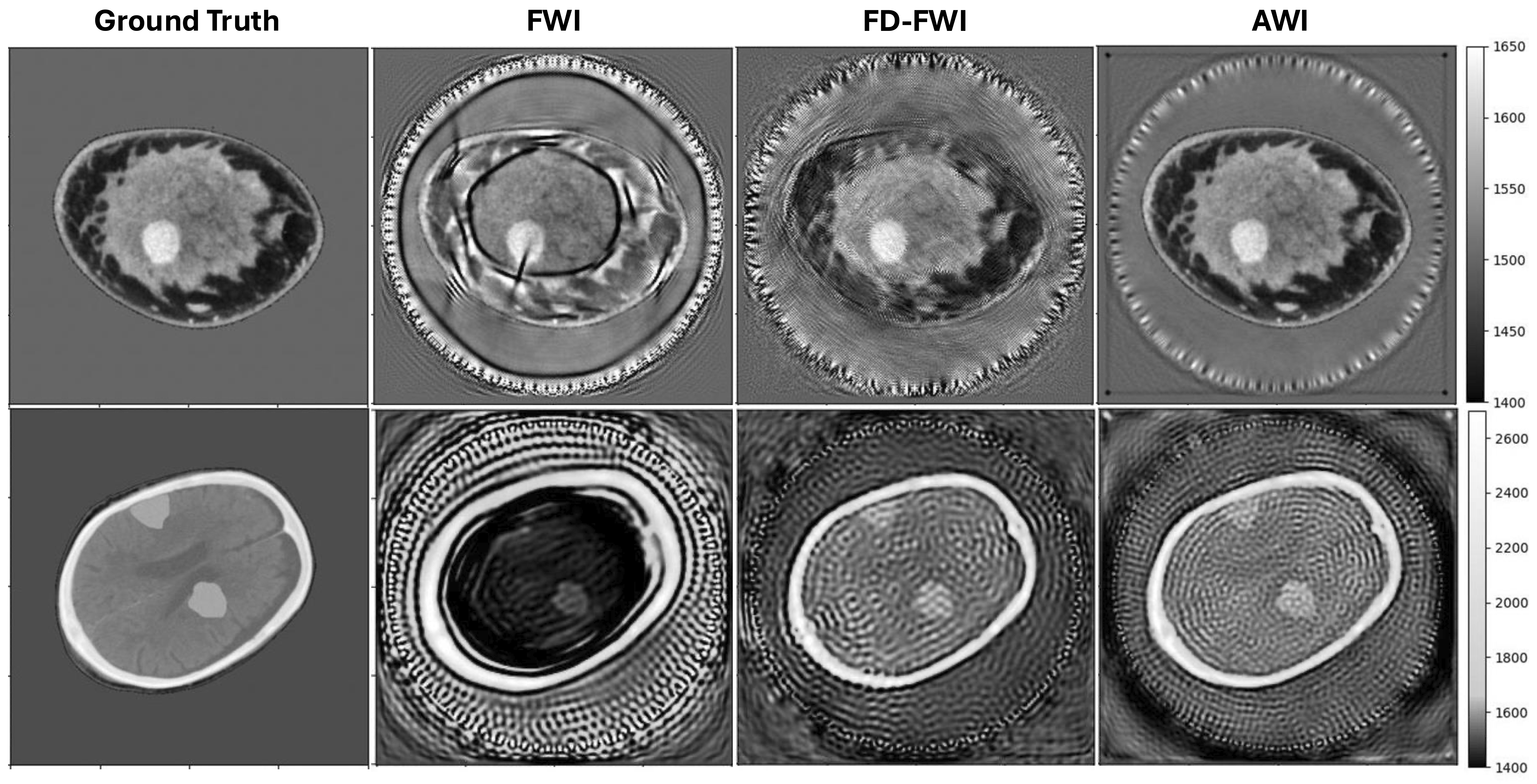 Using JAX to develop cycle-skipping resistant full-waveform inversion techniques for ultrasound tomographyAlex Klaben, Melanie Singh, Nebojsa Duric, and 1 more authorIn Medical Imaging 2026: Ultrasonic Imaging and Tomography, 2026
Full-waveform inversion (FWI) is limited by its dependence on accurate starting models and sufficiently low-frequency signals to avoid cycle skipping. This motivates the many cycle-skipping robust alternatives proposed in the literature, including frequency-difference full-waveform inversion (FD-FWI) and adaptive waveform inversion (AWI). In this work, the JAX Python library was used to implement and compare these methods more rapidly than would otherwise be possible. Using JAX, the gradient of an objective function can be found using automatic differentiation, removing the need for analytically derived gradients. FWI, FD-FWI, and AWI were implemented using JAX, and each method was used to reconstruct images of the breast and of the brain through the skull. The data for these images was synthetically created using k-Wave, and a separate time-domain wave-equation solver was used in the reconstruction process. In breast imaging, both FD-FWI and AWI produced more accurate reconstructions than FWI when applied to k-Wave data produced with a 400kHz center frequency and a 50% bandwidth, with AWI producing the most accurate reconstruction. Relative to FWI, FD-FWI reduced the root-mean-square (RMS) error by 16.3m/s while AWI reduced the RMS error by 39.4m/s. In brain imaging, using a 100kHz center frequency and a 50% fractional bandwidth, FD-FWI and AWI produced more accurate reconstructions than FWI. Relative to FWI, FD-FWI reduced the RMS error by 66.0 m/s while AWI reduced the error by 98.1m/s. Both accurately recovered the bulk sound speed and two hemorrhages in the brain. Using a 200kHz center frequency and a 50% fractional bandwidth, FD-FWI increased the RMS error by 20.3m/s and AWI reduced the RMS error by 85.5m/s. These results indicate that in many cases FD-FWI is more robust to cycle-skipping than FWI, while AWI is consistently more robust than either FWI or FD-FWI. Additionally, AWI was found to be robust to noise with signal-to-noise ratios of 40dB or higher.
@inproceedings{Klaben2026JAX, title = {Using JAX to develop cycle-skipping resistant full-waveform inversion techniques for ultrasound tomography}, author = {Klaben, Alex and Singh, Melanie and Duric, Nebojsa and Ali, Rehman}, booktitle = {Medical Imaging 2026: Ultrasonic Imaging and Tomography}, volume = {13931}, pages = {104--112}, year = {2026}, organization = {SPIE}, doi = {10.1117/12.3085595}, url = {https://www.spiedigitallibrary.org/conference-proceedings-of-spie/13931/3085595/Using-JAX-to-develop-cycleskipping-resistant-fullwaveform-inversion-techniques-for/10.1117/12.3085595.full} } -
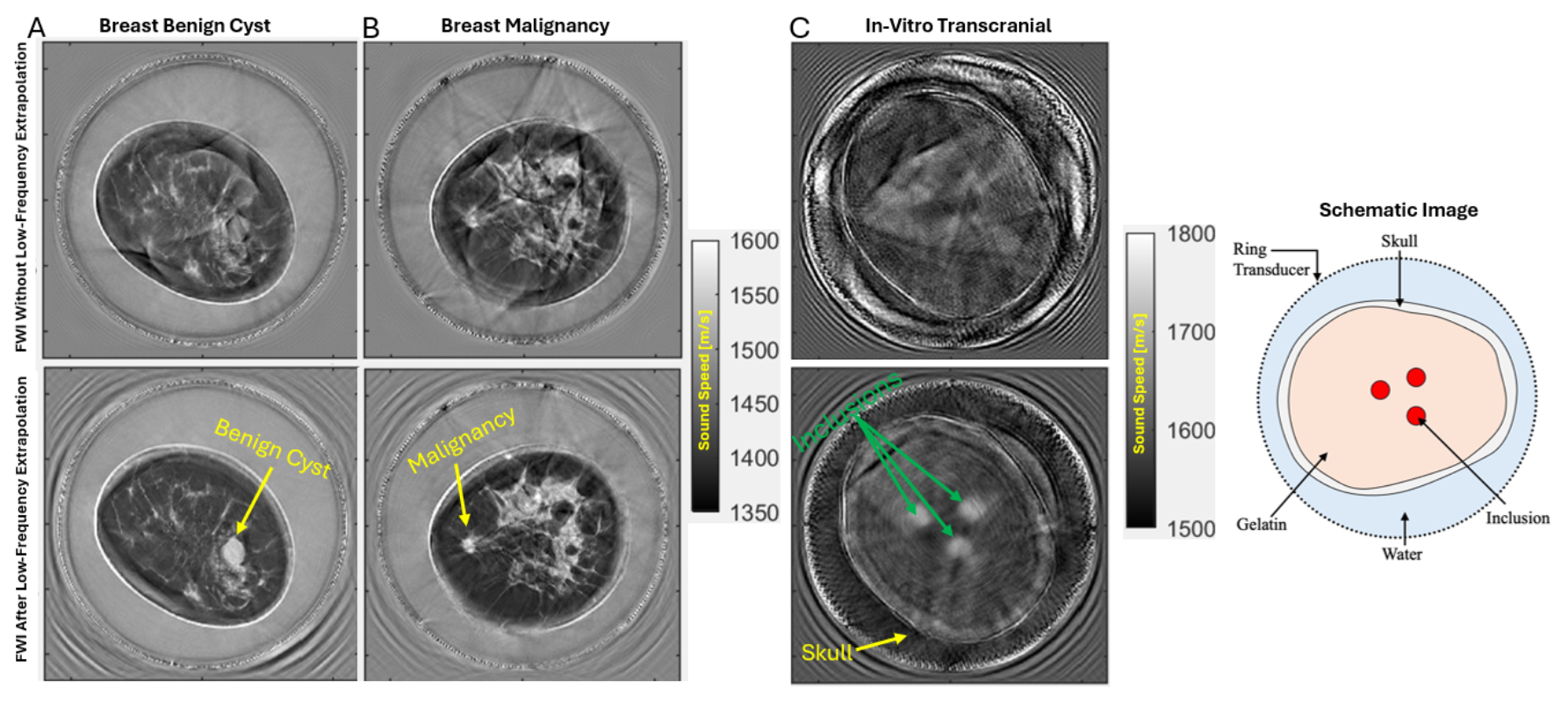 Least-Squares Low-Frequency Extrapolation for Full-Waveform Inversion Without Cycle SkippingIsrael Owolabi, Rehman Ali, Trevor Mitcham, and 3 more authorsIn Medical Imaging 2026: Ultrasonic Imaging and Tomography, 2026
In most ultrasound transducer designs, priority is given to a high frequency operation to maximize spatial resolution in conventional B-mode reflectivity imaging. However, applying full-waveform inversion (FWI) with the same high frequency hardware presents significant challenges, most notably the risk of cycle skipping artifacts. These artifacts arise when a phase mismatch between the predicted and measured wavefields leads the inversion to converge to incorrect solutions (false local minimal). Overcoming this issue requires the presence of low frequency content, which improves the robustness of the inversion by increasing the wavelength of the waveform and thereby enables better alignment between the predicted and measured wavefields. Least-squares extrapolation of low frequency data provides the FWI with a good initial model for reconstruction of tissue parameters and builds upon our previous work on frequency-differencing to circumvent cycle-skipping artifacts in UST sound speed image reconstruction.
@inproceedings{Owolabi2026LowFrequencyExtrapolation, title = {Least-Squares Low-Frequency Extrapolation for Full-Waveform Inversion Without Cycle Skipping}, author = {Owolabi, Israel and Ali, Rehman and Mitcham, Trevor and Nketia, Victoria and Singh, Melanie and Duric, Nebojsa}, booktitle = {Medical Imaging 2026: Ultrasonic Imaging and Tomography}, volume = {13931}, pages = {98--103}, year = {2026}, organization = {SPIE}, doi = {10.1117/12.3084570}, url = {https://www.spiedigitallibrary.org/conference-proceedings-of-spie/13931/3084570/Leastsquares-lowfrequency-extrapolation-for-fullwaveform-inversion-without-cycle-skipping/10.1117/12.3084570.full} } -
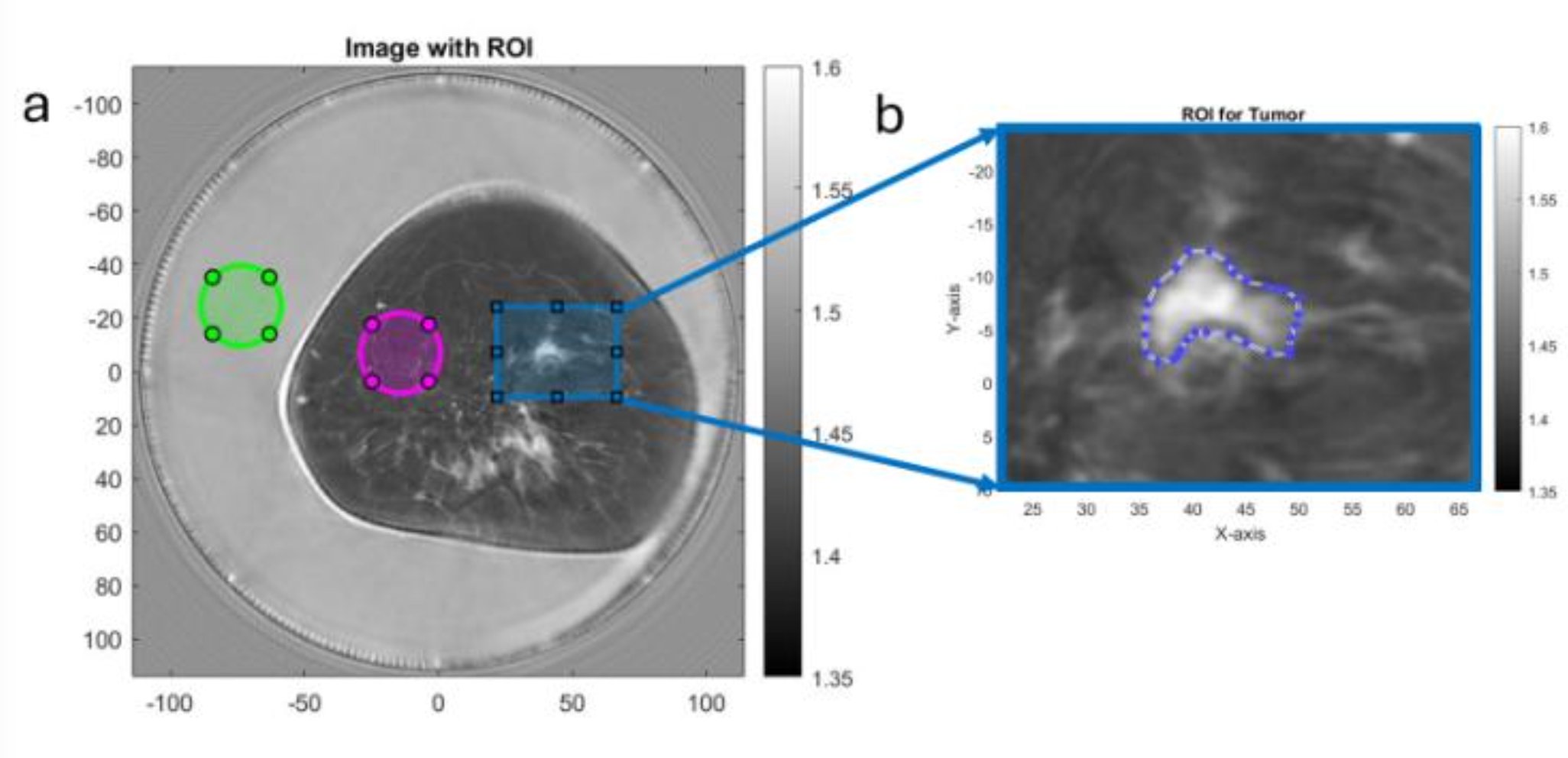 Optimizing computational efficiency and image quality in clinical breast ultrasound tomography through data downsamplingVictoria Nketia, Trevor Mitcham, Maria Camila Gonzalez Garcia, and 4 more authorsIn Medical Imaging 2026: Ultrasonic Imaging and Tomography, 2026
Ultrasound tomography (UST) offers quantitative, high-resolution breast imaging, but widespread clinical adoption remains limited by long acquisition times, large raw data volumes, and high computational demands for image reconstruction. Some current systems employ a 1024-element ring transducer array, producing more than 2 GB of raw data per slice and nearly 200 GB for a full breast volume, resulting in considerable memory and storage requirements, hardware, and processing burdens. This study systematically investigates downsampling as a practical strategy to reduce data size, computational load, and reconstruction time while preserving diagnostic image quality. Using clinical UST data from a ring-array system, raw data were downsampled from 1024×1024 to 512×512 and 256×256, with additional transmit-only reductions applied by factors of 4, 8, 16, and 32. Images were reconstructed using a Full Waveform Inversion (FWI) algorithm, and the quality of the reconstructed images was evaluated across consistent anatomical Regions of Interest (ROIs). Quantitative metrics included Signal-to-Noise Ratio (SNR), Contrast-to-Noise Ratio (CNR), and Root Mean Square Error (RMSE). Results show that downsampling reduces reconstruction time by up to a factor of three while decreasing memory size. Although tumor SNR decreased with extreme downsampling, CNR remained largely comparable across many configurations, indicating preserved tumor detectability. The 64×256 configuration provided an optimal balance, offering strong CNR performance with a reconstruction 3 times faster compared to the 3.0 minutes of the full dataset. These findings demonstrate that strategic downsampling enables substantial efficiency gains with minimal loss of clinically relevant image quality, supporting the development of lower-cost, UST systems suitable for clinical use.
@inproceedings{Nketia2026Downsampling, title = {Optimizing computational efficiency and image quality in clinical breast ultrasound tomography through data downsampling}, author = {Nketia, Victoria and Mitcham, Trevor and Garcia, Maria Camila Gonzalez and Ali, Rehman and Owolabi, Israel and Singh, Melanie and Duric, Neb}, booktitle = {Medical Imaging 2026: Ultrasonic Imaging and Tomography}, volume = {13931}, pages = {118--133}, year = {2026}, organization = {SPIE}, doi = {10.1117/12.3082370}, url = {https://www.spiedigitallibrary.org/conference-proceedings-of-spie/13931/3082370/Optimizing-computational-efficiency-and-image-quality-in-clinical-breast-ultrasound/10.1117/12.3082370.full} } -
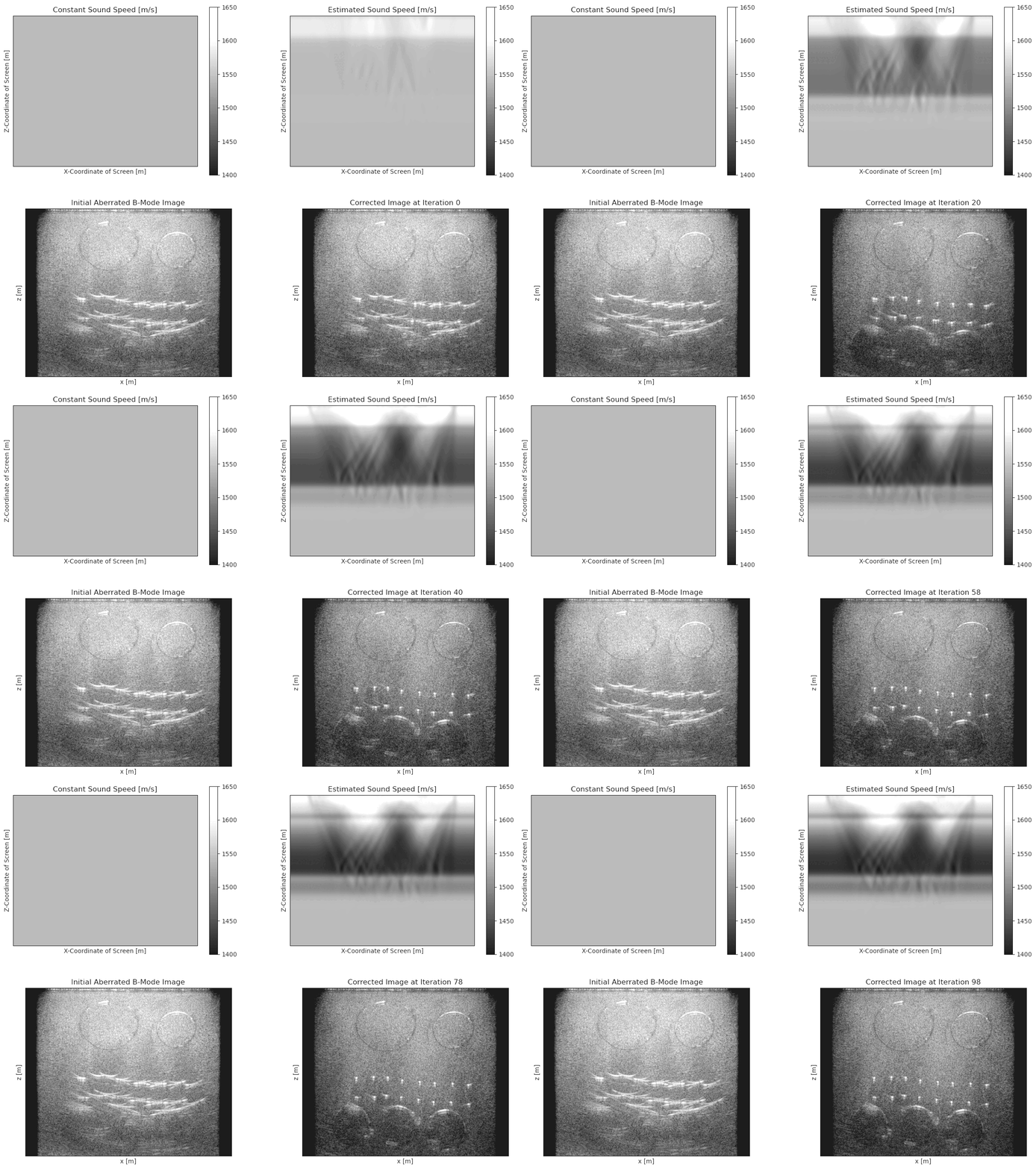 Differentiable Reverse-Time Migration for Sound Speed Estimation and Aberration Correction in Medical Pulse-Echo UltrasoundRehman Ali, Trevor Mitcham, and Nebojsa DuricIn Medical Imaging 2026: Ultrasonic Imaging and Tomography, 2026
Sound speed heterogeneities can create aberrations in B-mode ultrasound images by inducing tissue-dependent delays and diffractive effects that conventional beamforming does not incorporate. By using the Fourier split-step method to simulate pressure fields in heterogenous sound speed media, reverse-time migration (RTM) can reconstruct the B-mode image by cross-correlating transmitted and received pressure fields. As a result, RTM is differentiable with respect to sound speed. This enables the reconstruction of the sound speed profile that minimizes the aberration in the B-mode image. In seismic imaging, this form of diffraction tomography, known as wave-equation migration velocity analysis (WEMVA), can roughly be understood as a type of full-waveform inversion (FWI) that acts in the image space (i.e., migrated waveforms) rather than the data space (i.e., traces in the received channel data). This is the first work applying WEMVA to medical pulse-echo ultrasound imaging. Phantom experiments show dramatic improvements in image quality and an 80-87% improvement in point target resolution because of the proposed sound speed estimation and aberration correction scheme.
@inproceedings{Ali2026DifferentiableRTM, title = {Differentiable Reverse-Time Migration for Sound Speed Estimation and Aberration Correction in Medical Pulse-Echo Ultrasound}, author = {Ali, Rehman and Mitcham, Trevor and Duric, Nebojsa}, booktitle = {Medical Imaging 2026: Ultrasonic Imaging and Tomography}, volume = {13931}, pages = {1393103}, year = {2026}, organization = {SPIE}, doi = {10.1117/12.3085607}, url = {https://www.spiedigitallibrary.org/conference-proceedings-of-spie/13931/3085607/Differentiable-reversetime-migration-for-sound-speed-estimation-and-aberration-correction/10.1117/12.3085607.full} } -
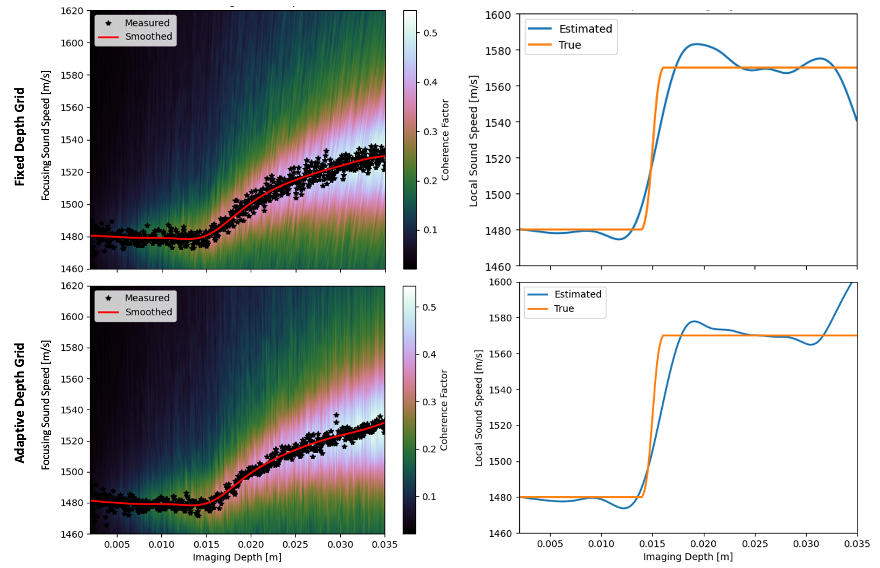 Target-Following Lagrangian Approach to Sound Speed Estimation in Pulse-Echo UltrasoundRehman Ali and Nebojsa DuricIn Medical Imaging 2026: Ultrasonic Imaging and Tomography, 2026
Sound speed estimation in pulse-echo ultrasound typically involves minimizing aberrations over a fixed grid of image points. However, the apparent positions of imaging targets depend on the speed of sound. In other words, each image point on a fixed grid may correspond to different imaging targets as the sound speed estimate changes. This source of nonlinearity becomes especially problematic when applying differentiable beamforming over a fixed imaging grid to estimate the speed of sound in a layered medium. Ideally, sound speed reconstruction would be based on a fixed set of imaging targets rather than a fixed set of image points. From a continuum mechanics perspective, working with a fixed image grid takes a strictly Eulerian approach to sound speed estimation. A Lagrangian approach would follow the image targets as the change in sound speed deforms the image from its initial configuration. By using an adaptive grid of image points that follows the image targets as the sound speed changes, we effectively account for both Eulerian and Lagrangian aspects of the problem. Simulations show that this target-following approach reduces the nonlinearity of the inverse problem of sound speed estimation in layered media.
@inproceedings{Ali2026TargetFollowingLagrangianApproach, title = {Target-Following Lagrangian Approach to Sound Speed Estimation in Pulse-Echo Ultrasound}, author = {Ali, Rehman and Duric, Nebojsa}, booktitle = {Medical Imaging 2026: Ultrasonic Imaging and Tomography}, volume = {13931}, pages = {26--33}, year = {2026}, organization = {SPIE}, doi = {10.1117/12.3085613}, url = {https://www.spiedigitallibrary.org/conference-proceedings-of-spie/13931/3085613/Targetfollowing-Lagrangian-approach-to-sound-speed-estimation-in-pulseecho-ultrasound/10.1117/12.3085613.full} } -
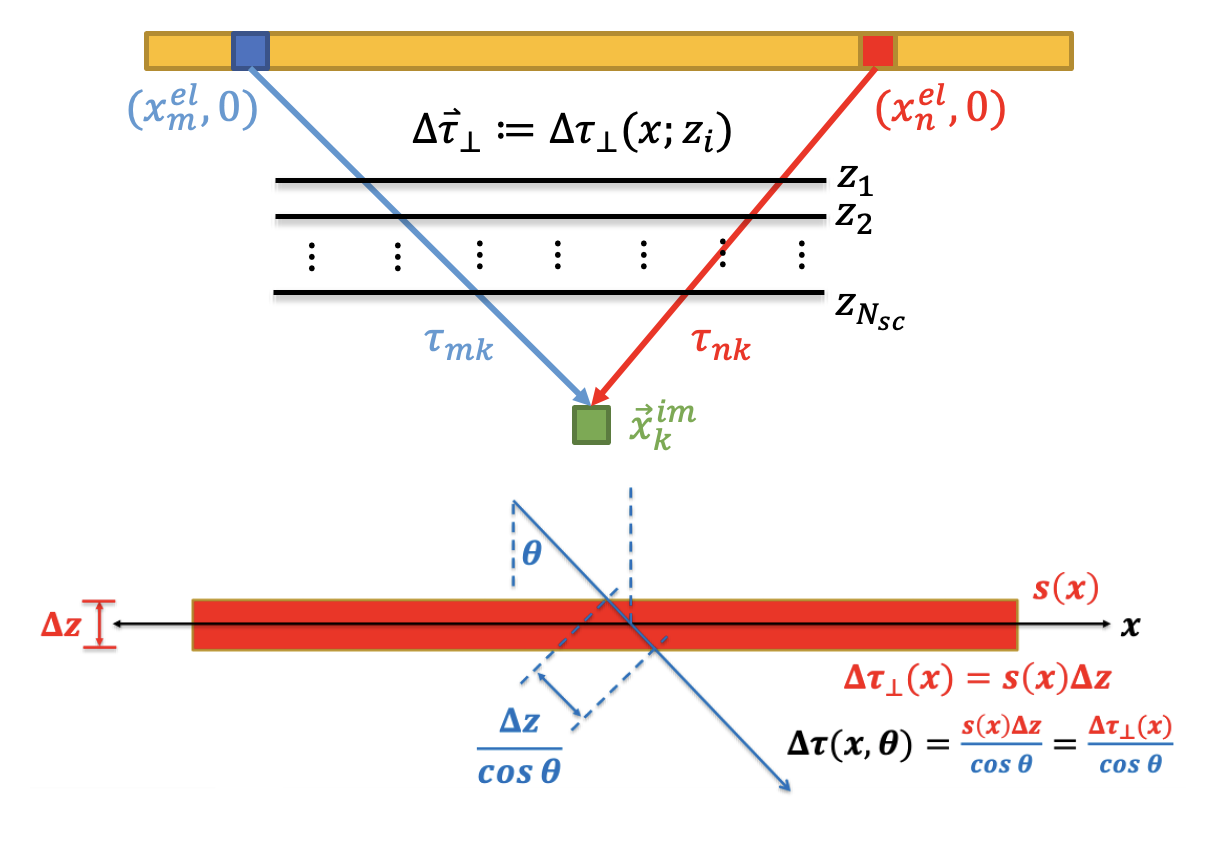 Reviving and Extending the Mid-Field Phase Screen Model for Distributed Aberration CorrectionRehman Ali, Trevor Mitcham, and Nebojsa DuricIn Medical Imaging 2026: Ultrasonic Imaging and Tomography, 2026
Aberration is one the key sources of image degradation in handheld B-mode ultrasound imaging. Sound speed heterogeneities in human tissue induce path-dependent delays that result in spatially varying aberrations in the image. One of the earliest models for aberration was the near-field phase screen. This was later extended to a mid-field phase screen model by introducing an offset between the aberrating screen and the transducer surface. By introducing this offset, the mid-field phase screen model could capture the parallax in the aberrations observed in the image. However, a single mid-field phase screen cannot fully capture the aberrations caused by a spatially varying sound speed. In this work, we extend the mid-field phase screen model by placing phase screens at multiple depths and demonstrate its approximate equivalence to a full sound speed profile under a straight-ray assumption. Phantom experiments show a 51-62% improvement in point target resolution because of the proposed aberration model and correction scheme.
@inproceedings{Ali2026MidFieldPhaseScreenModel, title = {Reviving and Extending the Mid-Field Phase Screen Model for Distributed Aberration Correction}, author = {Ali, Rehman and Mitcham, Trevor and Duric, Nebojsa}, booktitle = {Medical Imaging 2026: Ultrasonic Imaging and Tomography}, volume = {13931}, pages = {368--374}, year = {2026}, organization = {SPIE}, doi = {10.1117/12.3085608}, url = {https://www.spiedigitallibrary.org/conference-proceedings-of-spie/13931/3085608/Reviving-and-extending-the-midfield-phase-screen-model-for-distributed/10.1117/12.3085608.full} } -
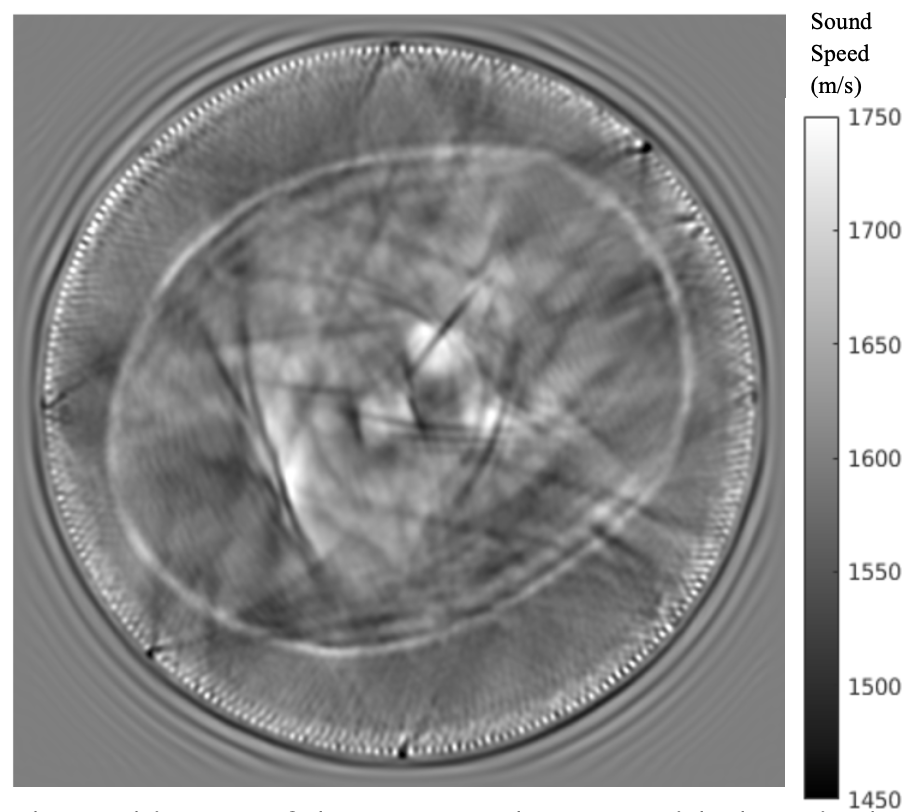 Assessing the Feasibility of Brain Imaging with Ultrasound Tomography: In-Silico and In-Vitro EvaluationMelanie Singh, Rehman Ali, Trevor Mitcham, and 4 more authorsIn Medical Imaging 2026: Ultrasonic Imaging and Tomography, 2026
Ultrasound Tomography (UST) provides a non-invasive way to reconstruct high-resolution images of tissue properties. When there is a high contrast between tissue properties, limited low-frequency signal content makes it difficult to apply UST to brain imaging, especially when high-impedance structures like bone are present. This study used both in-silico and in-vitro experiments to assess the viability of UST for brain imaging. A frequency-domain full waveform inversion (FWI) algorithm was used for image reconstructions. The impact of reconstruction parameters on image quality was methodically investigated. We validate our simulation techniques through comparison with experimental data and provide useful guidance for enhancing UST-based brain imaging in clinical settings. Results show that frequencies as low as 50kHz may be needed to mitigate cycle skipping artifacts and using smaller iterative step sizes further stabilized the reconstructions against cycle skipping.
@inproceedings{Singh2026TranscranialUST,
  title = {Assessing the Feasibility of Brain Imaging with Ultrasound Tomography: In-Silico and In-Vitro Evaluation},
  author = {Singh, Melanie and Ali, Rehman and Mitcham, Trevor and Owolabi, Israel and Nketia, Victoria and Klaben, Alex and Duric, Nebojsa},
  booktitle = {Medical Imaging 2026: Ultrasonic Imaging and Tomography},
  volume = {13931},
  pages = {15--25},
  year = {2026},
  organization = {SPIE},
  doi = {10.1117/12.3086112},
  url = {https://www.spiedigitallibrary.org/conference-proceedings-of-spie/13931/3086112/Assessing-the-feasibility-of-brain-imaging-with-ultrasound-tomography/10.1117/12.3086112.full}
}




2025
-
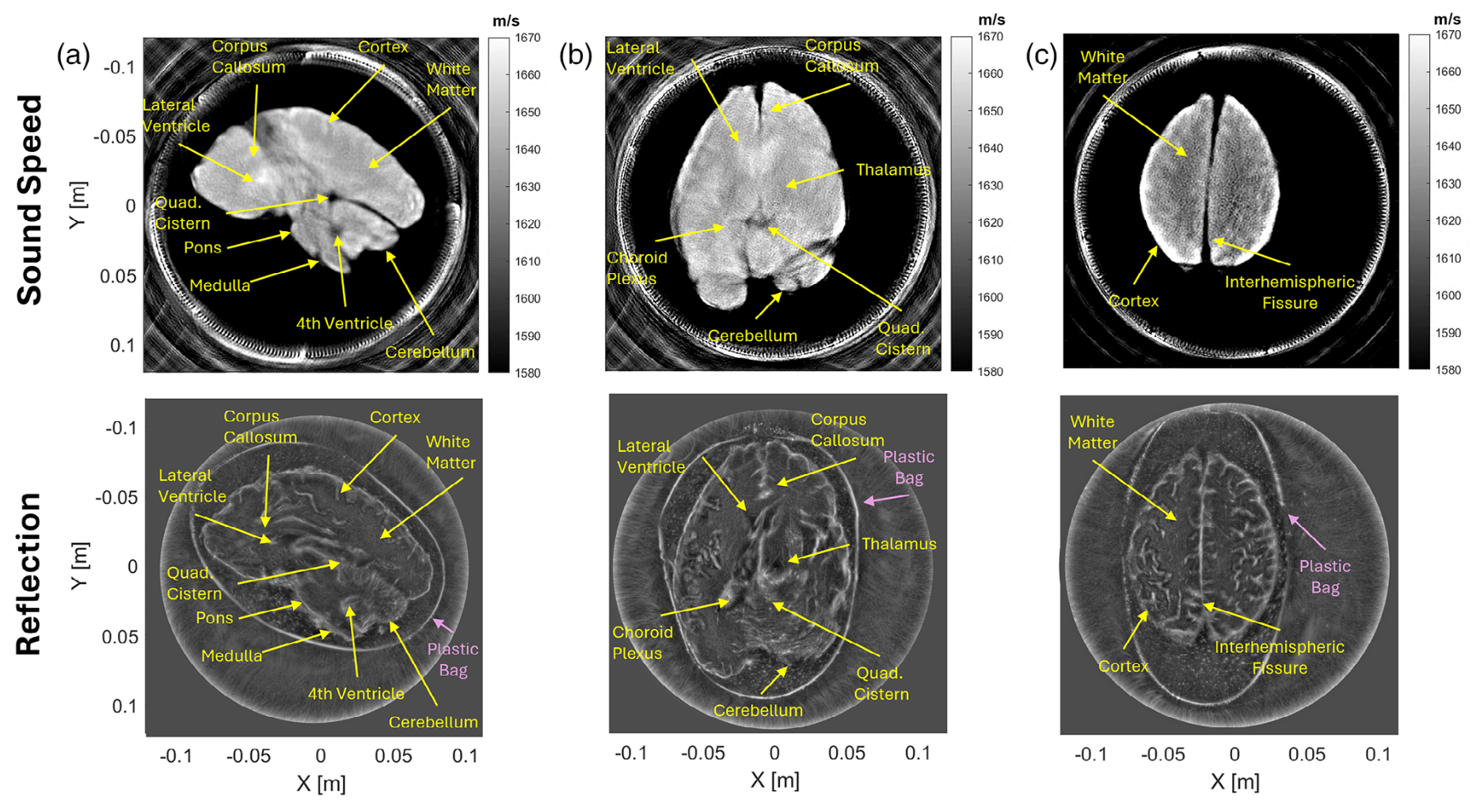 Transcranial ultrasound tomography for brain imaging: Ex vivo results and potential for stroke imagingTrevor Mitcham, Rehman Ali, Melanie Singh, and 6 more authorsMedical physics, 2025
@article{Mitcham2025TranscranialUST, title = {Transcranial ultrasound tomography for brain imaging: Ex vivo results and potential for stroke imaging}, author = {Mitcham, Trevor and Ali, Rehman and Singh, Melanie and McConnell, Sarah and Rahmani, Redi and Schartz, Derrek and Bender, Matthew and Vates, Edward and Duric, Neb}, journal = {Medical physics}, volume = {52}, number = {10}, pages = {e18090}, year = {2025}, doi = {10.1002/mp.18090}, publisher = {Wiley Online Library}, url = {https://aapm.onlinelibrary.wiley.com/doi/10.1002/mp.18090}, } -
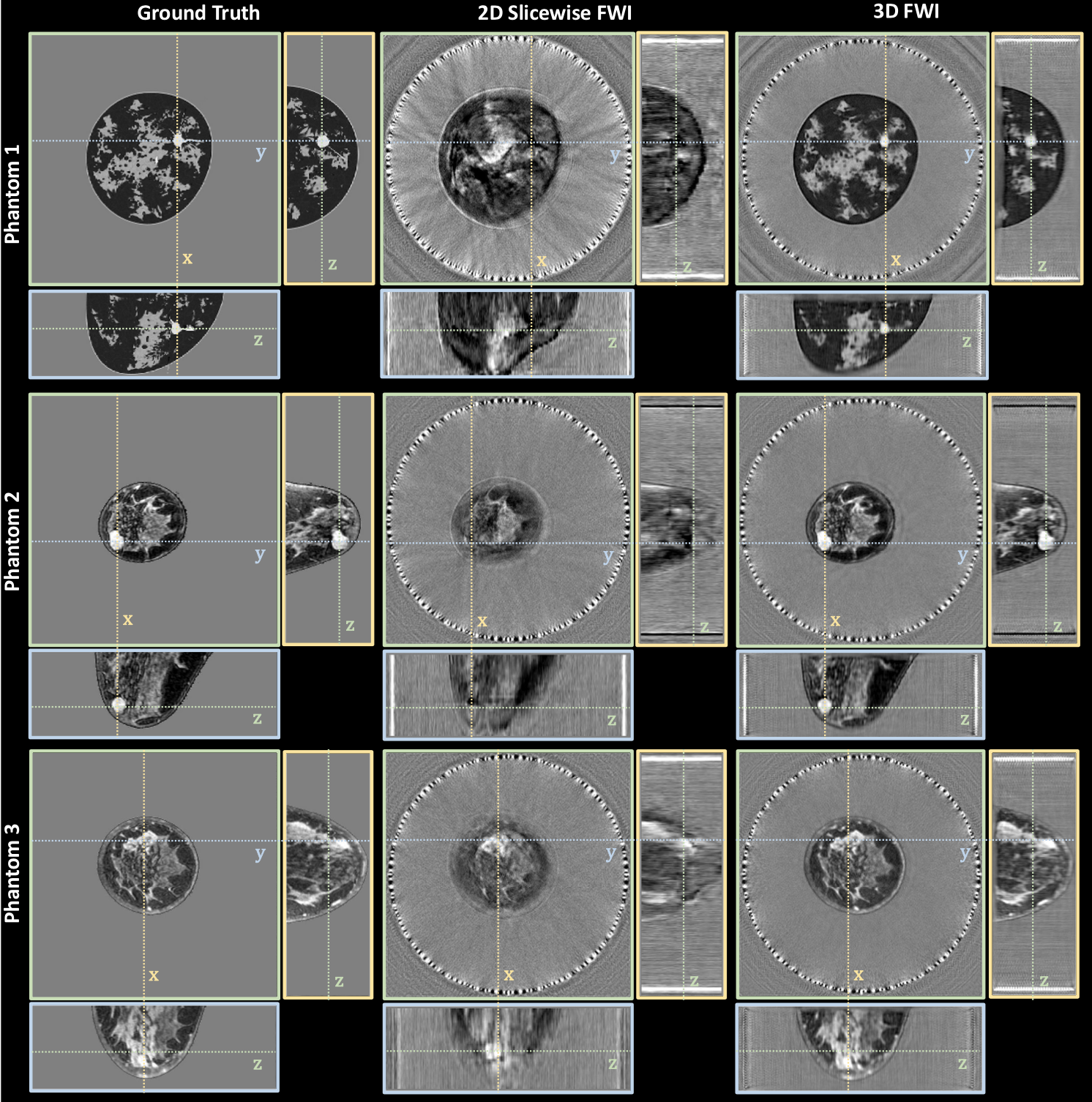 3D Frequency-Domain Full Waveform Inversion for Whole-Breast Imaging With a Multi-Row Ring ArrayRehman Ali, Gaofei Jin, Melanie Singh, and 2 more authorsIEEE open journal of ultrasonics, ferroelectrics, and frequency control, 2025
For ring-array ultrasound tomography, two-dimensional frequency-domain full waveform inversion is the clinical gold standard for high-resolution imaging of the breast. While yielding high-resolution images in the plane of the ring-array, the resulting slice-wise approach yields lower resolution out of plane when used to reconstruct the full volume. Instead, this work proposes a fully three-dimensional full-waveform inversion based on a multi-row ring-array transducer to improve out-of-plane resolution, while using cylindrical-wave transmissions to minimize acquisition and reconstruction time. For each numerical breast phantom tested, the root-mean-square error of three-dimensional full-waveform inversion is less than that of two-dimensional slice-wise full-waveform inversion by 6.3-13.7 m/s.
@article{Ali2025_3DFWI, title = {3D Frequency-Domain Full Waveform Inversion for Whole-Breast Imaging With a Multi-Row Ring Array}, author = {Ali, Rehman and Jin, Gaofei and Singh, Melanie and Mitcham, Trevor and Duric, Nebojsa}, journal = {IEEE open journal of ultrasonics, ferroelectrics, and frequency control}, volume = {5}, pages = {77--81}, year = {2025}, doi = {10.1109/OJUFFC.2025.3570253}, publisher = {IEEE}, url = {https://ieeexplore.ieee.org/abstract/document/11003981}, } -
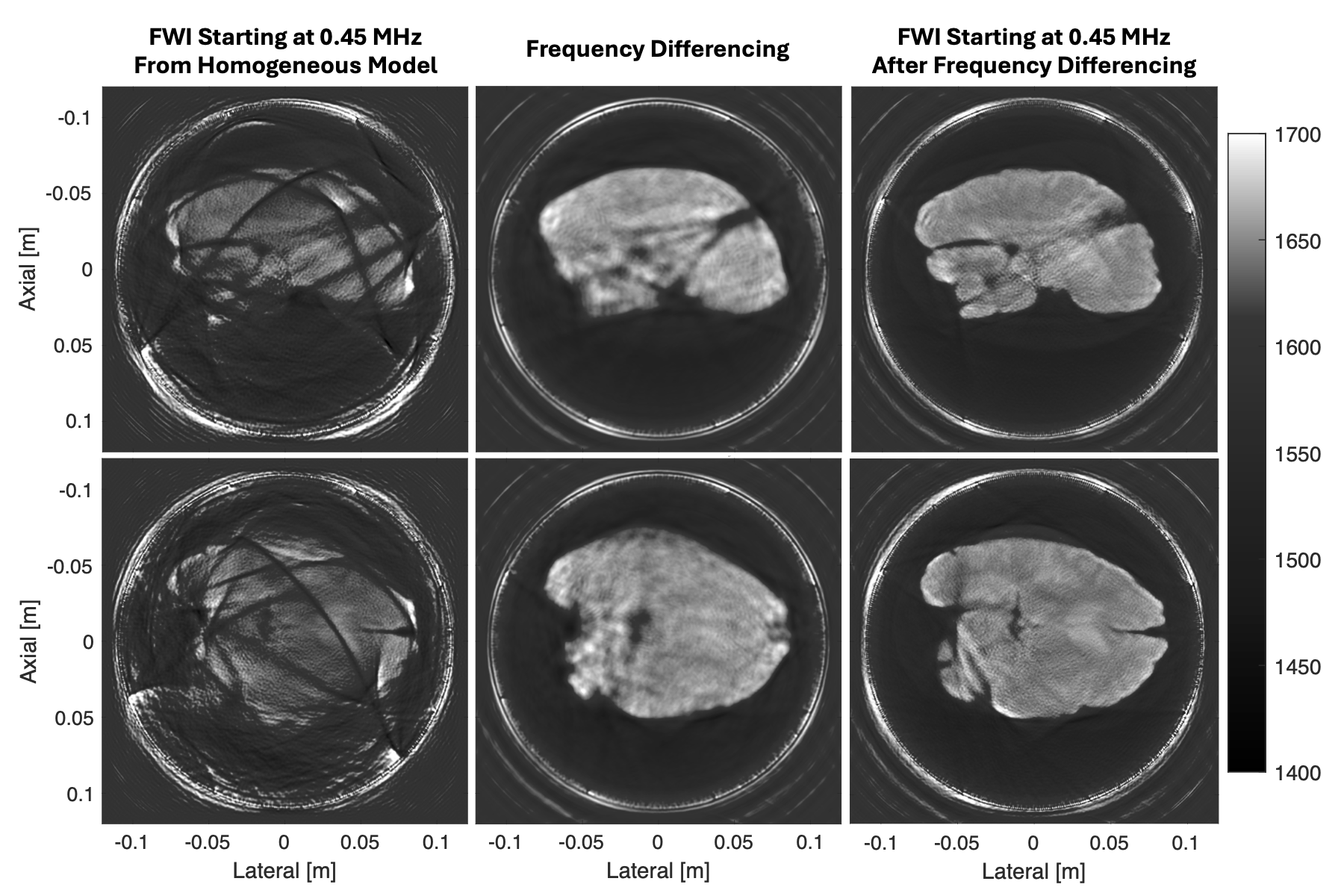 Frequency-differencing strategy to kickstart full-waveform inversion without cycle skippingRehman Ali, Trevor Mitcham, Israel Owolabi, and 2 more authorsJASA Express Letters, 2025
Ultrasound tomography fundamentally relies on low-frequency data to avoid cycle skipping in full-waveform inversion (FWI). In the absence of sufficiently low-frequency data, we can extrapolate low-frequency content from existing high-frequency signals by using the same approach used in frequency-difference beamforming. This low-frequency content is then used to kickstart FWI and avoid cycle skipping at higher frequencies. In simulations, the structural similarity index measure and peak signal-to-noise ratio of the reconstructed image improve by 0.28 and 8.6 dB, respectively, as a result of frequency differencing. Experiments show that internal structures can be seen with greater clarity because of frequency differencing.
@article{Ali2025FrequencyDifferencing, title = {Frequency-differencing strategy to kickstart full-waveform inversion without cycle skipping}, author = {Ali, Rehman and Mitcham, Trevor and Owolabi, Israel and McConnell, Sarah and Duric, Nebojsa}, journal = {JASA Express Letters}, volume = {5}, number = {1}, year = {2025}, doi = {10.1121/10.0034763}, publisher = {AIP Publishing}, url = {https://pubs.aip.org/asa/jel/article/5/1/012001/3329192}, } -
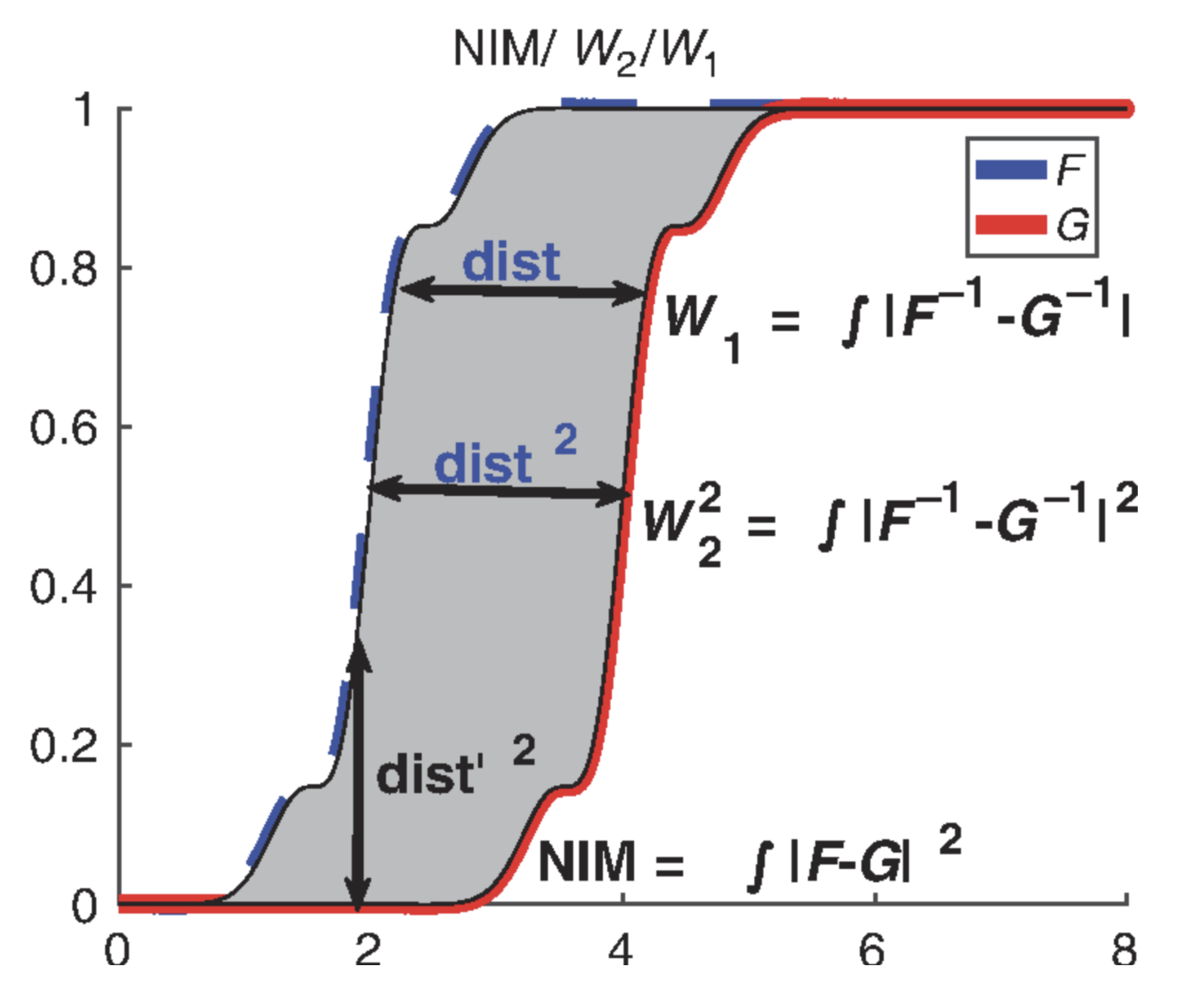 Optimal transport in transcranial ultrasound (Conference Presentation)Patrick Marty, Christian Boehm, Trevor Mitcham, and 3 more authorsIn Medical Imaging 2025: Ultrasonic Imaging and Tomography, 2025
@inproceedings{10.1117/12.3046989, author = {Marty, Patrick and Boehm, Christian and Mitcham, Trevor and Ali, Rehman and Duric, Neb and Fichtner, Andreas}, title = {{Optimal transport in transcranial ultrasound (Conference Presentation)}}, volume = {13412}, booktitle = {Medical Imaging 2025: Ultrasonic Imaging and Tomography}, editor = {Boehm, Christian and Mehrmohammadi, Mohammad}, organization = {International Society for Optics and Photonics}, publisher = {SPIE}, pages = {134120T}, keywords = {Transcranial Ultrasound, Optimal Transport, Ultrasound Computed Tomography, Adjoint Method, Full-Waveform Inversion, Spectral-Element Method}, year = {2025}, doi = {10.1117/12.3046989}, url = {https://doi.org/10.1117/12.3046989}, }



2024
-
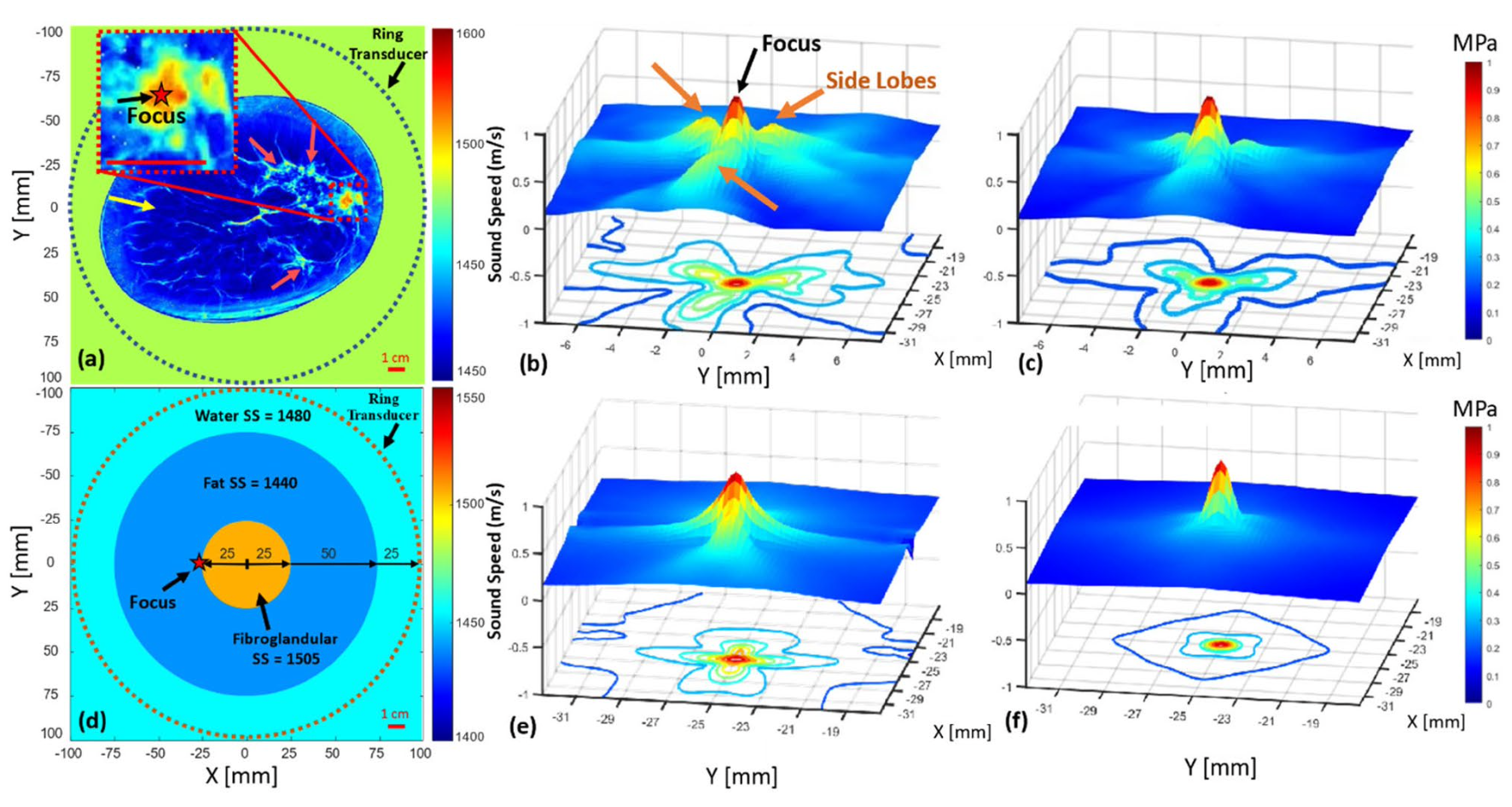 Generating and monitoring mild hyperthermia using a ring array ultrasound transducerDavid Bustamante, Yan Yan, Trevor Mitcham, and 6 more authorsInternational Journal of Hyperthermia, 2024
@article{Bustamante2024Hyperthermia, title = {Generating and monitoring mild hyperthermia using a ring array ultrasound transducer}, author = {Bustamante, David and Yan, Yan and Mitcham, Trevor and Ali, Rehman and Marples, Brian and Gergelis, Kimberly R and Littrup, Peter and Duric, Nebojsa and Mehrmohammadi, Mohammad}, journal = {International Journal of Hyperthermia}, volume = {41}, number = {1}, pages = {2376681}, year = {2024}, doi = {10.1080/02656736.2024.2376681}, publisher = {Taylor \& Francis}, url = {https://www.tandfonline.com/doi/full/10.1080/02656736.2024.2376681}, } -
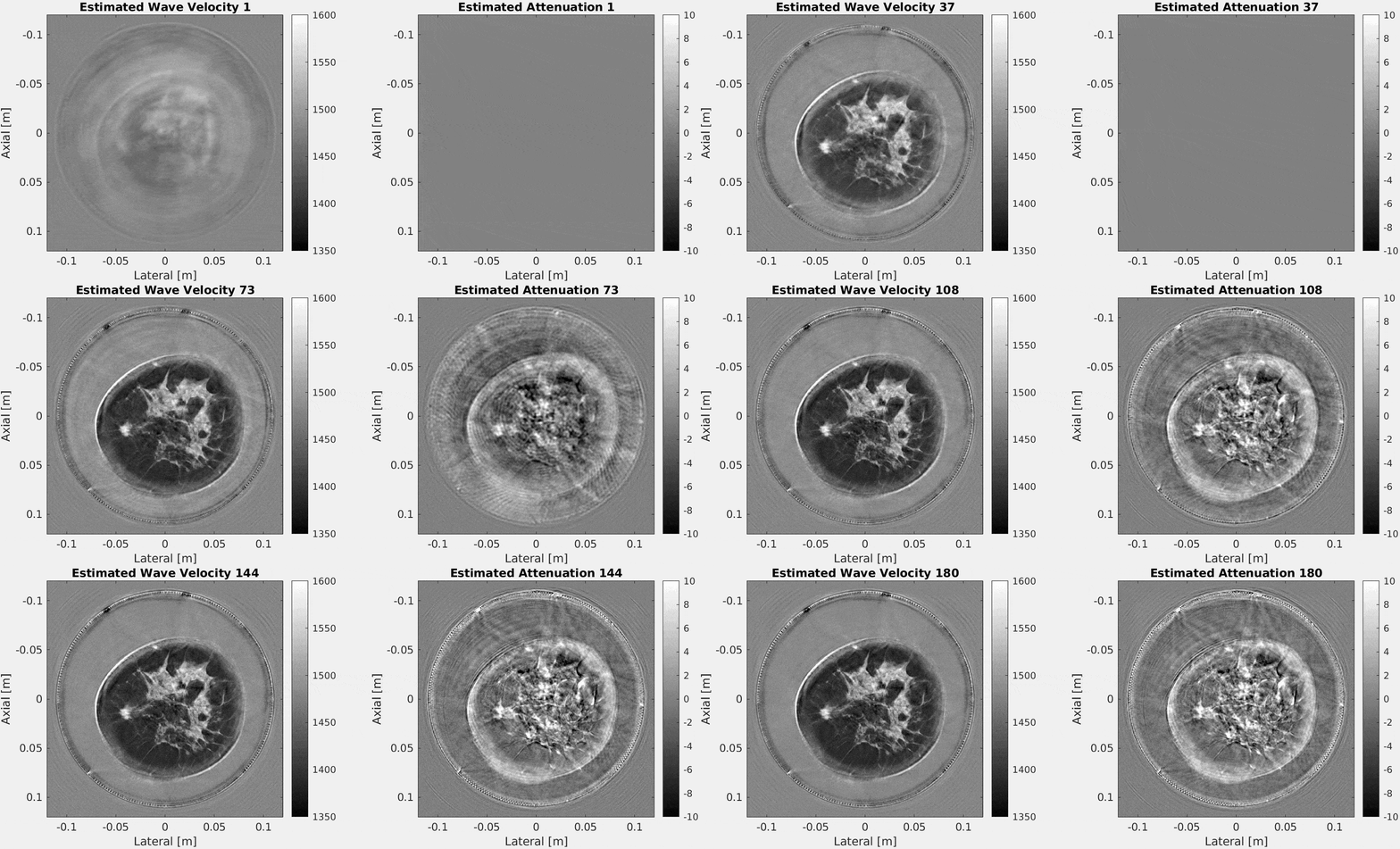 2-D Slicewise Waveform Inversion of Sound Speed and Acoustic Attenuation for Ring Array Ultrasound Tomography Based on a Block LU SolverRehman Ali, Trevor M Mitcham, Thurston Brevett, and 5 more authorsIEEE transactions on medical imaging, 2024
Ultrasound tomography is an emerging imaging modality that uses the transmission of ultrasound through tissue to reconstruct images of its mechanical properties. Initially, ray-based methods were used to reconstruct these images, but their inability to account for diffraction often resulted in poor resolution. Waveform inversion overcame this limitation, providing high-resolution images of the tissue. Most clinical implementations, often directed at breast cancer imaging, currently rely on a frequency-domain waveform inversion to reduce computation time. For ring arrays, ray tomography was long considered a necessary step prior to waveform inversion in order to avoid cycle skipping. However, in this paper, we demonstrate that frequency-domain waveform inversion can reliably reconstruct high-resolution images of sound speed and attenuation without relying on ray tomography to provide an initial model. We provide a detailed description of our frequency-domain waveform inversion algorithm with open-source code and data that we make publicly available.
@article{Ali2024_BlockLU_2DFWI, title = {2-D Slicewise Waveform Inversion of Sound Speed and Acoustic Attenuation for Ring Array Ultrasound Tomography Based on a Block LU Solver}, author = {Ali, Rehman and Mitcham, Trevor M and Brevett, Thurston and Agudo, {\`O}scar Calder{\'o}n and Martinez, Cristina Dur{\'a}n and Li, Cuiping and Doyley, Marvin M and Duric, Nebojsa}, journal = {IEEE transactions on medical imaging}, volume = {43}, number = {8}, pages = {2988--3000}, year = {2024}, doi = {10.1109/TMI.2024.3383816}, publisher = {IEEE}, url = {https://ieeexplore.ieee.org/document/10486959}, } -
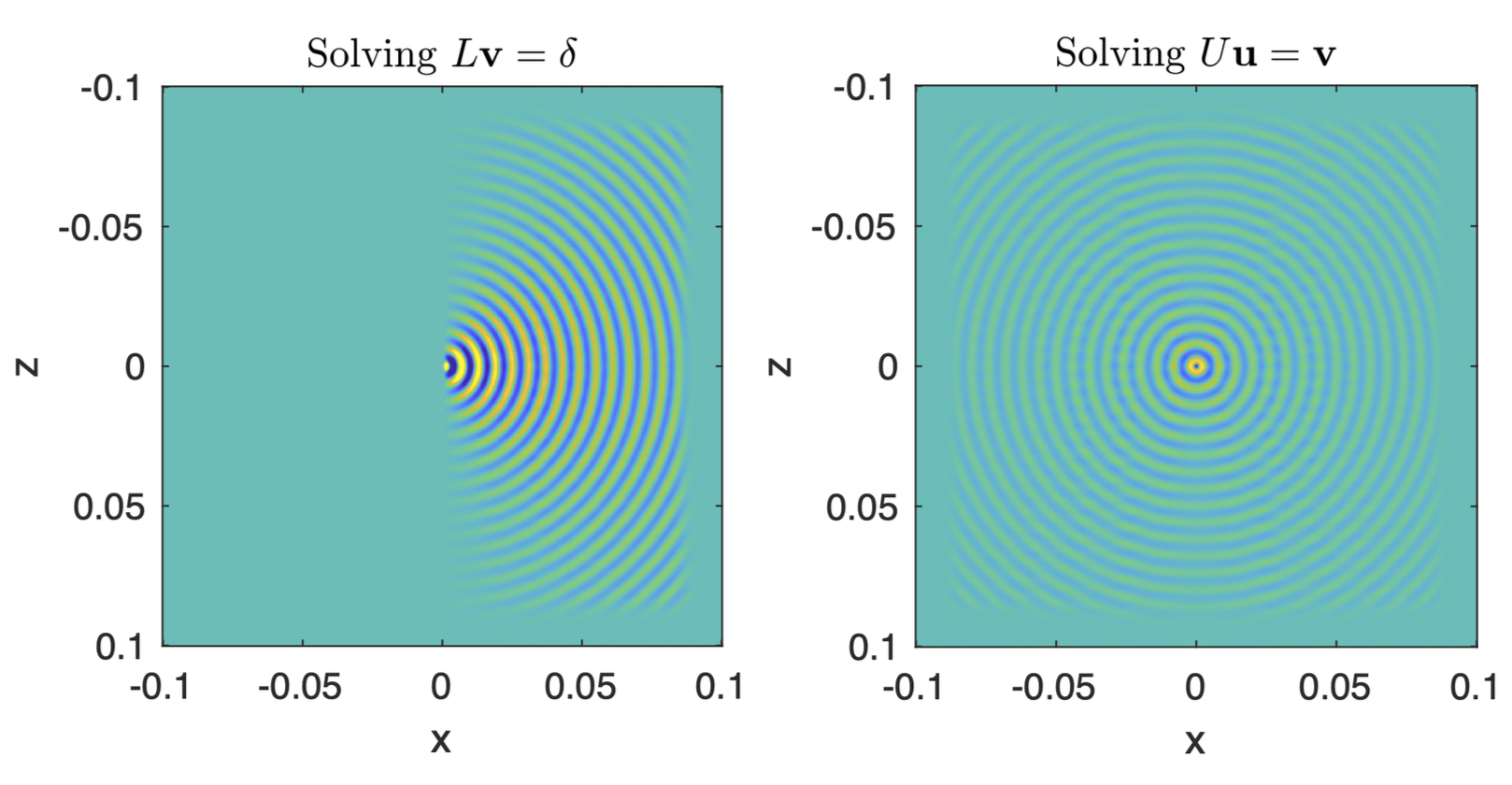 Efficient Helmholtz Equation Solver for Frequency Domain Waveform Inversion Based on the Decomposition into One-Way Wave EquationsRehman Ali, Feiyu Wang, Trevor Mitcham, and 1 more authorIn Medical Imaging 2024: Ultrasonic Imaging and Tomography, 2024
When using a ring array to perform ultrasound tomography, the most computationally intensive component of frequency-domain full waveform inversion (FWI) is the Helmholtz equation solver. The Helmholtz equation is an elliptic partial differential equation (PDE) whose discretization leads to a large system of equations; in many cases, the solution of this large system is itself the inverse problem and requires an iterative method. Our current solution relies on discretizing the 2D Helmholtz equation based on a 9-point stencil and using the resulting block tridiagonal structure to efficiently compute a block LU factorization. Conceptually, the L and U systems are equivalent to a forward and backward wave propagation along one of the spatial dimensions of the grid, resulting in a direct non-iterative solution to the Helmholtz equation based on a single forward and backward sweep. Based on this observation, the PDE representation of the Helmholtz equation is split into two one-way wave equations prior to discretization. The numerical implementations of these one-way wave equations are highly parallelizable and lend themselves favorably to accelerated GPU implementations. We consider the Fourier split-step and phase-shift-plus-interpolation (PSPI) methods from seismic imaging as numerical solutions to the one-way wave equations. We examine how each scheme affects the numerical accuracy of the final Helmholtz equation solution and present its impact on FWI with breast imaging examples.
@inproceedings{Ali2024OneWayDecomposition, title = {Efficient Helmholtz Equation Solver for Frequency Domain Waveform Inversion Based on the Decomposition into One-Way Wave Equations}, author = {Ali, Rehman and Wang, Feiyu and Mitcham, Trevor and Duric, Nebojsa}, booktitle = {Medical Imaging 2024: Ultrasonic Imaging and Tomography}, volume = {12932}, pages = {262--268}, year = {2024}, organization = {SPIE}, doi = {10.1117/12.3006288}, url = {https://www.spiedigitallibrary.org/conference-proceedings-of-spie/12932/3006288/Efficient-Helmholtz-equation-solver-for-frequency-domain-waveform-inversion-based/10.1117/12.3006288.full}, } -
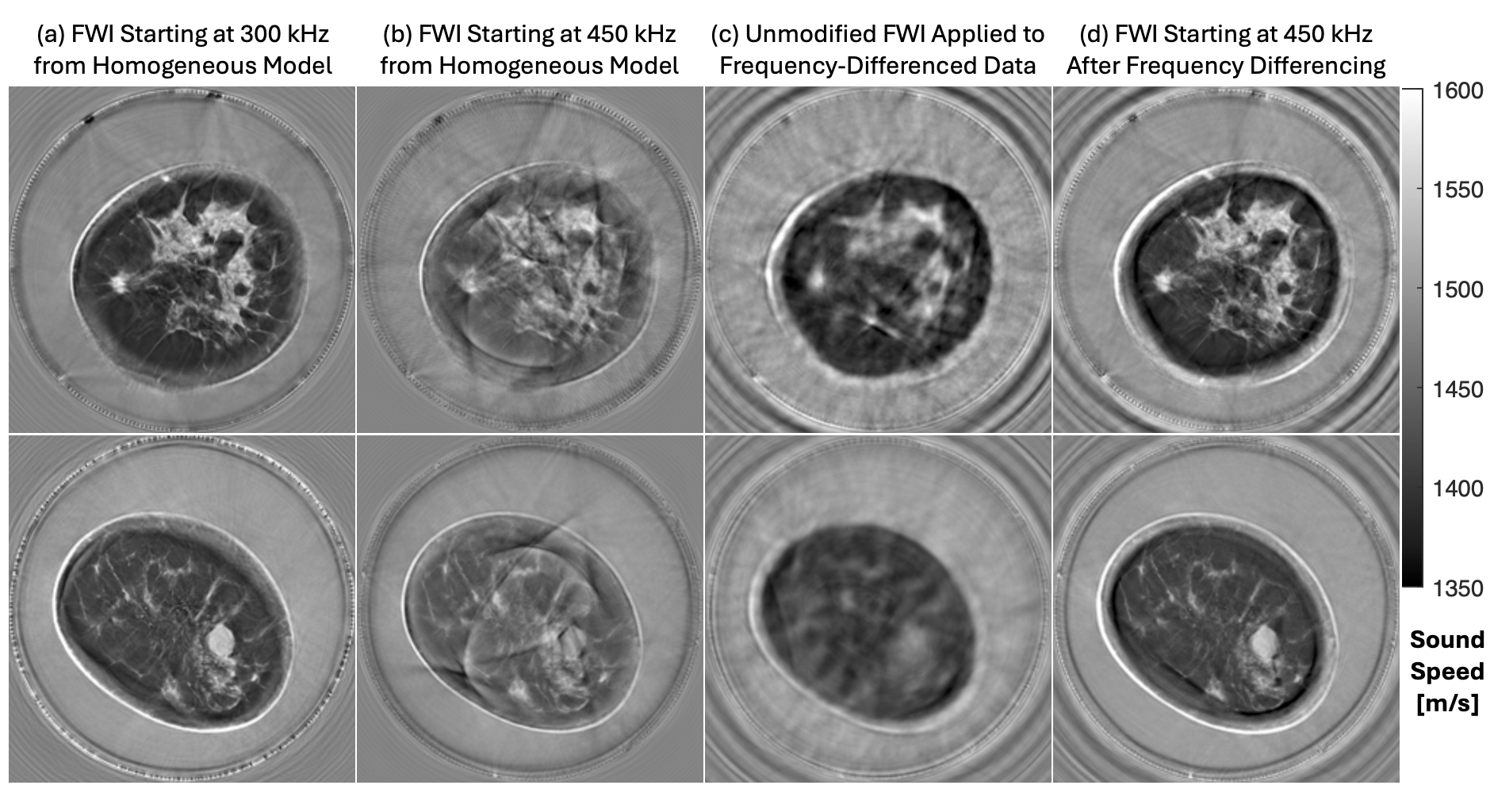 Frequency-Differencing Method to Kickstart Waveform Inversion Without Cycle SkippingRehman Ali, Trevor Mitcham, and Nebojsa DuricIn 2024 IEEE Ultrasonics, Ferroelectrics, and Frequency Control Joint Symposium (UFFC-JS), 2024
Because of its fast reconstruction times, frequency-domain full waveform inversion is the clinical gold standard for high-resolution sound speed imaging in medical ultrasound tomography; however, it fundamentally relies on having sufficiently low-frequency data to avoiding cycle skipping. This motivates the development of new strategies that can overcome cycle skipping in the absence of low-frequency data. In this work, we synthesize approximate low-frequency content from existing high-frequency signals using the same frequency differencing method used in frequency-difference beamforming for underwater sonar. The approximate low-frequency content is then used to kickstart full-waveform inversion so that cycle skipping can be better avoided at higher frequencies. We demonstrate the efficacy of this new approach using in-vivo breast imaging cases. In each case, internal tissue structures are seen with much greater clarity without cycle skipping artifacts when frequency differencing is used to provide a starting model for conventional full-waveform inversion.
@inproceedings{Ali2024FrequencyDifferencing, title = {Frequency-Differencing Method to Kickstart Waveform Inversion Without Cycle Skipping}, author = {Ali, Rehman and Mitcham, Trevor and Duric, Nebojsa}, booktitle = {2024 IEEE Ultrasonics, Ferroelectrics, and Frequency Control Joint Symposium (UFFC-JS)}, pages = {1--4}, year = {2024}, organization = {IEEE}, doi = {10.1109/UFFC-JS60046.2024.10794178}, url = {https://ieeexplore.ieee.org/abstract/document/10794178} } -
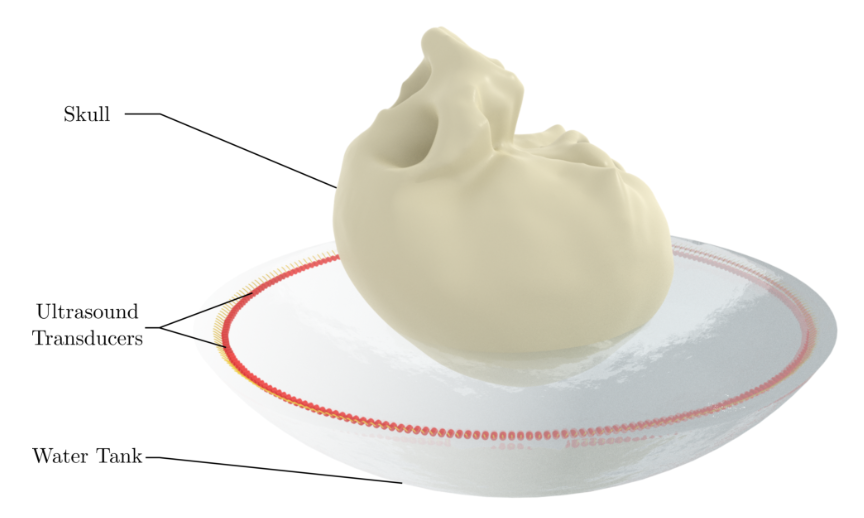 Towards elastic bone characterization in transcranial ultrasoundPatrick Marty, Trevor Mitcham, Rehman Ali, and 3 more authorsIn Medical Imaging 2024: Ultrasonic Imaging and Tomography, 2024
Constructing a physics-augmented digital twin of the skull is imperative for a wide range of transcranial ultrasound applications including ultrasound computed tomography and focused ultrasound therapy. The high impedance contrast as well as the acoustic-elastic coupling observed between soft tissue and bone increase the complexity of the ultrasound wavefield considerably, thus emphasizing the need for waveform-based inversion approaches. This work applies reverse time migration in conjunction with the spectral-element method to an in vitro human skull to obtain a starting model, which can be used for full-waveform inversion and adjoint-based shape optimization. Two distinct brain phantoms are considered where the cranial cavity of the in vitro human skull was filled with (1) homogeneous water and (2) gelatin with two cylindrical inclusions. A 2D slice through the posterior of the skull was collected using a ring-like aperture consisting of 1024 ultrasound transducers with a bandwidth of approximately 1MHz to 3MHz. Waveform-based reverse time migration was then used to resolve the inner and outer contours of the skull from which a conforming hexahedral finite-element mesh was constructed. The synthetically generated measurements which are obtained by solving the coupled acoustic-viscoelastic wave equation are in good agreement with the observed laboratory measurements. It is demonstrated that using this revised wave speed model for recomputing the reverse time migration reconstructions allows for improved localization of the gelatin inclusions within the cranial cavity.
@inproceedings{Marty2024ElasticBoneCharacterization, title = {Towards elastic bone characterization in transcranial ultrasound}, author = {Marty, Patrick and Mitcham, Trevor and Ali, Rehman and Boehm, Christian and Duric, Neb and Fichtner, Andreas}, booktitle = {Medical Imaging 2024: Ultrasonic Imaging and Tomography}, volume = {12932}, pages = {116--129}, year = {2024}, organization = {SPIE}, doi = {10.1117/12.3006769}, url = {https://www.spiedigitallibrary.org/conference-proceedings-of-spie/12932/3006769/Towards-elastic-bone-characterization-in-transcranial-ultrasound/10.1117/12.3006769.full} } -
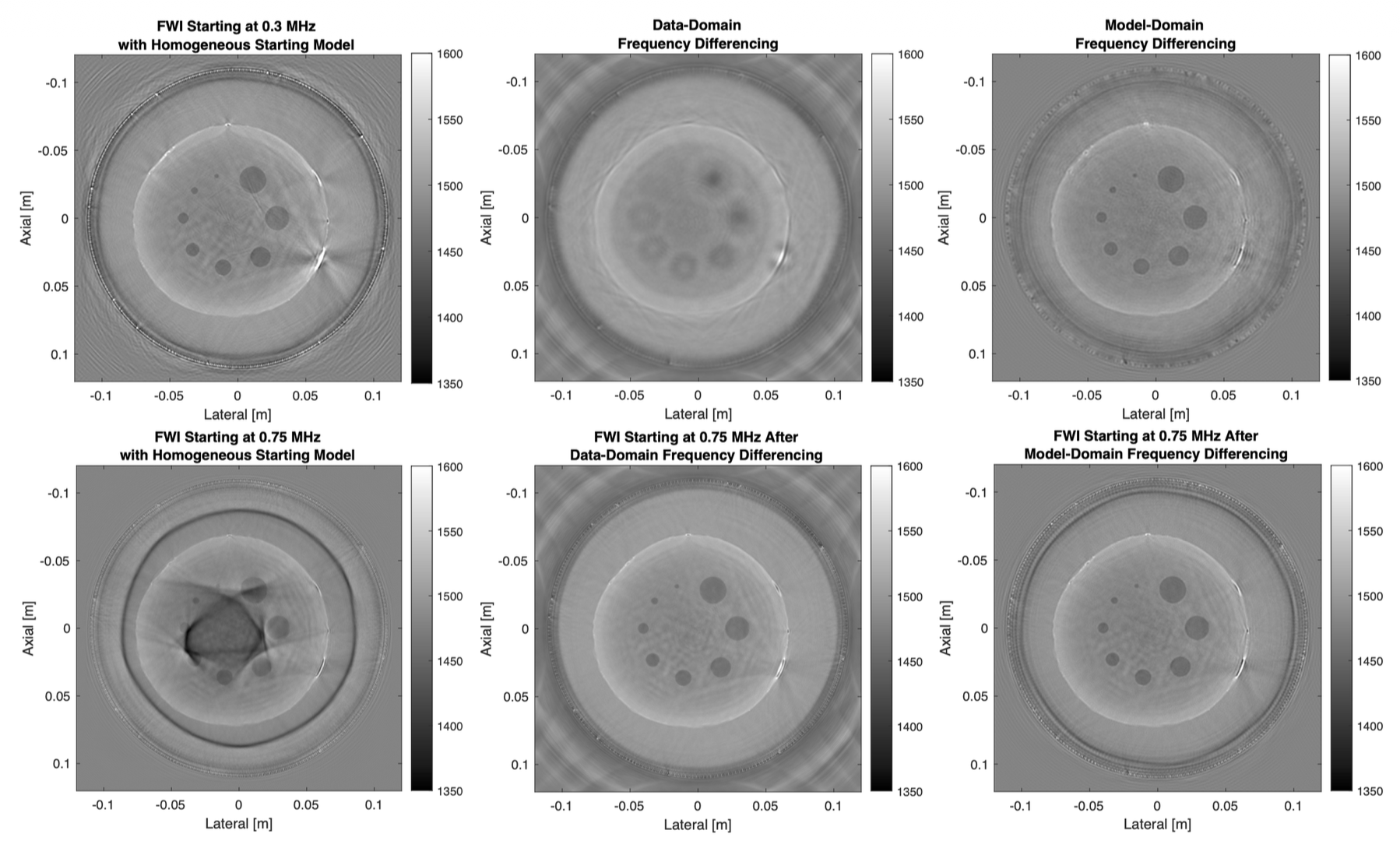 A New Strategy to Overcome Cycle Skipping: Frequency-Difference Waveform InversionRehman Ali, Trevor Mitcham, and Nebojsa DuricIn Medical Imaging 2024: Ultrasonic Imaging and Tomography, 2024
Most ultrasound transducer designs are driven towards high frequencies by the need to maximize the resolution achievable by B-mode reflectivity imaging. Because full-waveform inversion (FWI) requires low frequencies to overcome cycle skipping, it is often difficult to apply FWI to the same high-frequency transducer hardware. Recent work on time-domain adaptive waveform inversion (AWI) addresses this based on a deconvolution approach to overcome cycle skipping. However, most clinical implementations of ultrasound tomography rely on frequency-domain FWI to quickly reconstruct images on clinically relevant time scales. Although the broadband nature of AWI makes it difficult to translate to the frequency domain, we can approximate the properties of AWI by using a frequency-differencing approach. We develop and describe both a model-domain and a data-domain method for frequency-differencing. Simulations and phantom experiments show that each frequency-differencing approach helps overcome cycle skipping by providing a sufficiently accurate starting model for FWI.
@inproceedings{Ali2024FrequencyDifferenceFWI, title = {A New Strategy to Overcome Cycle Skipping: Frequency-Difference Waveform Inversion}, author = {Ali, Rehman and Mitcham, Trevor and Duric, Nebojsa}, booktitle = {Medical Imaging 2024: Ultrasonic Imaging and Tomography}, volume = {12932}, pages = {85--92}, year = {2024}, organization = {SPIE}, doi = {10.1117/12.3006287}, url = {https://www.spiedigitallibrary.org/conference-proceedings-of-spie/12932/3006287/A-new-strategy-to-overcome-cycle-skipping--frequency-difference/10.1117/12.3006287.full} } -
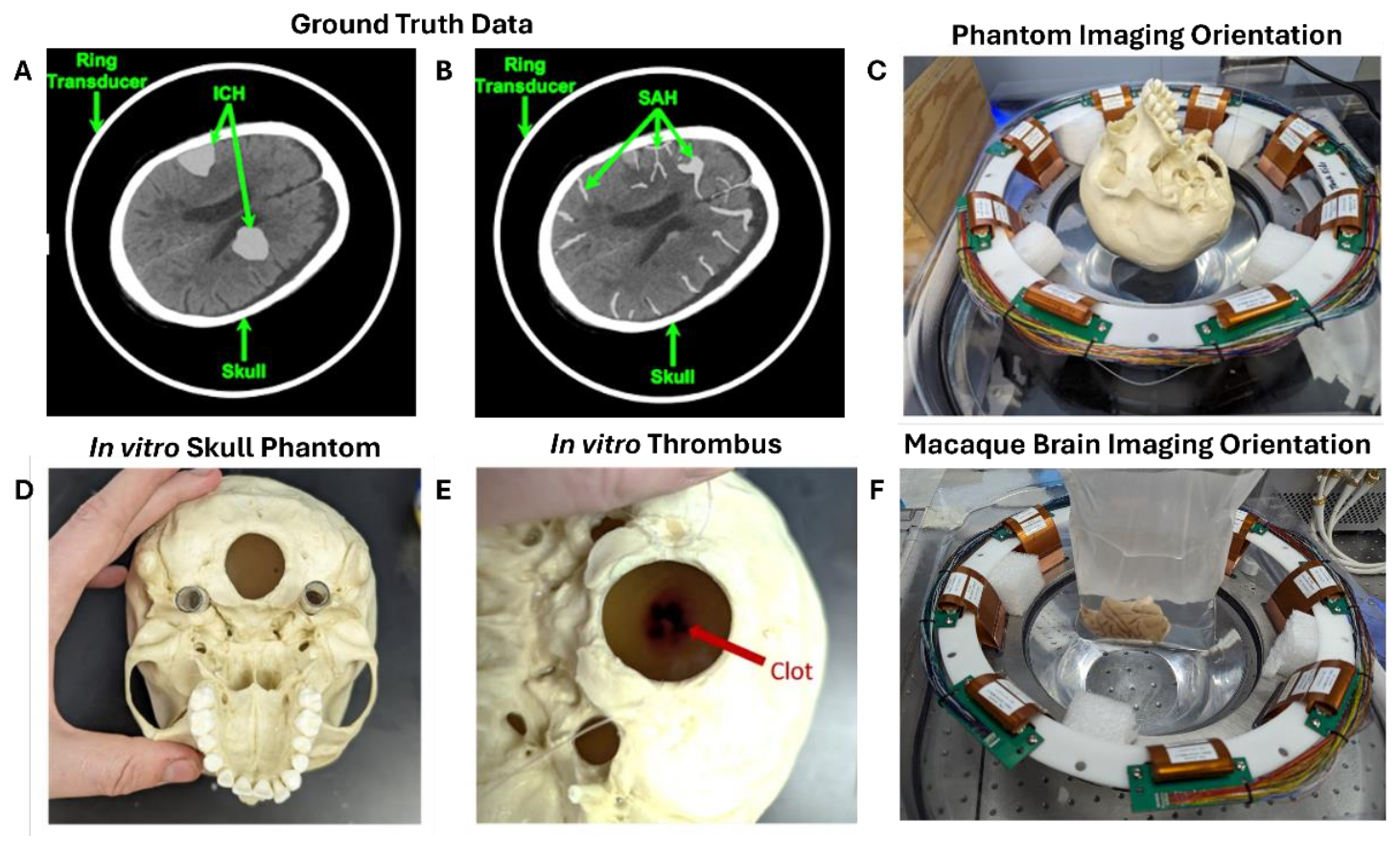 Imaging Stroke Through the Skull Using Ultrasound TomographyTrevor Mitcham, Rehman Ali, Derrek Schartz, and 5 more authorsIn Medical Imaging 2024: Ultrasonic Imaging and Tomography, 2024
Stroke is a significant cause of mortality and disability in America. Due to differences in the treatment of ischemic and hemorrhagic stroke, imaging must be performed before administration of therapeutic medication. Unfortunately, the current standard imaging methods, namely CT and MRI, require specialized locations and staff, which can induce delays in triage, and therefore, treatment time. Recent work suggests that ultrasound tomography (UST) is capable of imaging in vivo tissue properties and may have potential as a diagnostic tool during stroke treatment which could be performed at the point of injury rather than at a local hospital. In this work, we investigate the feasibility of using UST imaging to image the brain via in silico, in vitro, and ex vivo studies. The results of this work indicate some of the challenges which must be overcome to effectively image in vivo stroke patients.
@inproceedings{Mitcham2024ImagingStroke,
  title = {Imaging Stroke Through the Skull Using Ultrasound Tomography},
  author = {Mitcham, Trevor and Ali, Rehman and Schartz, Derrek and Rahmani, Redi and Singh, Melanie and Bender, Matthew and Vates, Edward and Duric, Nebojsa},
  booktitle = {Medical Imaging 2024: Ultrasonic Imaging and Tomography},
  volume = {12932},
  pages = {107--115},
  year = {2024},
  organization = {SPIE},
  doi = {10.1117/12.3006595},
  url = {https://www.spiedigitallibrary.org/conference-proceedings-of-spie/12932/3006595/Imaging-stroke-through-the-skull-using-ultrasound-tomography/10.1117/12.3006595.full}
}


2023
-
 Aberration correction in diagnostic ultrasound: A review of the prior field and current directionsRehman Ali, Thurston Brevett, Louise Zhuang, and 7 more authorsZeitschrift für Medizinische Physik, 2023
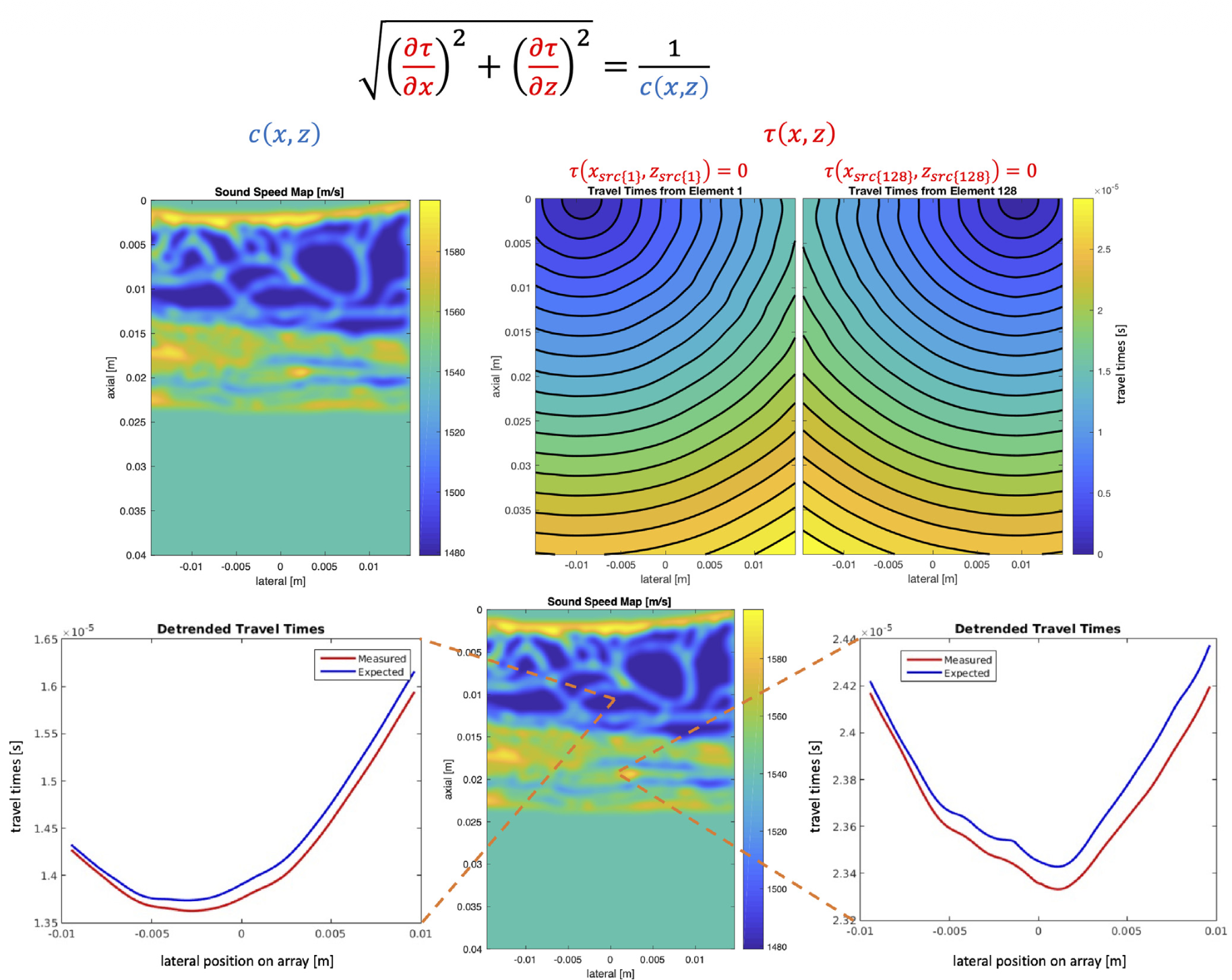
Medical ultrasound images are reconstructed with simplifying assumptions on wave propagation, with one of the most prominent assumptions being that the imaging medium is composed of a constant sound speed. When the assumption of a constant sound speed are violated, which is true in most in vivo or clinical imaging scenarios, distortion of the transmitted and received ultrasound wavefronts appear and degrade the image quality. This distortion is known as aberration, and the techniques used to correct for the distortion are known as aberration correction techniques. Several models have been proposed to understand and correct for aberration. In this review paper, aberration and aberration correction are explored from the early models and correction techniques, including the near-field phase screen model and its associated correction techniques such as nearest-neighbor cross-correlation, to more recent models and correction techniques that incorporate spatially varying aberration and diffractive effects, such as models and techniques that rely on the estimation of the sound speed distribution in the imaging medium. In addition to historical models, future directions of ultrasound aberration correction are proposed.
@article{Ali2023AberrationCorrectionReview, title = {Aberration correction in diagnostic ultrasound: A review of the prior field and current directions}, author = {Ali, Rehman and Brevett, Thurston and Zhuang, Louise and Bendjador, Hanna and Podkowa, Anthony S and Hsieh, Scott S and Simson, Walter and Sanabria, Sergio J and Herickhoff, Carl D and Dahl, Jeremy J}, journal = {Zeitschrift f{\"u}r Medizinische Physik}, year = {2023}, volume = {33}, number = {3}, pages = {267--291}, doi = {10.1016/j.zemedi.2023.01.003}, publisher = {Elsevier}, url = {https://www.sciencedirect.com/science/article/pii/S093938892300003X}, } -
 Optimal transmit apodization for the maximization of lag-one coherence with applications to aberration delay estimationRehman Ali, Nebojsa Duric, and Jeremy J DahlUltrasonics, 2023
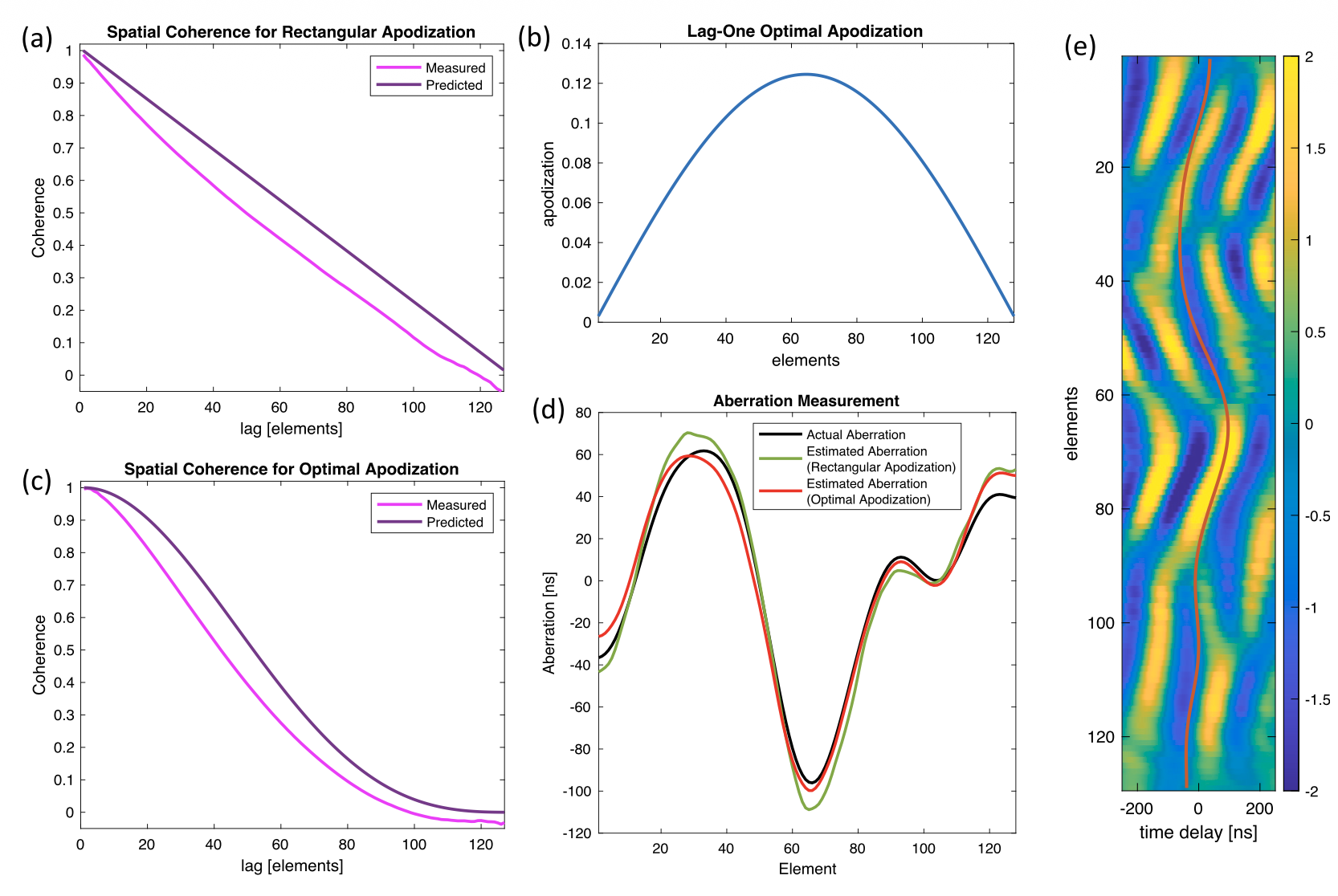
Phase aberration is one of the major sources of image degradation in medical ultrasound imaging. One of the earliest and simplest techniques to correct for phase aberration involves nearest-neighbor cross correlation to estimate delays between neighboring receive channels and the compensation of aberration delays in a delay-and-sum beamformer. The main challenge is that neighboring receive channels may not have sufficient signal correlation to accurately estimate the aberration delays. Although algorithms such as the translating transmit aperture or the common midpoint gather are designed to perfectly maximize signal correlations between received signals, these algorithms require the use of different transmit apertures for each received signal. Instead, this work proposes the use of a single globally-applicable transmit apodization function that optimizes the lag-one coherence based on the van Cittert–Zernike theorem. For the application to phase aberration correction, it is shown across 20 different zero-mean Gaussian-random aberrators that the proposed optimal apodization function reduces the estimation error in the aberration delay profile from 22.85% to 15.72%.
@article{Ali2023OptimalApodization, title = {Optimal transmit apodization for the maximization of lag-one coherence with applications to aberration delay estimation}, author = {Ali, Rehman and Duric, Nebojsa and Dahl, Jeremy J}, journal = {Ultrasonics}, volume = {132}, pages = {107010}, year = {2023}, doi = {10.1016/j.ultras.2023.107010}, publisher = {Elsevier}, url = {https://www.sciencedirect.com/science/article/abs/pii/S0041624X23000860}, } -
 Sound Speed Estimation for Distributed Aberration Correction in Laterally Varying MediaRehman Ali, Trevor M Mitcham, Melanie Singh, and 4 more authorsIEEE transactions on computational imaging, 2023
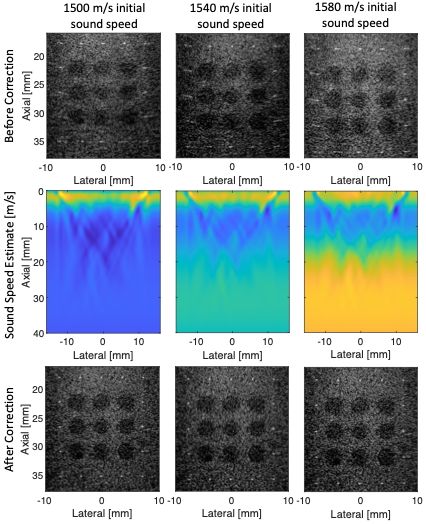
Spatial variation in sound speed causes aberration in medical ultrasound imaging. Although our previous work has examined aberration correction in the presence of a spatially varying sound speed, practical implementations were limited to layered media due to the sound speed estimation process involved. Unfortunately, most models of layered media do not capture the lateral variations in sound speed that have the greatest aberrative effect on the image. Building upon a Fourier split-step migration technique from geophysics, this work introduces an iterative sound speed estimation and distributed aberration correction technique that can model and correct for aberrations resulting from laterally varying media. We first characterize our approach in simulations where the scattering in the media is known a-priori. Phantom and in-vivo experiments further demonstrate the capabilities of the iterative correction technique. As a result of the iterative correction scheme, point target resolution improves by up to a factor of 4 and lesion contrast improves by up to 10.0 dB in the phantom experiments presented.
@article{Ali2023IMPACT, title = {Sound Speed Estimation for Distributed Aberration Correction in Laterally Varying Media}, author = {Ali, Rehman and Mitcham, Trevor M and Singh, Melanie and Doyley, Marvin M and Bouchard, Richard R and Dahl, Jeremy J and Duric, Nebojsa}, journal = {IEEE transactions on computational imaging}, volume = {9}, pages = {367--382}, year = {2023}, doi = {10.1109/TCI.2023.3261507}, publisher = {IEEE}, url = {https://ieeexplore.ieee.org/document/10083328}, } -
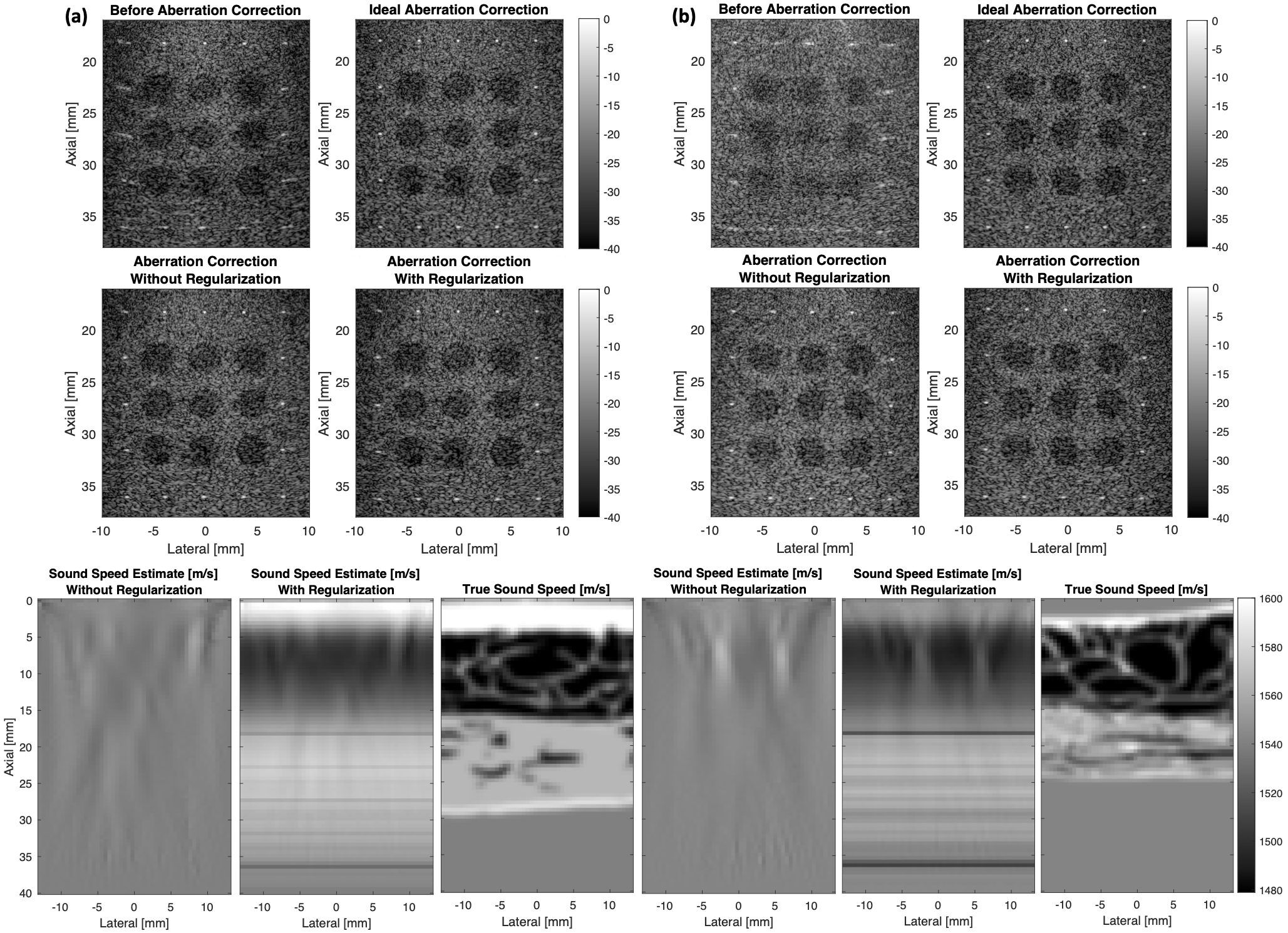 Iterative Sound Speed Tomography for Distributed Aberration CorrectionRehman Ali, Trevor Mitcham, Melanie Singh, and 4 more authorsIn 2023 IEEE International Ultrasonics Symposium (IUS), 2023
In pulse-echo ultrasound imaging, there exists a strong duality between sound speed estimation and aberration correction. This has led to the development of closed-loop iterative frameworks that address both estimation and correction simultaneously. This work revisits previous work on wave-equation migration velocity analysis (WEMVA) to derive and explain our new closed-loop solution to the problem based on a waveform inversion-style approach: full-waveform iterative model-based phase aberration computed tomography (Full-Waveform IMPACT). Full-Waveform IMPACT reproduces the same velocity-depth ambiguities that many previous works have described. However, by approaching the problem using a waveform inversion-style method, we demonstrate that the velocity-depth ambiguity is intricately tied to the problem of cycle skipping and false local minima.
@inproceedings{Ali2023IterativeAberrationCorrection, title = {Iterative Sound Speed Tomography for Distributed Aberration Correction}, author = {Ali, Rehman and Mitcham, Trevor and Singh, Melanie and Bouchard, Richard and Doyley, Marvin and Dahl, Jeremy and Duric, Nebojsa}, booktitle = {2023 IEEE International Ultrasonics Symposium (IUS)}, pages = {1--4}, year = {2023}, organization = {IEEE}, doi = {10.1109/IUS51837.2023.10306695}, url = {https://ieeexplore.ieee.org/abstract/document/10306695} } -
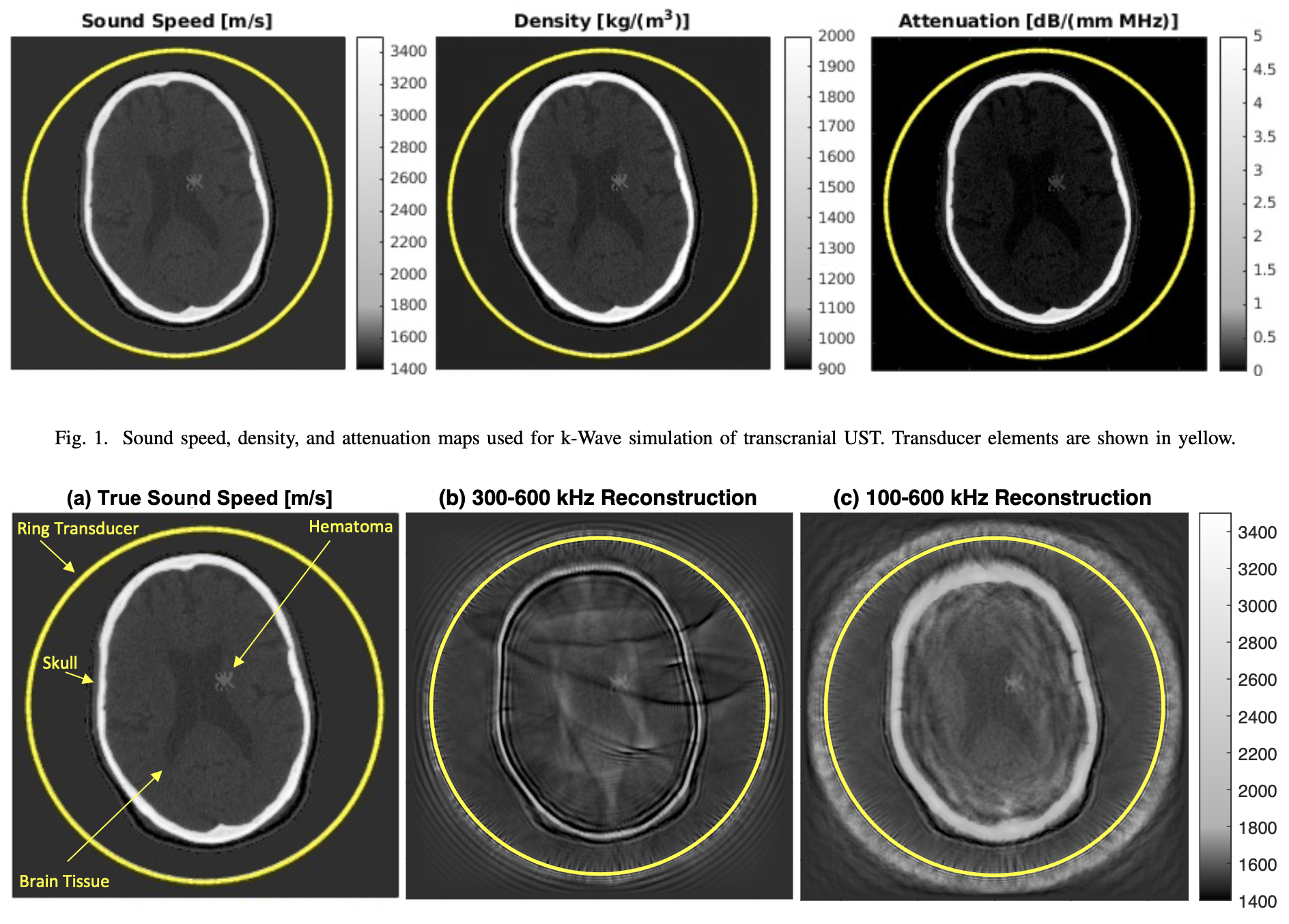 Waveform Inversion in Ultrasound Tomography from Homogeneous Starting ModelsRehman Ali, Trevor Mitcham, Melanie Singh, and 3 more authorsIn 2023 IEEE International Ultrasonics Symposium (IUS), 2023
While waveform inversion is the clinical gold standard for obtaining high-resolution images of sound speed and attenuation in tissue, it was long assumed that bent ray tomography was necessary to obtain a starting model, especially with a ring array transducer. However, recent works show that waveform inversion is possible with a reasonable choice of homogeneous starting models and sufficiently low-frequency content in the waveform to avoid cycle skipping. In the case of transcranial imaging, we cannot afford to use a bent ray tomography because it quickly becomes unstable in the presence of a highly refractive skull. We examine the parameters that would enable waveform inversion to image the soft tissue in the brain through the high sound speed and attenuation in the skull.
@inproceedings{Ali2023HomogeneousStartingModelFWI, title = {Waveform Inversion in Ultrasound Tomography from Homogeneous Starting Models}, author = {Ali, Rehman and Mitcham, Trevor and Singh, Melanie and Harris, Brenna and Tivarus, Madalina and Duric, Nebojsa}, booktitle = {2023 IEEE International Ultrasonics Symposium (IUS)}, pages = {1--4}, year = {2023}, organization = {IEEE}, doi = {10.1109/IUS51837.2023.10307870}, url = {https://ieeexplore.ieee.org/abstract/document/10307870} } -
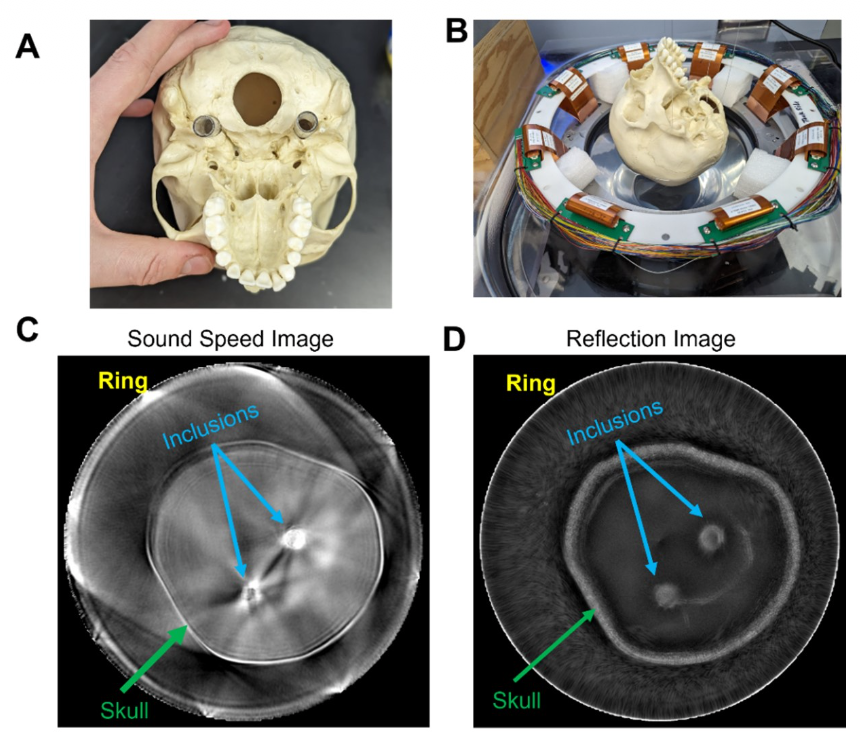 Feasibility of Imaging Ischemic Stroke Through the Skull Using Ultrasound TomographyTrevor Mitcham, Rehman Ali, Derrek Schartz, and 3 more authorsIn 2023 IEEE International Ultrasonics Symposium (IUS), 2023
Stroke is a significant cause of mortality and disability in America. Due to differences in ischemic and hemorrhagic stroke, imaging must be performed before administration of therapeutic medication; however, the nature of both CT and MRI imaging can induce delays in triage time. Recent work suggests that ultrasound tomography (UST) is capable of imaging in vivo tissue properties and may have potential as a diagnostic tool during stroke treatment which could be performed at the patient’s location rather than at a local hospital. In this work, we investigate the feasibility of using UST imaging to detect ischemic stroke in tissue-mimicking environments in both in silico and in vitro studies. The results of this work dictate the challenges which must be overcome in order to effectively image in vivo stroke patients.
@inproceedings{Mitcham2023IschemicStrokeThroughSkull, title = {Feasibility of Imaging Ischemic Stroke Through the Skull Using Ultrasound Tomography}, author = {Mitcham, Trevor and Ali, Rehman and Schartz, Derrek and Singh, Melanie and Bender, Matthew and Duric, Neb}, booktitle = {2023 IEEE International Ultrasonics Symposium (IUS)}, pages = {1--3}, year = {2023}, organization = {IEEE}, doi = {10.1109/IUS51837.2023.10308116}, url = {https://ieeexplore.ieee.org/abstract/document/10308116} } -
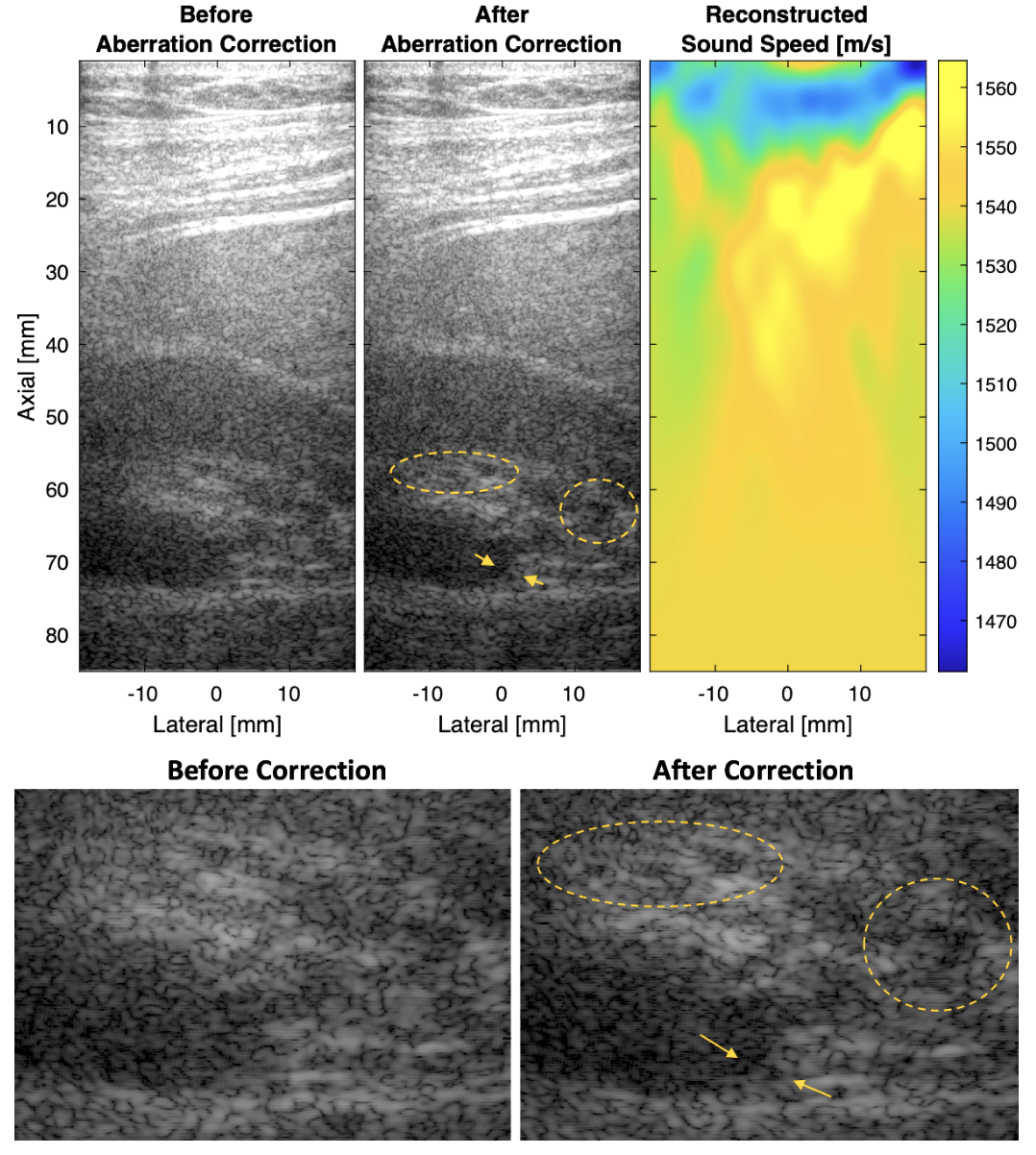 Distributed Aberration Correction in Handheld Ultrasound Based on Tomographic Estimates of the Speed of SoundRehman Ali, Trevor Mitcham, Melanie Singh, and 4 more authorsIn Medical Imaging 2023: Ultrasonic Imaging and Tomography, 2023
Phase aberration is one the key sources of image degradation in handheld B-mode ultrasound imaging. Sound speed heterogeneities create phase aberrations in the image by inducing additional tissue-dependent delays and diffractive effects that conventional beamforming does not incorporate. For this reason, the Fourier split-step angular spectrum method is used to simulate pressure fields in a heterogeneous sound speed medium and create B-mode images based on the cross-correlation of transmitted and received wavefields. Because the strongest aberrations are caused by a laterally varying sound speed profile, this work presents a new sound speed estimator that can be used to correct for aberrations in laterally varying media. Phantom experiments show a 58-76% improvement in point target resolution and a 2.5x improvement in contrast-to-noise ratio because of the proposed sound speed estimation and phase aberration correction scheme.
@inproceedings{Ali2023DistributedAberrationCorrection, title = {Distributed Aberration Correction in Handheld Ultrasound Based on Tomographic Estimates of the Speed of Sound}, author = {Ali, Rehman and Mitcham, Trevor and Singh, Melanie and Bouchard, Richard and Dahl, Jeremy and Doyley, Marvin and Duric, Nebojsa}, booktitle = {Medical Imaging 2023: Ultrasonic Imaging and Tomography}, volume = {12470}, pages = {25--35}, year = {2023}, organization = {SPIE}, doi = {10.1117/12.2653935}, url = {https://www.spiedigitallibrary.org/conference-proceedings-of-spie/12470/2653935/Distributed-aberration-correction-in-handheld-ultrasound-based-on-tomographic-estimates/10.1117/12.2653935.full} } -
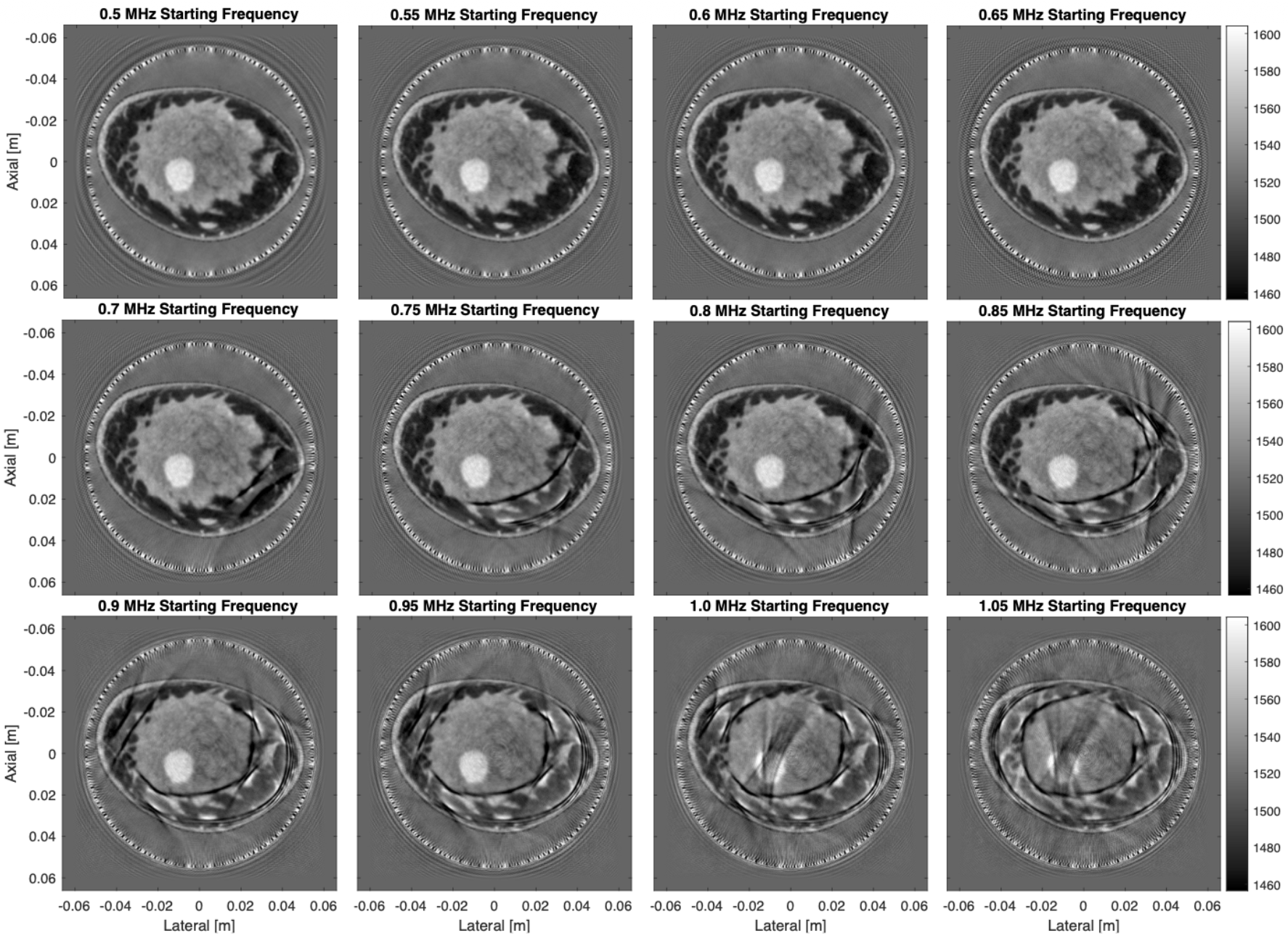 Impact of Starting Model on Waveform Inversion in Ultrasound TomographyRehman Ali, Trevor Mitcham, and Nebojsa DuricIn Medical Imaging 2023: Ultrasonic Imaging and Tomography, 2023
The convergence of waveform inversion in ultrasound tomography is heavily impacted by the choice of starting model. Ray tomography is often used as the starting model for waveform inversion; however, artifacts resulting from ray tomography can continue to persist during waveform inversion. On the other hand, a homogeneous starting model for waveform inversion may result in cycle skipping artifacts if the frequency of the transmitted waveform is too high or the error between the starting model and ground-truth is too large. Clinical in vivo breast data suggests that waveform inversion from a homogeneous starting model is sufficient for an accurate reconstruction of the speed of sound if the starting model is close enough to the average speed of sound in the medium and the starting frequency for waveform inversion is sufficiently low to avoid cycle skipping. Comparing the results of waveform inversion using ray tomography and a homogeneous sound speed as initial models, the homogeneous starting model avoids oscillatory artifacts produced by ray tomography at the edges of the breast. Although the RMS error between the two waveform inversion results is 29.6 m/s, most of the error is the result of reconstruction artifacts at the edges of the breast. When the RMS error is measured inside the breast away from its boundaries, this RMS error drops down to 11.5 m/s.
@inproceedings{Ali2023StartingModelFWI,
  title = {Impact of Starting Model on Waveform Inversion in Ultrasound Tomography},
  author = {Ali, Rehman and Mitcham, Trevor and Duric, Nebojsa},
  booktitle = {Medical Imaging 2023: Ultrasonic Imaging and Tomography},
  volume = {12470},
  pages = {89--98},
  year = {2023},
  organization = {SPIE},
  doi = {10.1117/12.2653575},
  url = {https://www.spiedigitallibrary.org/conference-proceedings-of-spie/12470/2653575/Impact-of-starting-model-on-waveform-inversion-in-ultrasound-tomography/10.1117/12.2653575.full}
}


2022
-
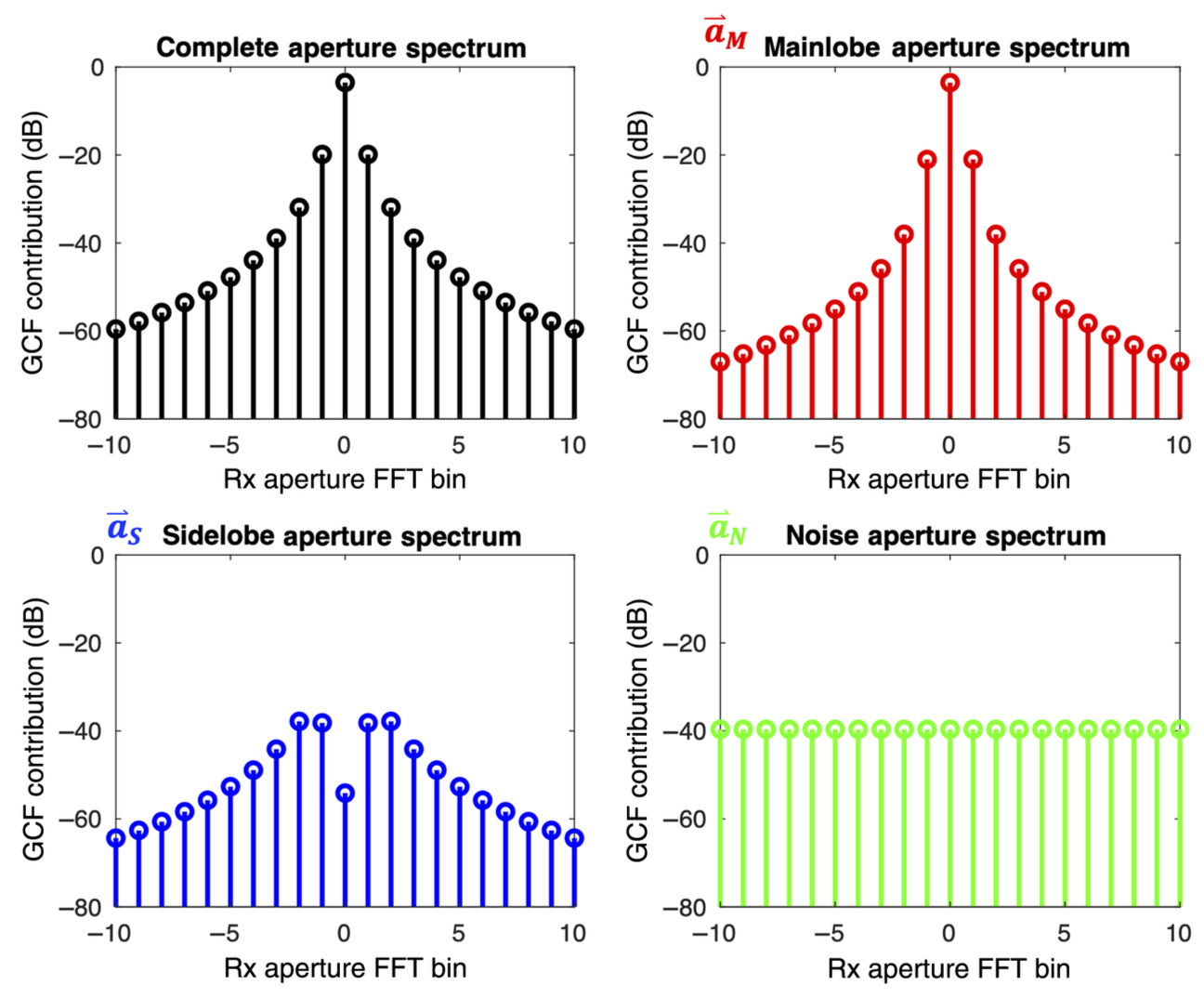 Separation of mainlobe and sidelobe contributions to B-mode ultrasound images based on the aperture spectrumRehman Ali, Trevor Mitcham, Leandra Brickson, and 6 more authorsJournal of Medical Imaging, 2022
@article{Ali2022MainlobeSidelobeSeparation, title = {Separation of mainlobe and sidelobe contributions to B-mode ultrasound images based on the aperture spectrum}, author = {Ali, Rehman and Mitcham, Trevor and Brickson, Leandra and Hu, Wentao and Doyley, Marvin and Rubens, Deborah and Ignjatovic, Zeljko and Duric, Nebojsa and Dahl, Jeremy}, journal = {Journal of Medical Imaging}, volume = {9}, number = {6}, pages = {067001--067001}, year = {2022}, doi = {10.1117/1.JMI.9.6.067001}, publisher = {Society of Photo-Optical Instrumentation Engineers}, url = {https://www.spiedigitallibrary.org/journals/journal-of-medical-imaging/volume-9/issue-06/067001/Separation-of-mainlobe-and-sidelobe-contributions-to-B-mode-ultrasound/10.1117/1.JMI.9.6.067001.full}, } -
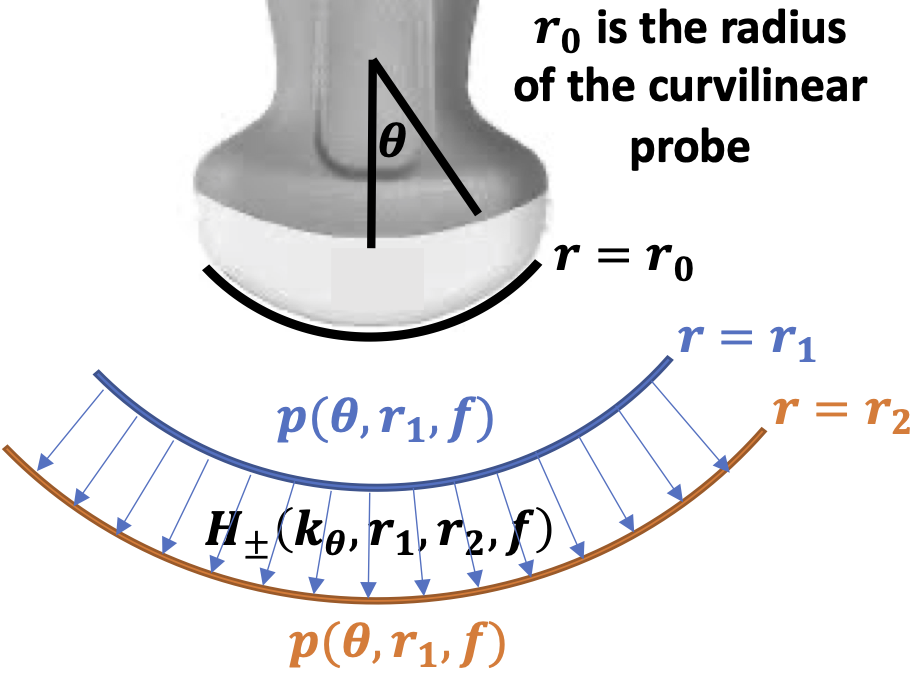 Angular spectrum method for curvilinear arrays: Theory and application to Fourier beamformingRehman Ali and Jeremy DahlJASA Express Letters, 2022
Fourier beamforming techniques for medical ultrasound imaging have largely been limited to linear transducer arrays. This work extends the angular spectrum method to curvilinear arrays and demonstrates a migration-based Fourier beamforming technique that has implications for sound speed estimation and distributed aberration correction for abdominal imaging applications. When compared to Field II simulations, the proposed angular spectrum method simulates the pressure field from a focused transmission to within 3.7% normalized root mean square error. The resulting Fourier beamforming technique is then compared to virtual source synthetic aperture using in vivo abdominal imaging examples where resolution and imaging quality improvements are observed.
@article{Ali2022CurvilinearAngularSpectrumMethod, title = {Angular spectrum method for curvilinear arrays: Theory and application to Fourier beamforming}, author = {Ali, Rehman and Dahl, Jeremy}, journal = {JASA Express Letters}, volume = {2}, number = {5}, year = {2022}, doi = {10.1121/10.0010536}, publisher = {AIP Publishing}, url = {https://pubs.aip.org/asa/jel/article/2/5/052001/2843365}, } -
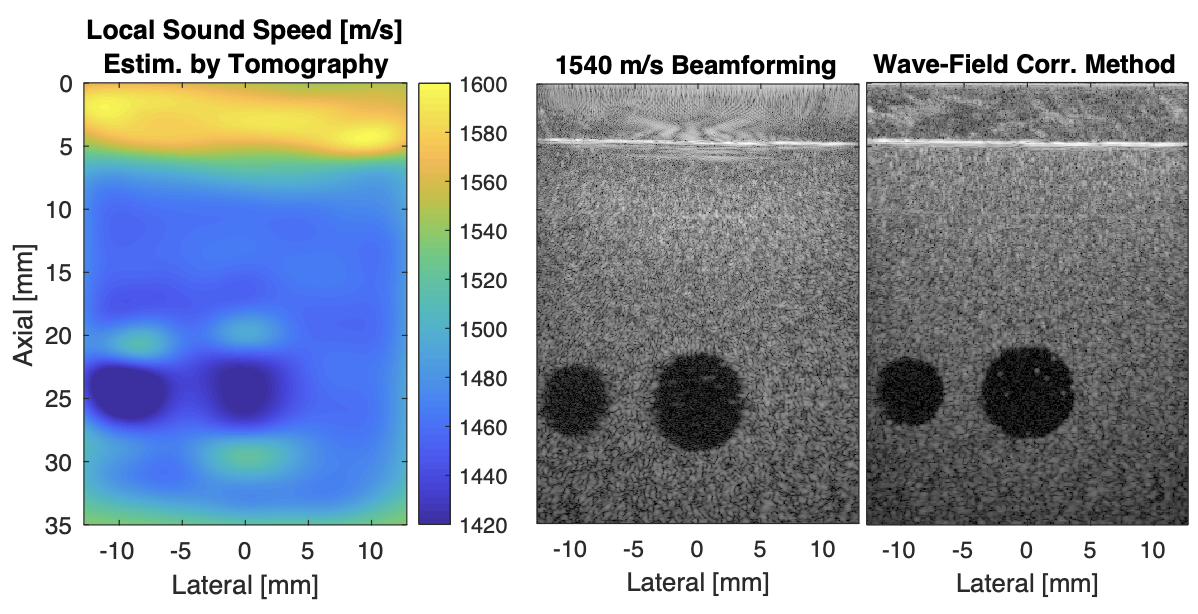 Distributed Aberration Correction Techniques Based on Tomographic Sound Speed EstimatesRehman Ali, Thurston Brevett, Dongwoon Hyun, and 2 more authorsIEEE Transactions on Ultrasonics, Ferroelectrics, and Frequency Control, 2022
Phase aberration is widely considered a major source of image degradation in medical pulse-echo ultrasound. Traditionally, near-field phase aberration correction techniques are unable to account for distributed aberrations due to a spatially varying speed of sound in the medium, while most distributed aberration correction techniques require the use of point-like sources and are impractical for clinical applications where diffuse scattering is dominant. Here, we present two distributed aberration correction techniques that utilize sound speed estimates from a tomographic sound speed estimator that builds on our previous work with diffuse scattering in layered media. We first characterize the performance of our sound speed estimator and distributed aberration correction techniques in simulations where the scattering in the media is known a priori. Phantom and in vivo experiments further demonstrate the capabilities of the sound speed estimator and the aberration correction techniques. In phantom experiments, point target resolution improves from 0.58 to 0.26 and 0.27 mm, and lesion contrast improves from 17.7 to 23.5 and 25.9 dB, as a result of distributed aberration correction using the eikonal and wavefield correlation techniques, respectively.
@article{Ali2022DistributedAberrationCorrection, title = {Distributed Aberration Correction Techniques Based on Tomographic Sound Speed Estimates}, author = {Ali, Rehman and Brevett, Thurston and Hyun, Dongwoon and Brickson, Leandra L and Dahl, Jeremy J}, journal = {IEEE Transactions on Ultrasonics, Ferroelectrics, and Frequency Control}, volume = {69}, number = {5}, pages = {1714--1726}, year = {2022}, doi = {10.1109/TUFFC.2022.3162836}, publisher = {IEEE}, url = {https://ieeexplore.ieee.org/document/9745035}, } -
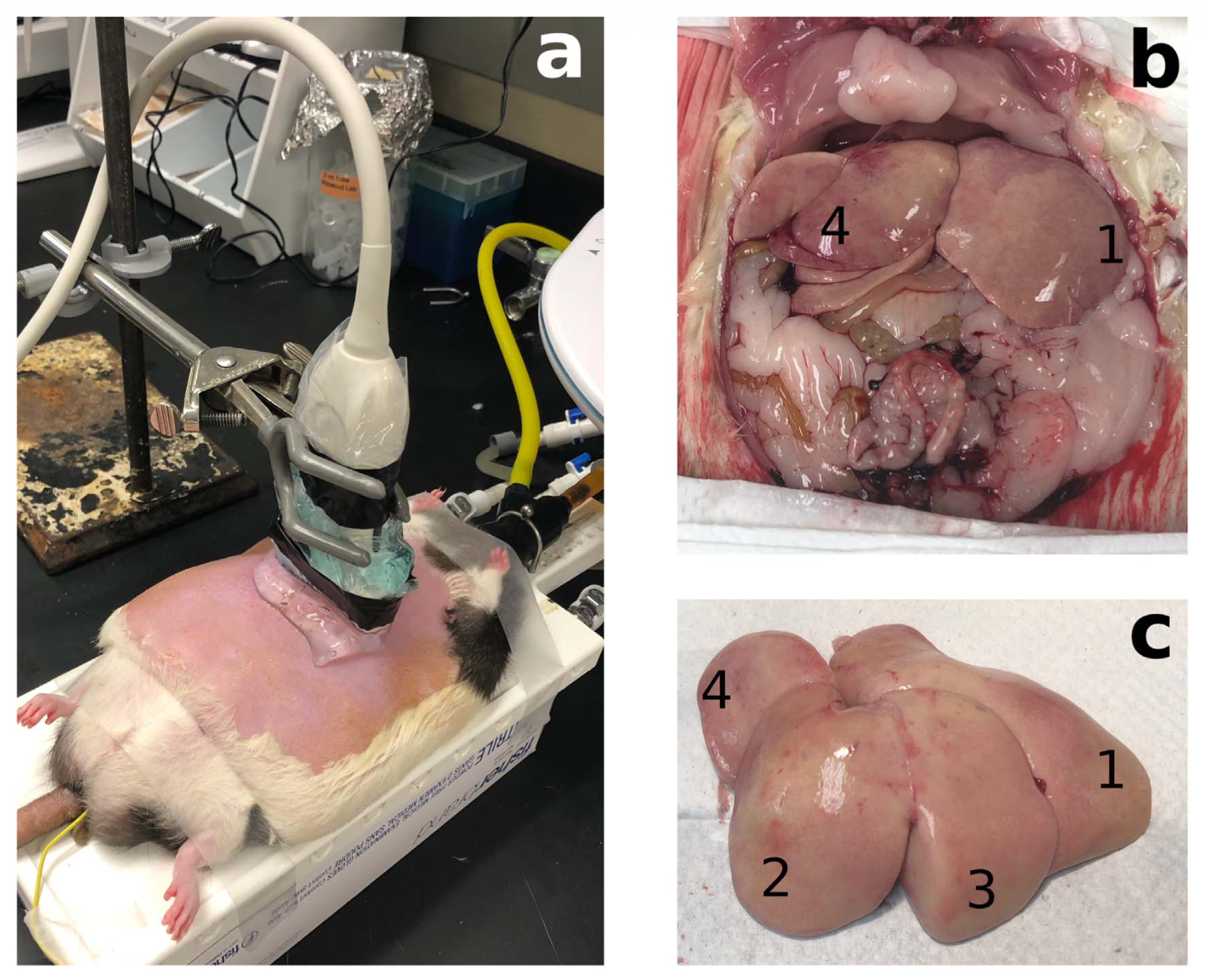 Noninvasive estimation of local speed of sound by pulse-echo ultrasound in a rat model of nonalcoholic fatty liverArsenii V Telichko, Rehman Ali, Thurston Brevett, and 5 more authorsPhysics in Medicine & Biology, 2022
Objective. Speed of sound has previously been demonstrated to correlate with fat concentration in the liver. However, estimating speed of sound in the liver noninvasively can be biased by the speed of sound of the tissue layers overlying the liver. Here, we demonstrate a noninvasive local speed of sound estimator, which is based on a layered media assumption, that can accurately capture the speed of sound in the liver. We validate the estimator using an obese Zucker rat model of non-alcoholic fatty liver disease and correlate the local speed of sound with liver steatosis. Approach. We estimated the local and global average speed of sound noninvasively in 4 lean Zucker rats fed a normal diet and 16 obese Zucker rats fed a high fat diet for up to 8 weeks. The ground truth speed of sound and fat concentration were measured from the excised liver using established techniques. Main Results. The noninvasive, local speed of sound estimates of the livers were similar in value to their corresponding ‘ground truth’ measurements, having a slope ± standard error of the regression of 0.82 ± 0.15 (R2 = 0.74 and p < 0.001). Measurement of the noninvasive global average speed of sound did not reliably capture the ‘ground truth’ speed of sound in the liver, having a slope of 0.35 ± 0.07 (R2 = 0.74 and p < 0.001). Decreasing local speed of sound was observed with increasing hepatic fat accumulation (approximately −1.7 m s−1 per 1% increase in hepatic fat) and histopathology steatosis grading (approximately −10 to −13 m s−1 per unit increase in steatosis grade). Local speed of sound estimates were highly correlated with steatosis grade, having Pearson and Spearman correlation coefficients both ranging from −0.87 to −0.78. In addition, a lobe-dependent speed of sound in the liver was observed by the ex vivo measurements, with speed of sound differences of up to 25 m s−1 (p < 0.003) observed between lobes in the liver of the same animal. Significance. The findings of this study suggest that local speed of sound estimation has the potential to be used to predict or assist in the measurement of hepatic fat concentration and that the global average speed of sound should be avoided in hepatic fat estimation due to significant bias in the speed of sound estimate.
@article{Telichko2022RatStudy, title = {Noninvasive estimation of local speed of sound by pulse-echo ultrasound in a rat model of nonalcoholic fatty liver}, author = {Telichko, Arsenii V and Ali, Rehman and Brevett, Thurston and Wang, Huaijun and Vilches-Moure, Jose G and Kumar, Sukumar U and Paulmurugan, Ramasamy and Dahl, Jeremy J}, journal = {Physics in Medicine \& Biology}, volume = {67}, number = {1}, pages = {015007}, year = {2022}, doi = {10.1088/1361-6560/ac4562}, publisher = {IOP Publishing}, url = {https://iopscience.iop.org/article/10.1088/1361-6560/ac4562}, } -
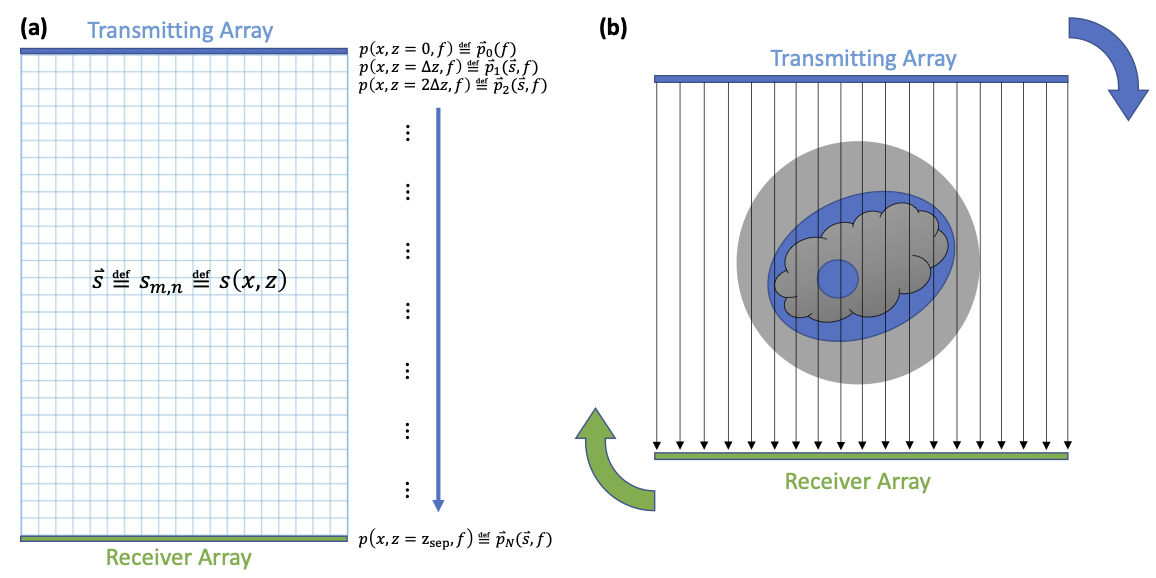 Open-Source Full-Waveform Ultrasound Computed Tomography Based on the Angular Spectrum Method Using Linear ArraysRehman AliIn Medical Imaging 2022: Ultrasonic Imaging and Tomography, 2022
We present full-waveform ultrasound computed tomography (USCT) for sound speed reconstruction based on the angular spectrum method using linear transducer arrays. We first present a transmission scenario in which plane-waves are emitted by a transmitting array and received by an array on the opposite side of the object of interest. These arrays are rotated around the object of interest to interrogate the medium from di↵erent view angles. Waveform inversion reconstruction is demonstrated on a numerical breast phantom, in which sound speed is varied from 1486 to 1584 m/s. This example is used to isolate and examine the impact of each view angles and frequency used in the reconstruction process. We also examine cycle-skipping artifacts as well as optimization schemes that can be used to overcome them. The goal of this work is to provide an opensource example and implementation of the waveform inversion reconstruction algorithm on Github: https:// github.com/rehmanali1994/FullWaveformInversionUSCT (DOI: 10.5281/zenodo.4774394). Next, we extend the waveform inversion framework to perform sound speed tomography for pulse-echo ultrasound imaging with a single linear array that transmits pulsed waves and receives signals backscattered from the medium. We first demonstrate that B-mode image reconstructions can be achieved using the angular spectrum method; then, we derive an optimization framework for estimating the sound speed in the medium by optimizing B-mode images with respect to slowness, via the angular spectrum method. We demonstrate an initial proof of concept with point targets in a homogeneous medium to demonstrate the fundamental principles of this new technique.
@inproceedings{Ali2022OpenSourceFullWaveformUSCT_LinearArrays, title = {Open-Source Full-Waveform Ultrasound Computed Tomography Based on the Angular Spectrum Method Using Linear Arrays}, author = {Ali, Rehman}, booktitle = {Medical Imaging 2022: Ultrasonic Imaging and Tomography}, volume = {12038}, pages = {187--205}, year = {2022}, organization = {SPIE}, doi = {10.1117/12.2601257}, url = {https://www.spiedigitallibrary.org/conference-proceedings-of-spie/12038/2601257/Open-source-full-waveform-ultrasound-computed-tomography-based-on-the/10.1117/12.2601257.full}, } -
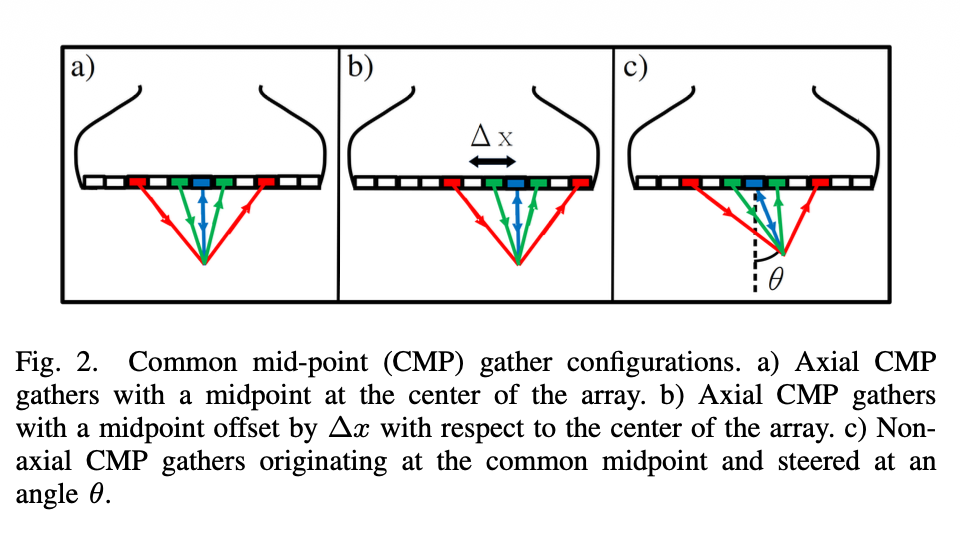 Speed of Sound Estimation at Multiple Angles from Common Midpoint Gathers of Non-Beamformed DataThurston Brevett, Sergio J Sanabria, Rehman Ali, and 1 more authorIn 2022 IEEE International Ultrasonics Symposium (IUS), 2022
Sound speed estimation is a promising quantitative parameter in ultrasound for both for it’s potential as a biomarker, where sound speed is known to be correlated with biological changes, and for aberration correction, where knowledge of the sound speed allows for correction of distortions in the image. Previous methods for sound speed estimation rely on the use of an a-priori sound speed for beamforming, from which sound-speed estimates are then calculated. However, this assumption introduces a bias in the estimation technique, because errors in the a-priori sound speed lead to distortions in the image. Here we present a method for sound speed estimation that avoids this bias by estimating the sound speed without beamforming.
@inproceedings{Brevett2022CMP, title = {Speed of Sound Estimation at Multiple Angles from Common Midpoint Gathers of Non-Beamformed Data}, author = {Brevett, Thurston and Sanabria, Sergio J and Ali, Rehman and Dahl, Jeremy}, booktitle = {2022 IEEE International Ultrasonics Symposium (IUS)}, pages = {1--4}, year = {2022}, organization = {IEEE}, doi = {10.1109/IUS54386.2022.9958779}, url = {https://ieeexplore.ieee.org/abstract/document/9958779} } -
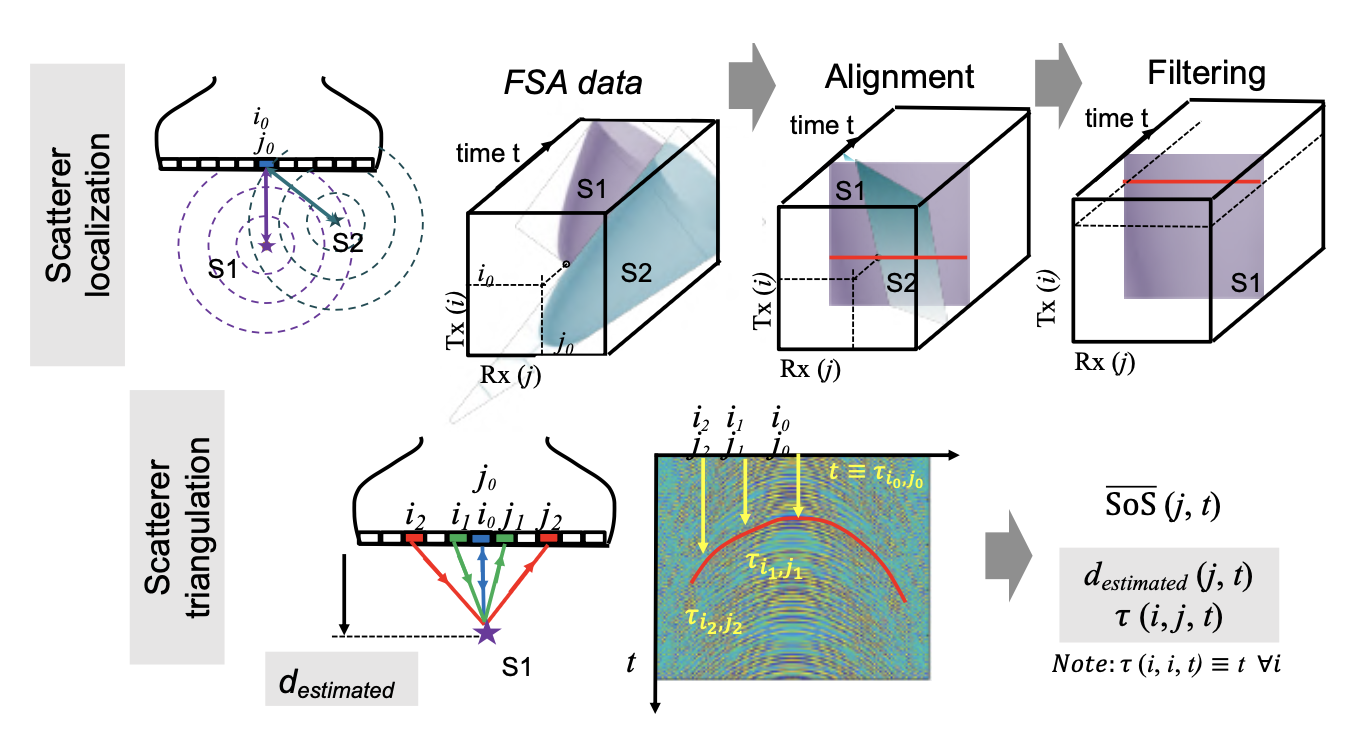 Direct Speed of Sound Reconstruction from Full-Synthetic Aperture Data with Dual RegularizationSergio J Sanabria, Thurston Brevett, Rehman Ali, and 2 more authorsIn 2022 IEEE International Ultrasonics Symposium (IUS), 2022
Speed-of-sound (SoS) reconstruction in pulse-echo ultrasound can reduce aberrations in imaging and provide quantitative biomarkers for diagnostics. State-of-the-art SoS imaging requires beamformed data for time-delay estimation. This translates either into multi-layered models, where absolute delays ti at multiple depths are fitted to axial SoS variations, or a perturbation approach, where differential delays between adjacent paths τi are used to map SoS heterogeneities. In this work, we remove the beamforming constraint and propose a dual regularization method to combine absolute and differential delays into a generalized SoS reconstruction. Our approach provides quantitative reconstructions in both layered distributions and focal lesions with bias < 2.3 m/s and rmse < 6 m/s. Moreover, it allows scatterer localization with sub-micron resolution. We show experimental results in SoS reconstruction through heterogeneous aberrating layers.
@inproceedings{Sanabria2022DualRegularization,
  title = {Direct Speed of Sound Reconstruction from Full-Synthetic Aperture Data with Dual Regularization},
  author = {Sanabria, Sergio J and Brevett, Thurston and Ali, Rehman and Telichko, Arsenii and Dahl, Jeremy},
  booktitle = {2022 IEEE International Ultrasonics Symposium (IUS)},
  pages = {1--4},
  year = {2022},
  organization = {IEEE},
  doi = {10.1109/IUS54386.2022.9958718},
  url = {https://ieeexplore.ieee.org/abstract/document/9958718}
}


2021
-
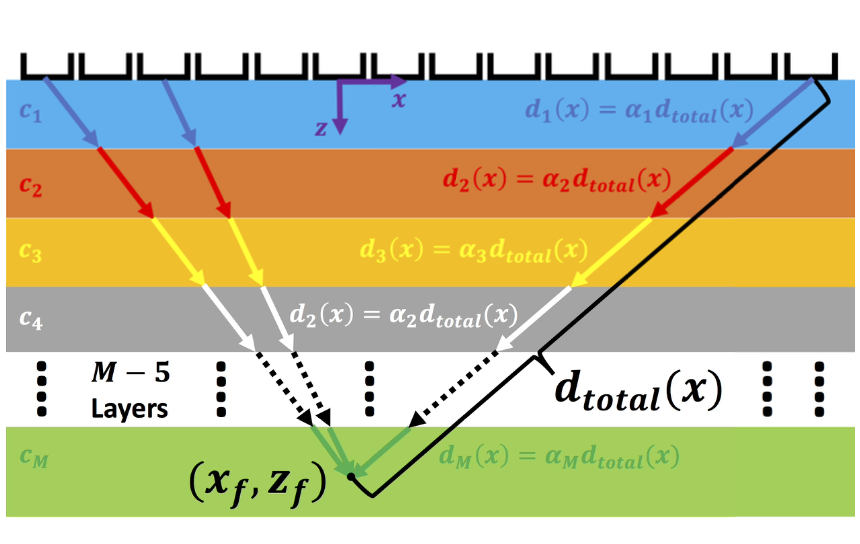 Local Sound Speed Estimation for Pulse-Echo Ultrasound in Layered MediaRehman Ali, Arsenii V Telichko, Huaijun Wang, and 4 more authorsIEEE transactions on ultrasonics, ferroelectrics, and frequency control, 2021
Our previous methodology in local sound speed estimation utilized time delays measured by the cross correlation of delayed full-synthetic aperture channel data to estimate the average speed of sound. However, focal distortions in this methodology lead to biased estimates of the average speed of sound, which, in turn, leads to biased estimates of the local speed of sound. Here, we demonstrate the bias in the previous methodology and introduce a coherence-based average sound speed estimator that eliminates this bias and is computationally much cheaper in practice. Because this coherence-based approach estimates the average sound speed in the medium over an equally spaced grid in depth rather than time, we derive a refined model that relates the local and average speeds of sound as a function of depth in layered media. A fast, closed-form inversion of this model yields highly accurate local sound speed estimates. The root-mean-square (rms) error of local sound speed reconstruction in simulations of two-layer media is 4.6 and 2.5 m/s at 4 and 8 MHz, respectively. This work examines the impact of frequency, f -number, aberration, and reverberation on sound speed estimation. Phantom and in vivo experiments in rats further validate the coherence-based sound speed estimator.
@article{Ali2021LayeredMedia, title = {Local Sound Speed Estimation for Pulse-Echo Ultrasound in Layered Media}, author = {Ali, Rehman and Telichko, Arsenii V and Wang, Huaijun and Sukumar, Uday K and Vilches-Moure, Jose G and Paulmurugan, Ramasamy and Dahl, Jeremy J}, journal = {IEEE transactions on ultrasonics, ferroelectrics, and frequency control}, volume = {69}, number = {2}, pages = {500--511}, year = {2021}, doi = {10.1109/TUFFC.2021.3124479}, publisher = {IEEE}, url = {https://ieeexplore.ieee.org/abstract/document/9597614}, } -
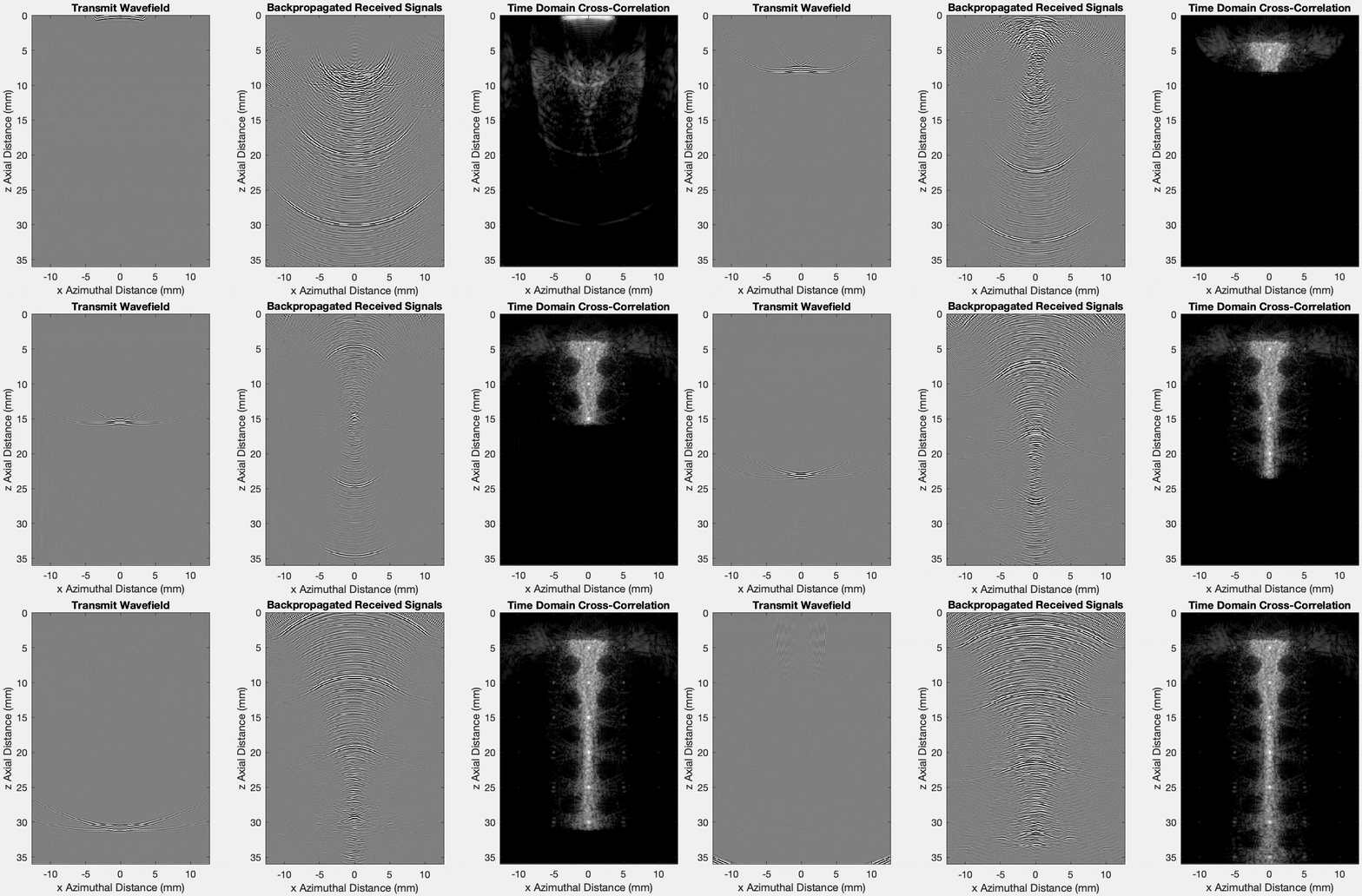 Fourier-based Synthetic-aperture Imaging for Arbitrary Transmissions by Cross-correlation of Transmitted and Received Wave-fieldsRehman AliUltrasonic imaging, 2021
Investigations into Fourier beamforming for medical ultrasound imaging have largely been limited to plane-wave and single-element transmissions. The main aim of this work is to generalize Fourier beamforming to enable synthetic aperture imaging with arbitrary transmit sequences. When applied to focused transmit beams, the proposed approach yields a full-waveform-based alternative to virtual-source synthetic aperture, which has implications for both coherence imaging and sound speed estimation. When compared to virtual-source synthetic aperture and retrospective encoding for conventional ultrasound sequences (REFoCUS), the proposed imaging technique shows an 8.6 and 3.8 dB improvement in contrast over virtual source synthetic aperture and REFoCUS, respectively, and a 55% improvement in point target resolution over virtual source synthetic aperture. The proposed image reconstruction technique also demonstrates general imaging improvements in vivo, while avoiding limitations seen in prior techniques.
@article{Ali2021FourierSyntheticAperture,
  title = {Fourier-based Synthetic-aperture Imaging for Arbitrary Transmissions by Cross-correlation of Transmitted and Received Wave-fields},
  author = {Ali, Rehman},
  journal = {Ultrasonic imaging},
  volume = {43},
  number = {5},
  pages = {282--294},
  year = {2021},
  doi = {10.1177/01617346211026350},
  publisher = {SAGE Publications Sage CA: Los Angeles, CA},
  url = {https://journals.sagepub.com/doi/full/10.1177/01617346211026350},
}


2020
-
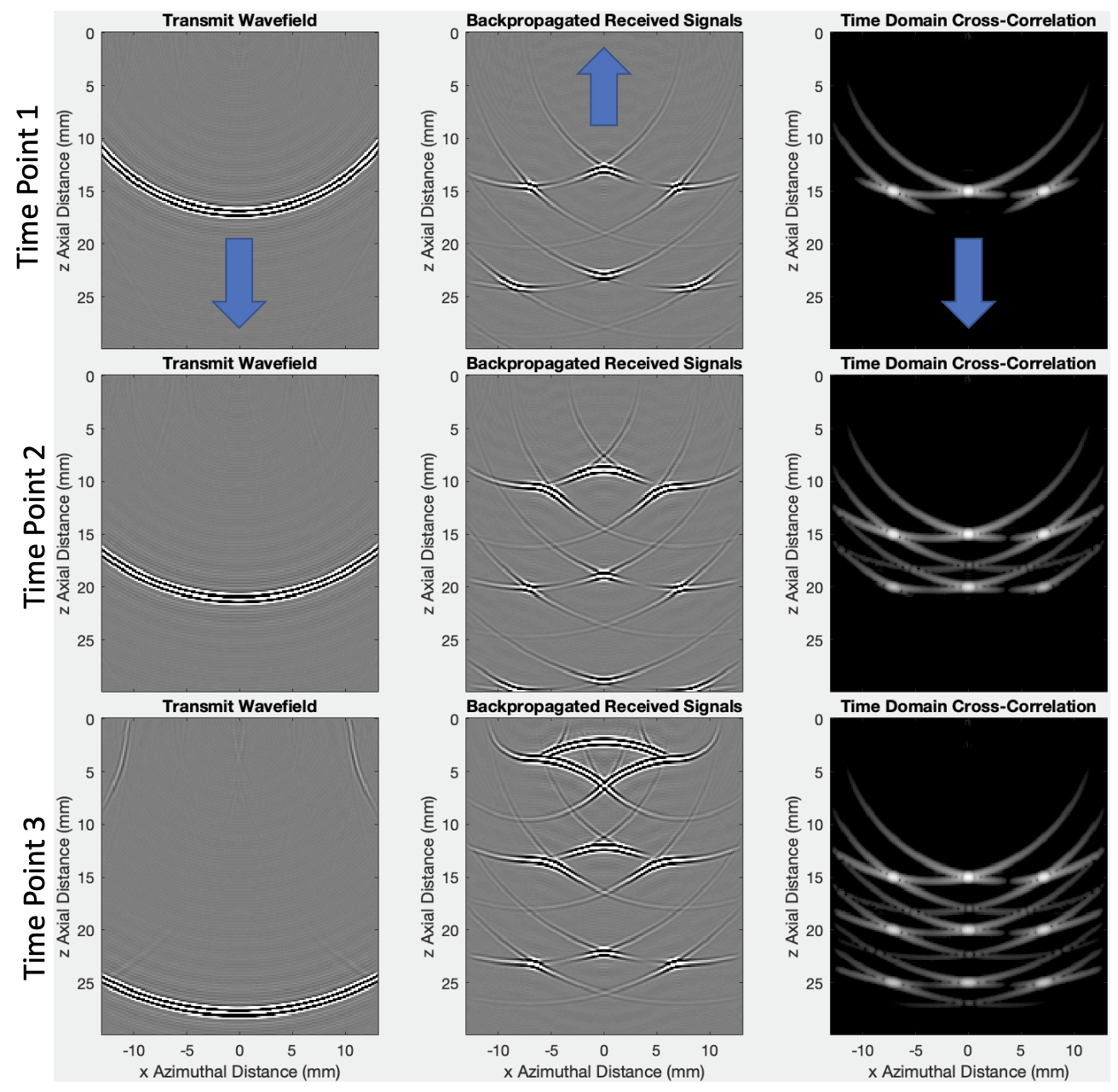 Medical Pulse-Echo Ultrasound Imaging Based on the Cross-Correlation of Transmitted and Backpropagated-Receive WavefieldsRehman Ali, Joseph Jennings, and Jeremy J DahlIn 2020 IEEE International Ultrasonics Symposium (IUS), 2020
In seismic imaging, a shot gather collects time series data from all receivers (geophones) with a common transmitter (source or shot). Shot-gather migration is an imaging technique that performs time-domain cross-correlation of the transmitted wavefield with the back-propagated receive wavefield. Shot-gather migration can be used to achieve the focusing quality of synthetic aperture imaging without susceptibility to motion by accurately modeling each wave-front, regardless of the transmit sequence applied. Since wave propagation is parameterized by the speed of sound in the medium, shot gather migration can also be used to perform distributed phase aberration correction enabling additional focusing improvements. In this work, we illustrate the shot gather migration process for point targets in simulation.
@inproceedings{Ali2020WavefieldCorrelation, title = {Medical Pulse-Echo Ultrasound Imaging Based on the Cross-Correlation of Transmitted and Backpropagated-Receive Wavefields}, author = {Ali, Rehman and Jennings, Joseph and Dahl, Jeremy J}, booktitle = {2020 IEEE International Ultrasonics Symposium (IUS)}, pages = {1--4}, year = {2020}, organization = {IEEE}, doi = {10.1109/IUS46767.2020.9251320}, url = {https://ieeexplore.ieee.org/abstract/document/9251320} } -
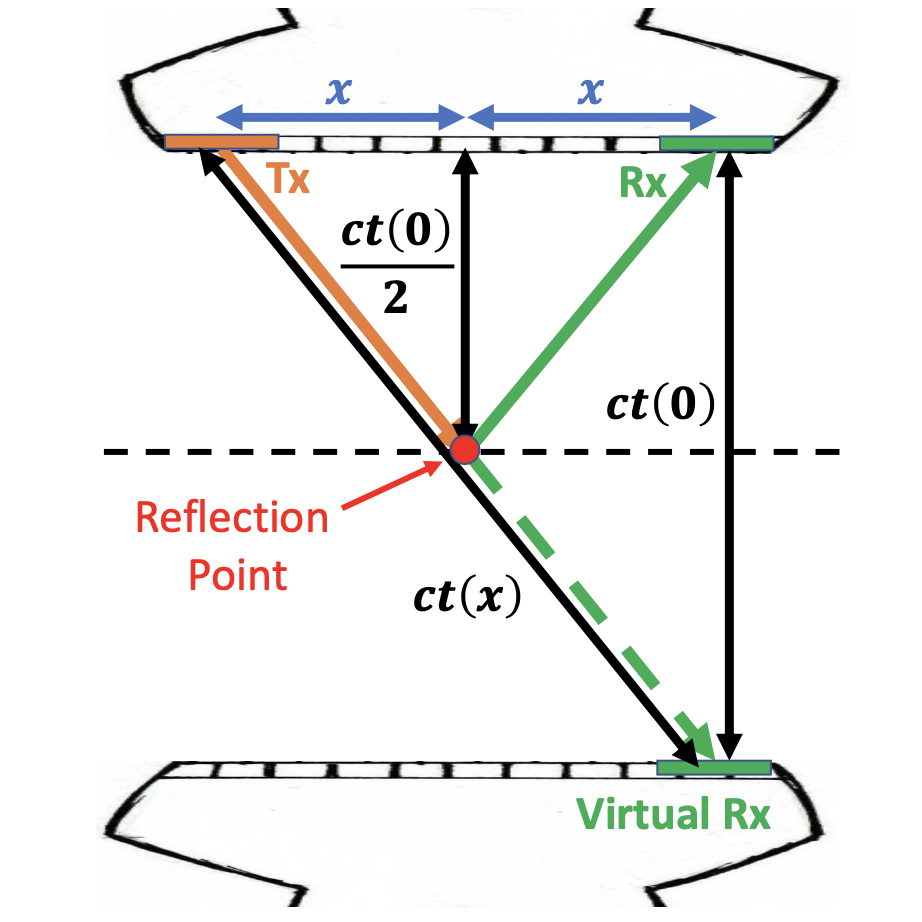 Application of Common Midpoint Gathers to Medical Pulse-Echo Ultrasound for Optimal Coherence and Improved Sound Speed Estimation in Layered MediaRehman Ali, Dongwoon Hyun, and Jeremy J DahlIn 2020 IEEE International Ultrasonics Symposium (IUS), 2020
In seismic imaging, common midpoint (CMP) gathers are collections of time-series data organized by source-receiver pairs having a common midpoint. CMP gathers have been used in geophysics to image the subsurface of the Earth and estimate wave velocity as a function of depth. According to the Van Cittert-Zernike (VCZ) theorem, if the signals from a CMP gather are focused using an ideal set of delays based on the true speed of sound in the medium, there should be a perfect correlation between any two signals in the CMP gather in the absence of noise. In ultrasound imaging, Walker et al. have applied this concept to translating transmit and receive apertures. The goal of this work is to apply CMP gathers to pulse-echo ultrasound imaging in order to improve coherence-based sound speed estimation in layered media.
@inproceedings{Ali2020CMP, title = {Application of Common Midpoint Gathers to Medical Pulse-Echo Ultrasound for Optimal Coherence and Improved Sound Speed Estimation in Layered Media}, author = {Ali, Rehman and Hyun, Dongwoon and Dahl, Jeremy J}, booktitle = {2020 IEEE International Ultrasonics Symposium (IUS)}, pages = {1--4}, year = {2020}, organization = {IEEE}, doi = {10.1109/IUS46767.2020.9251370}, url = {https://ieeexplore.ieee.org/abstract/document/9251370} } -
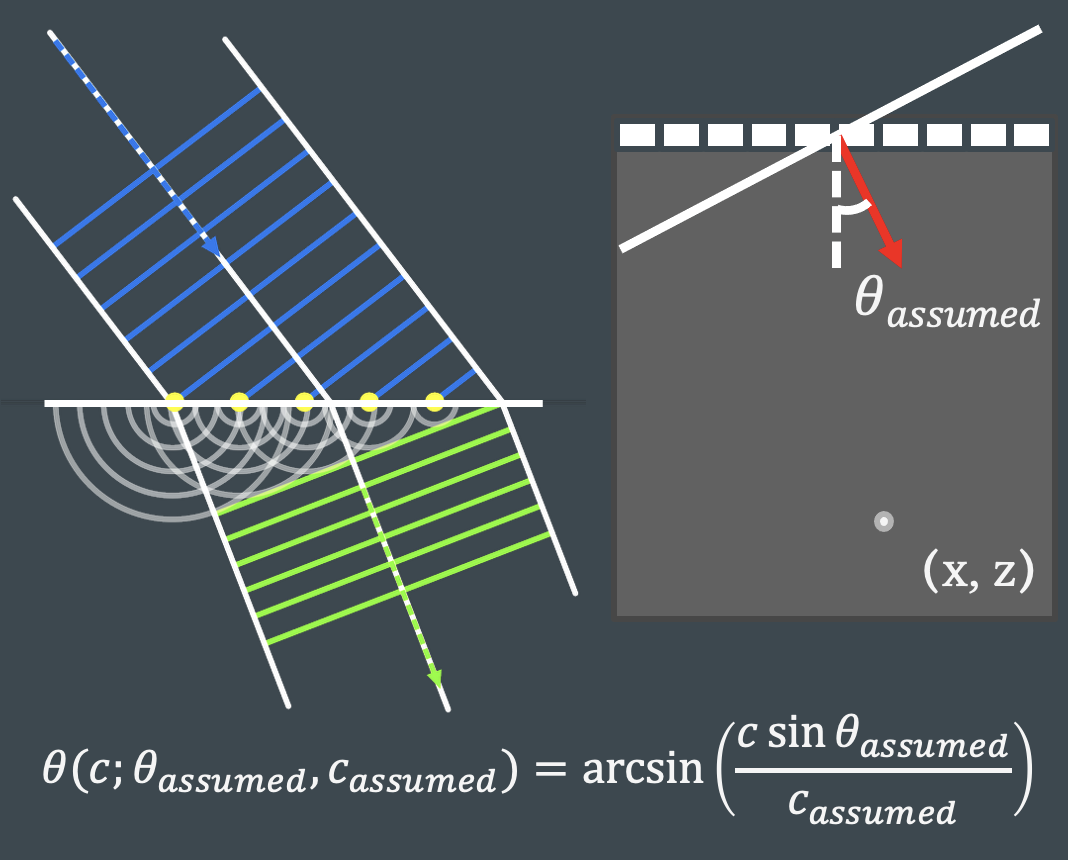 Sound Speed Estimation in Layered Media Using the Angular Coherence of Plane WavesRehman Ali, Sharil Maredia, Arsenii Telichko, and 4 more authorsIn Medical Imaging 2020: Ultrasonic Imaging and Tomography, 2020
We present a refraction-corrected sound speed reconstruction technique for layered media based on the angular coherence of plane waves. Previous work has successfully shown that sound speed estimation and refraction- corrected image reconstruction can be achieved using the coherence of full-synthetic aperture channel data. However, methods for acquiring the full-synthetic aperture dataset require a large number of transmissions, which can confound sound speed estimation due to the scatterer motion between transmit events, especially for in-vivo application. Furthermore, sound speed estimation requires producing full-synthetic aperture coherence images for each trial sound speed, which can make the overall computational cost quite burdensome. The angular coherence beamformer, initially devised as a quicker alternative to the more conventional spatial coherence beamformer, measures coherence between fully-beamformed I/Q channel data for each plane wave as opposed to the receive channel data prior to receive beamforming. As a result, angular coherence beamforming can significantly reduce the computation time needed to reconstruct a coherence image by taking advantage of receive beamforming. Previous work has used the coherence maximization of full-synthetic aperture channel data to perform sound speed estimation. By replacing spatial coherence with angular coherence, we apply a similar methodology to channel data from plane-waves to significantly reduce the computational cost of sound speed estimation. This methodology has been confirmed by both simulated and experimental channel data from plane waves.
@inproceedings{Ali2020PlaneWaveSoS,
  title = {Sound Speed Estimation in Layered Media Using the Angular Coherence of Plane Waves},
  author = {Ali, Rehman and Maredia, Sharil and Telichko, Arsenii and Wang, Huaijun and Paulmurugan, Ramasamy and Vilches-Moure, Jose and Dahl, Jeremy},
  booktitle = {Medical Imaging 2020: Ultrasonic Imaging and Tomography},
  volume = {11319},
  pages = {81--90},
  year = {2020},
  organization = {SPIE},
  doi = {10.1117/12.2548878},
  url = {https://www.spiedigitallibrary.org/conference-proceedings-of-spie/11319/2548878/Sound-speed-estimation-in-layered-media-using-the-angular-coherence/10.1117/12.2548878.full}
}


2019
-
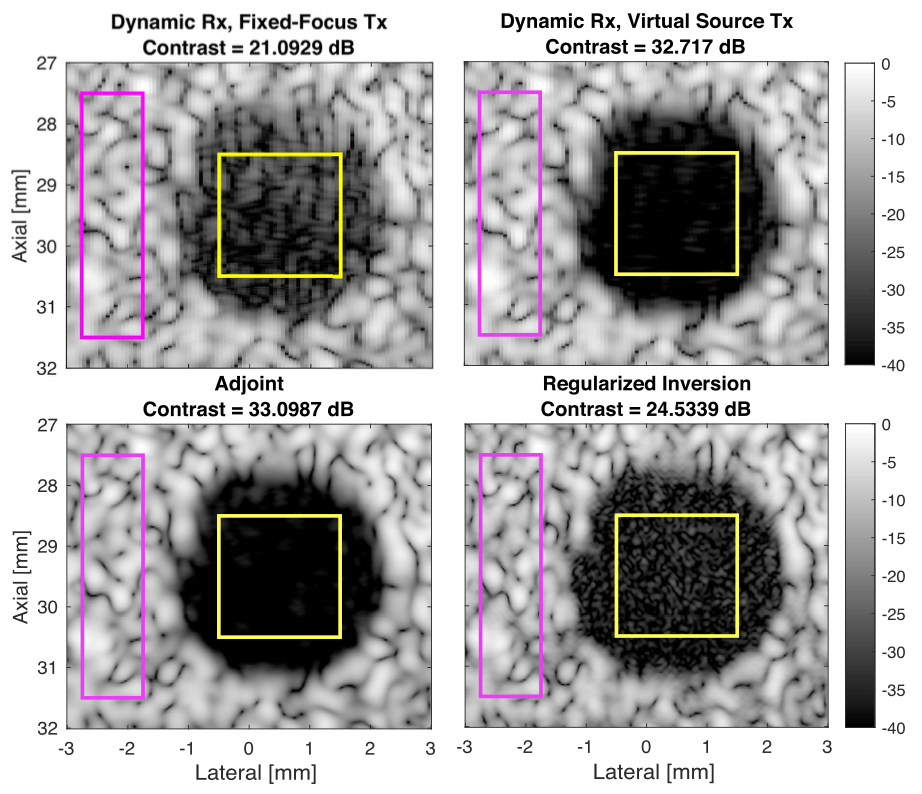 Extending retrospective encoding for robust recovery of the multistatic data setRehman Ali, Carl D Herickhoff, Dongwoon Hyun, and 2 more authorsIEEE transactions on ultrasonics, ferroelectrics, and frequency control, 2019
Robust recovery of multistatic synthetic aperture data from conventional ultrasound sequences can enable complete transmit-and-receive focusing at all points in the field of view without the drawbacks of virtual-source synthetic aperture and further enables more advanced imaging applications, such as backscatter coherence, sound speed estimation, and phase aberration correction. Recovery of the multistatic data set has previously been demonstrated on a steered transmit sequence for phased arrays using an adjoint-based method. We introduce two methods to improve the accuracy of the multistatic data set. We first modify the original technique used for steered transmit sequences by applying a ramp filter to compensate for the nonuniform frequency scaling introduced by the adjoint-based method. Then, we present a regularized inversion technique that allows additional aperture specification and is intended to work for both steered transmit and walking aperture sequences. The ramp-filtered adjoint and regularized inversion techniques, respectively, improve the correlation of the recovered signal with the ground truth from 0.9404 to 0.9774 and 0.9894 in steered transmit sequences and 0.4610 to 0.4733 and 0.9936 in walking aperture sequences.
@article{Ali2019REFoCUS, title = {Extending retrospective encoding for robust recovery of the multistatic data set}, author = {Ali, Rehman and Herickhoff, Carl D and Hyun, Dongwoon and Dahl, Jeremy J and Bottenus, Nick}, journal = {IEEE transactions on ultrasonics, ferroelectrics, and frequency control}, volume = {67}, number = {5}, pages = {943--956}, year = {2019}, doi = {10.1109/TUFFC.2019.2961875}, publisher = {IEEE}, url = {https://ieeexplore.ieee.org/abstract/document/8939466}, } -
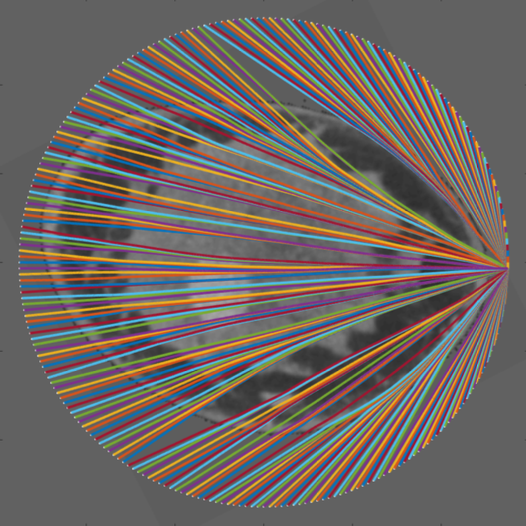 Open-source Gauss-Newton-based methods for refraction-corrected ultrasound computed tomographyRehman Ali, Scott Hsieh, and Jeremy DahlIn Medical Imaging 2019: Ultrasonic Imaging and Tomography, 2019
This work presents refraction-corrected sound speed reconstruction techniques for transmission-based ultrasound computed tomography using a circular transducer array. Pulse travel times between element pairs can be calculated from slowness (the reciprocal of sound speed) using the eikonal equation. Slowness reconstruction is posed as a nonlinear least squares problem where the objective is to minimize the error between measured and forward-modeled pulse travel times. The Gauss-Newton method is used to convert this problem into a sequence of linear least-squares problems, each of which can be efficiently solved using conjugate gradients. However, the sparsity of ray-pixel intersection leads to ill-conditioned linear systems and hinders stable convergence of the reconstruction. This work considers three approaches for resolving the ill-conditioning in this sequence of linear inverse problems: 1) Laplacian regularization, 2) Bayesian formulation, and 3) resolution-filling gradients. The goal of this work is to provide an open-source example and implementation of the algorithms used to perform sound speed reconstruction, which is currently being maintained on Github: https://github.com/ rehmanali1994/refractionCorrectedUSCT.github.io
@inproceedings{Ali2019OpenSourceBentRayTomography, title = {Open-source Gauss-Newton-based methods for refraction-corrected ultrasound computed tomography}, author = {Ali, Rehman and Hsieh, Scott and Dahl, Jeremy}, booktitle = {Medical Imaging 2019: Ultrasonic Imaging and Tomography}, volume = {10955}, pages = {39--52}, year = {2019}, organization = {SPIE}, doi = {10.1117/12.2511319}, url = {https://www.spiedigitallibrary.org/conference-proceedings-of-spie/10955/2511319/Open-source-Gauss-Newton-based-methods-for-refraction-corrected-ultrasound/10.1117/12.2511319.full}, } -
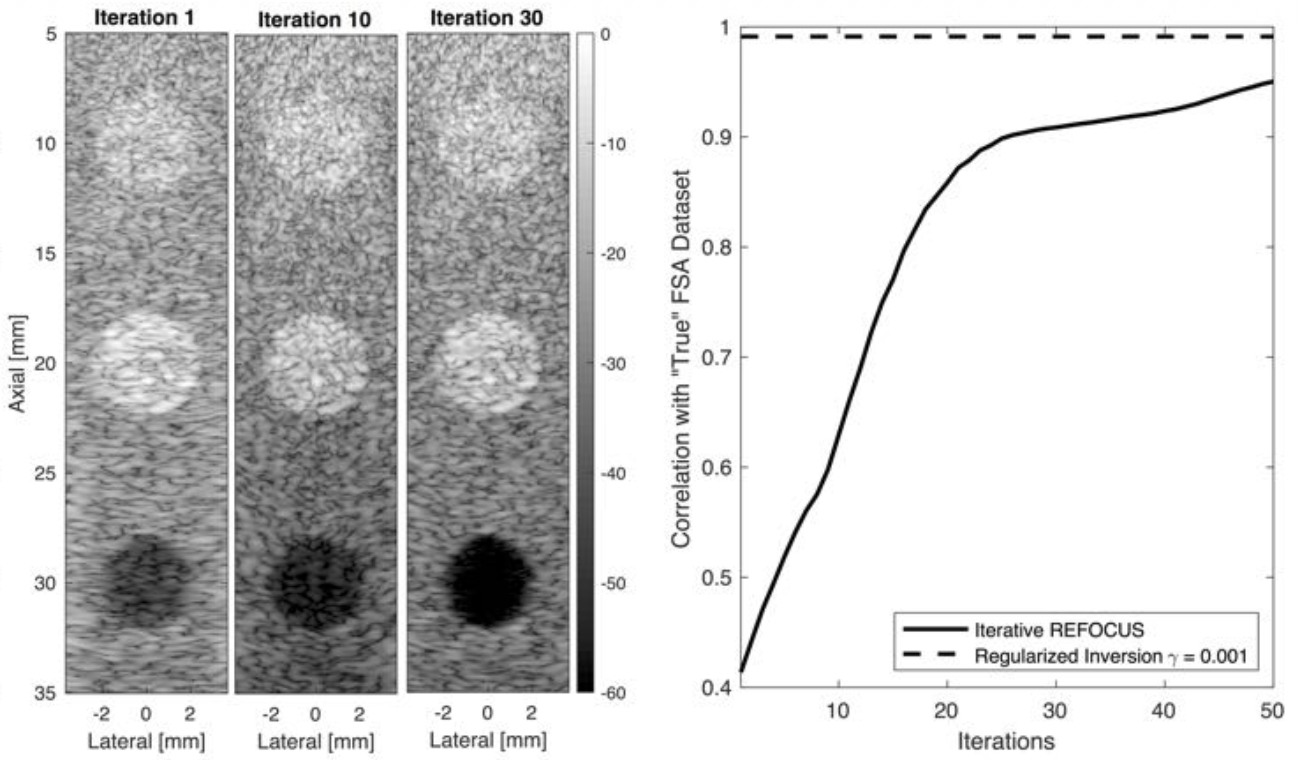 Iterative Retrospective Recovery of Full Synthetic Aperture Data from Focused TransmissionsRehman Ali, Jeremy J Dahl, and Nick BottenusIn 2019 IEEE International Ultrasonics Symposium (IUS), 2019
Retrospective Encoding For Conventional Ultrasound Sequences (REFoCUS) enables recovery of the full-synthetic aperture (FSA) dataset from focused transmits while avoiding the drawbacks of single- and virtual-element transmissions. It was recently shown that a regularized inversion approach significantly improves the accuracy of the recovered FSA dataset over the REFoCUS method when applied to a walking-aperture transmit sequence. However, this approach becomes computationally burdensome when applied to walking aperture sequences on larger linear arrays. We present an iterative form of REFoCUS that improves FSA dataset recovery to better handle these cases.
@inproceedings{Ali2019IterativeREFoCUS, title = {Iterative Retrospective Recovery of Full Synthetic Aperture Data from Focused Transmissions}, author = {Ali, Rehman and Dahl, Jeremy J and Bottenus, Nick}, booktitle = {2019 IEEE International Ultrasonics Symposium (IUS)}, pages = {1005--1008}, year = {2019}, organization = {IEEE}, doi = {10.1109/ULTSYM.2019.8925717}, url = {https://ieeexplore.ieee.org/abstract/document/8925717} } -
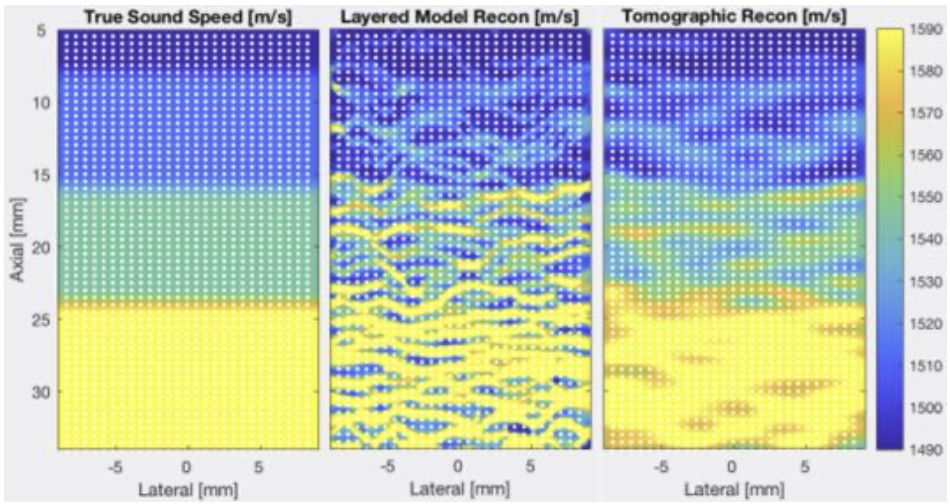 Travel-Time Tomography for Local Sound Speed Reconstruction Using Average Sound SpeedsRehman Ali and Jeremy J DahlIn 2019 IEEE International Ultrasonics Symposium (IUS), 2019
Our previous work on estimating the local speed of sound from average sound speed assumes a perfectly layered medium where sound speed is only allowed to vary axially away from the transducer surface. This layered-medium approach relies on inverting the relationship between the local interval sound speeds in each layer and the effective average sound speed up to a particular imaging depth. The primary limitation of this approach is that local sound speed estimation can become inaccurate in the presence of lateral variations in sound speed or a curved transducer surface. To better estimate sound speed in the presence of these non-idealities, we propose a travel-time tomographic approach that accounts for propagation paths from the scattering volume to each transducer element.
@inproceedings{Ali2019Average2LocalSoS,
  title = {Travel-Time Tomography for Local Sound Speed Reconstruction Using Average Sound Speeds},
  author = {Ali, Rehman and Dahl, Jeremy J},
  booktitle = {2019 IEEE International Ultrasonics Symposium (IUS)},
  pages = {2007--2010},
  year = {2019},
  organization = {IEEE},
  doi = {10.1109/ULTSYM.2019.8925890},
  url = {https://ieeexplore.ieee.org/abstract/document/8925890}
}


2018
-
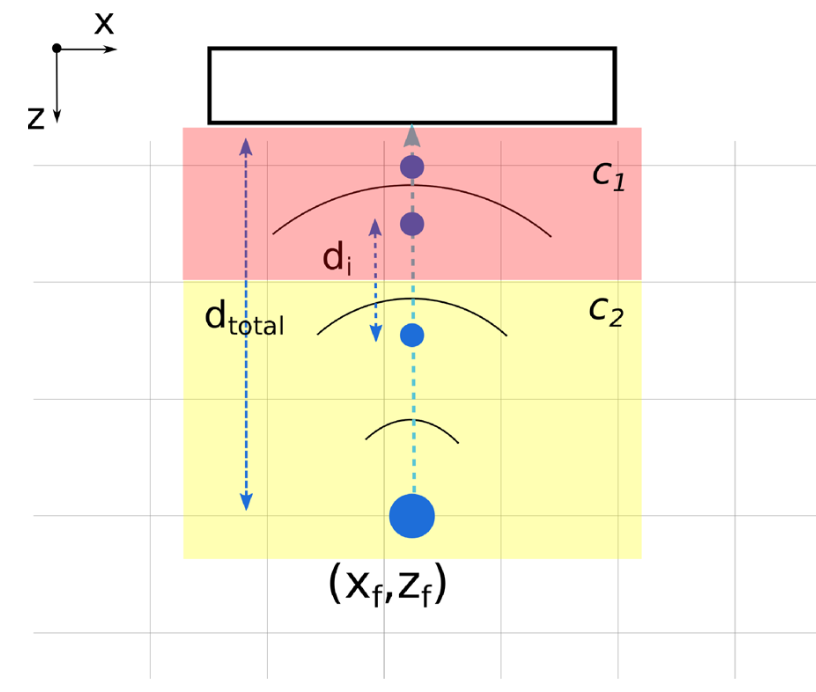 Local speed of sound estimation in tissue using pulse-echo ultrasound: Model-based approachMarko Jakovljevic, Scott Hsieh, Rehman Ali, and 3 more authorsThe Journal of the Acoustical Society of America, 2018
A model and method to accurately estimate the local speed of sound in tissue from pulse-echo ultrasound data is presented. The model relates the local speeds of sound along a wave propagation path to the average speed of sound over the path, and allows one to avoid bias in the sound-speed estimates that can result from overlying layers of subcutaneous fat and muscle tissue. Herein, the average speed of sound using the approach by Anderson and Trahey is measured, and then the authors solve the proposed model for the local sound-speed via gradient descent. The sound-speed estimator was tested in a series of simulation and ex vivo phantom experiments using two-layer media as a simple model of abdominal tissue. The bias of the local sound-speed estimates from the bottom layers is less than 6.2 m/s, while the bias of the matched Anderson’s estimates is as high as 66 m/s. The local speed-of-sound estimates have higher standard deviation than the Anderson’s estimates. When the mean local estimate is computed over a 5-by-5 mm region of interest, its standard deviation is reduced to less than 7 m/s.
@article{Jakovljevic2018LocalSoS, title = {Local speed of sound estimation in tissue using pulse-echo ultrasound: Model-based approach}, author = {Jakovljevic, Marko and Hsieh, Scott and Ali, Rehman and Chau Loo Kung, Gustavo and Hyun, Dongwoon and Dahl, Jeremy J}, journal = {The Journal of the Acoustical Society of America}, volume = {144}, number = {1}, pages = {254--266}, year = {2018}, publisher = {AIP Publishing}, doi = {10.1121/1.5043402}, url = {https://pubs.aip.org/asa/jasa/article/144/1/254/854722}, } -
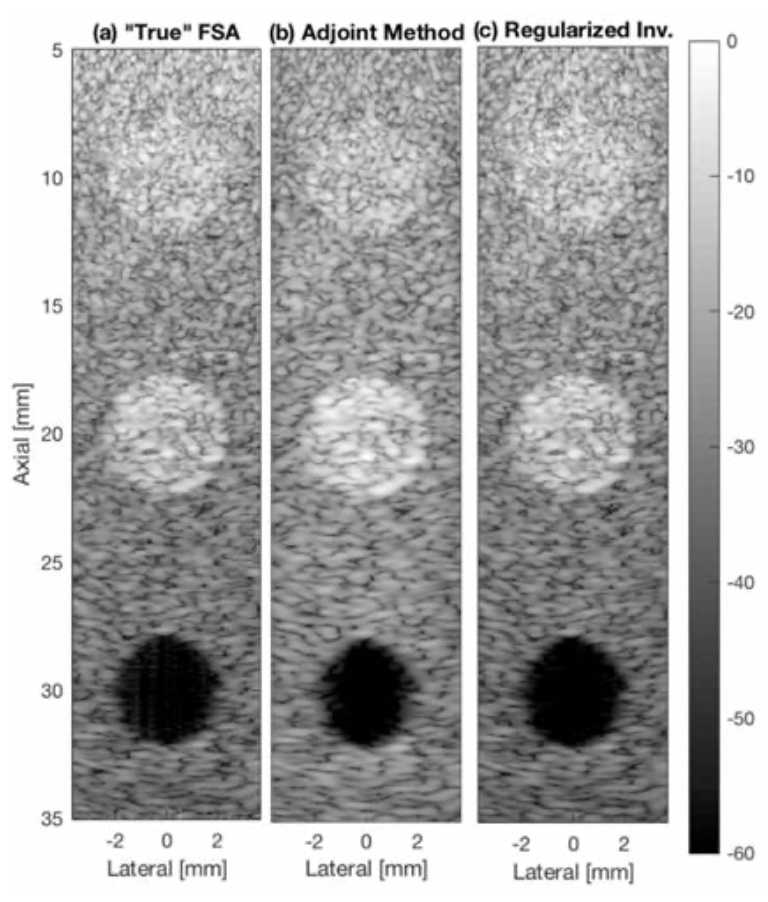 Regularized Inversion Method for Frequency-Domain Recovery of the Full Synthetic Aperture Dataset from Focused TransmissionsRehman Ali, Jeremy J Dahl, and Nick BottenusIn 2018 IEEE International Ultrasonics Symposium (IUS), 2018
Accurate recovery of the full-synthetic aperture (FSA) dataset from focused transmissions can enable synthetic transmit focusing without the drawbacks of single-element and virtual-element transmissions and enable a wide array of imaging techniques that require the FSA dataset. Recovery of the FSA dataset has previously been performed using an adjoint-based method on a steered transmit sequence for phased-arrays. We present a regularized inversion method for FSA dataset recovery that allows a wider variety of aperture specifications and is intended to perform more accurately in walking aperture sequences. The goal of this method is to improve FSA dataset accuracy and achievable image quality.
@inproceedings{Ali2018RegularizedREFoCUS,
  title = {Regularized Inversion Method for Frequency-Domain Recovery of the Full Synthetic Aperture Dataset from Focused Transmissions},
  author = {Ali, Rehman and Dahl, Jeremy J and Bottenus, Nick},
  booktitle = {2018 IEEE International Ultrasonics Symposium (IUS)},
  pages = {1--9},
  year = {2018},
  organization = {IEEE},
  doi = {10.1109/ULTSYM.2018.8580213},
  url = {https://ieeexplore.ieee.org/abstract/document/8580213}
}

2016
-
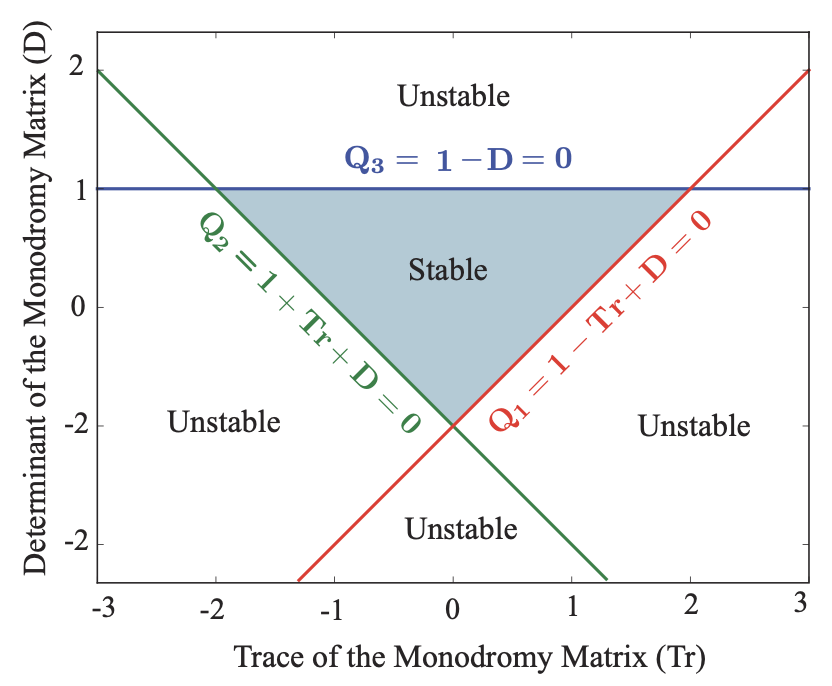 Pattern formation in oscillatory media without lateral inhibitionRehman Ali, Jeremy Harris, and Bard ErmentroutPhysical Review E, 2016
Spontaneous symmetry breaking instabilities are the most common mechanism for how biological, chemical, and physical systems produce spatial patterns. Beginning with Turing’s original paper, so-called lateral inhibition—in which negative feedback has greater spread than positive feedback—has been the underlying mechanism for pattern formation in biological models. Despite this, there are many biological systems that exhibit pattern formation but do not have lateral inhibition. In this paper, we present an example of such a system that is able to generate robust patterns emerging from a spatially homogeneous state. In fact, patterns can arise when there is only spatial spread of the activator. Unlike classic Turing pattern formation, these patterns arise from a spatially homogeneous oscillation rather than from a constant steady state.
@article{Ali2016PatternFormation,
  title = {Pattern formation in oscillatory media without lateral inhibition},
  author = {Ali, Rehman and Harris, Jeremy and Ermentrout, Bard},
  journal = {Physical Review E},
  volume = {94},
  number = {1},
  pages = {012412},
  year = {2016},
  doi = {10.1103/PhysRevE.94.012412},
  publisher = {APS},
  url = {https://journals.aps.org/pre/abstract/10.1103/PhysRevE.94.012412},
}