Making FWI Robust Against False Minima
Variants of FWI robust against false minima caused by cycle skipping
Cycle Skipping in FWI
Full-waveform inversion is highly sensitive to the starting model. When the predicted and measured waveforms are shifted by more than half a cycle, the FWI objective function develops local minima and the inversion can converge toward the wrong solution. This phenomenon, known as cycle skipping, is particularly problematic in ultrasound tomography because the sound-speed contrast between the initial model and tissue can be large.
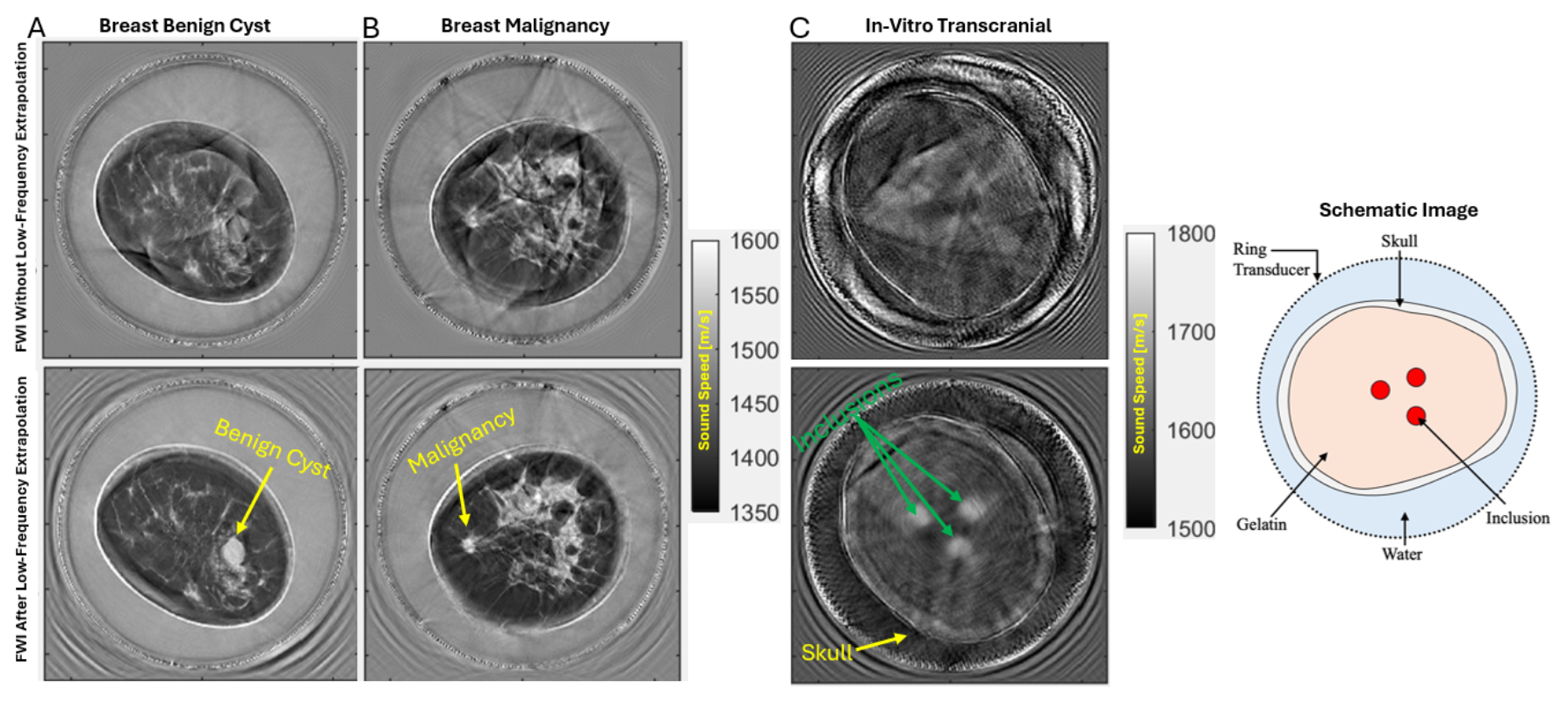
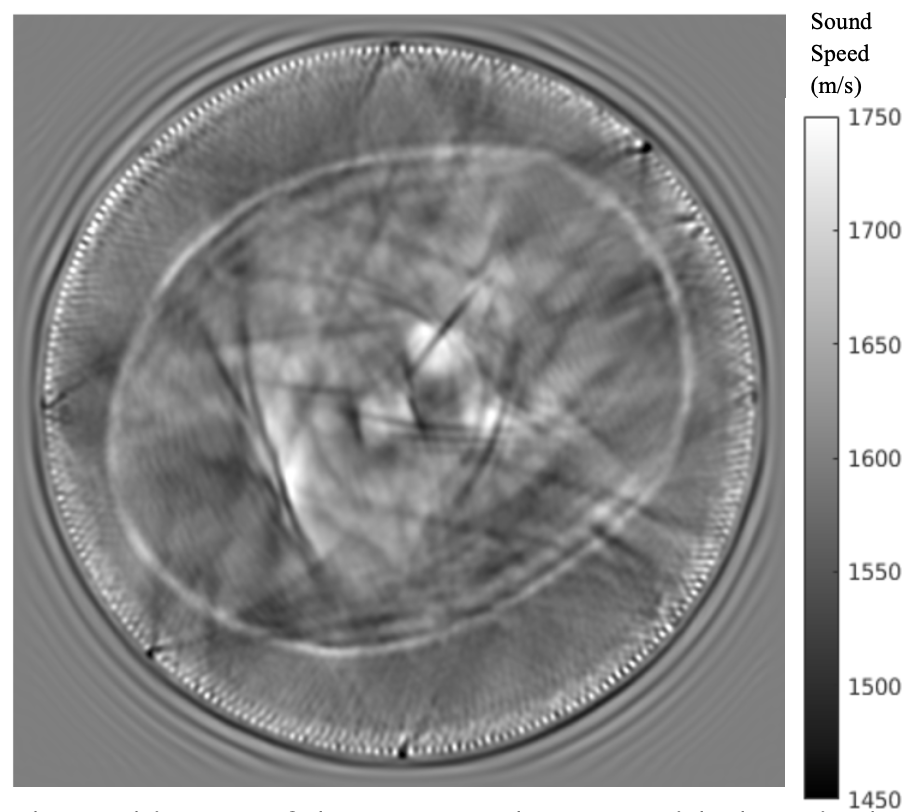
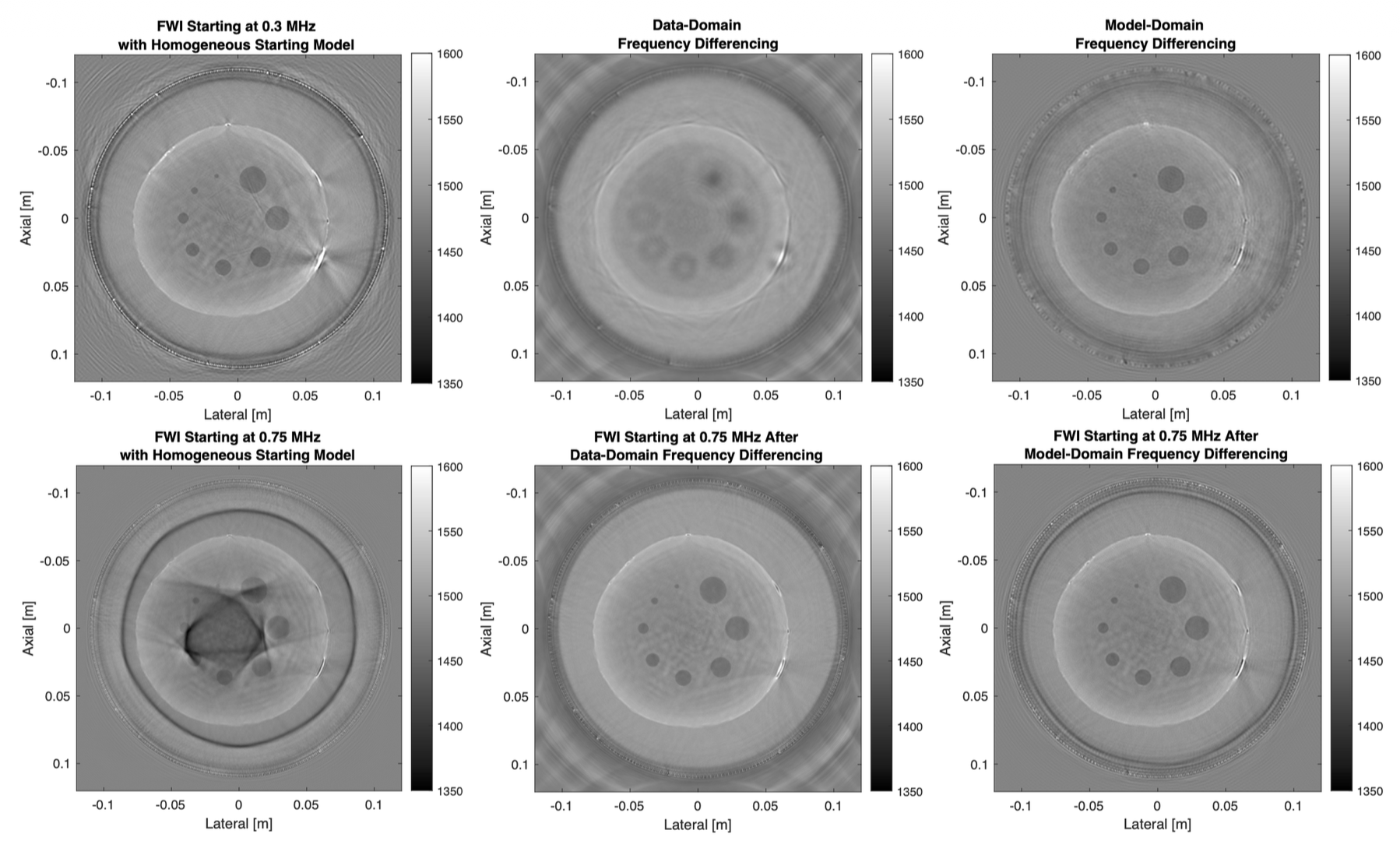
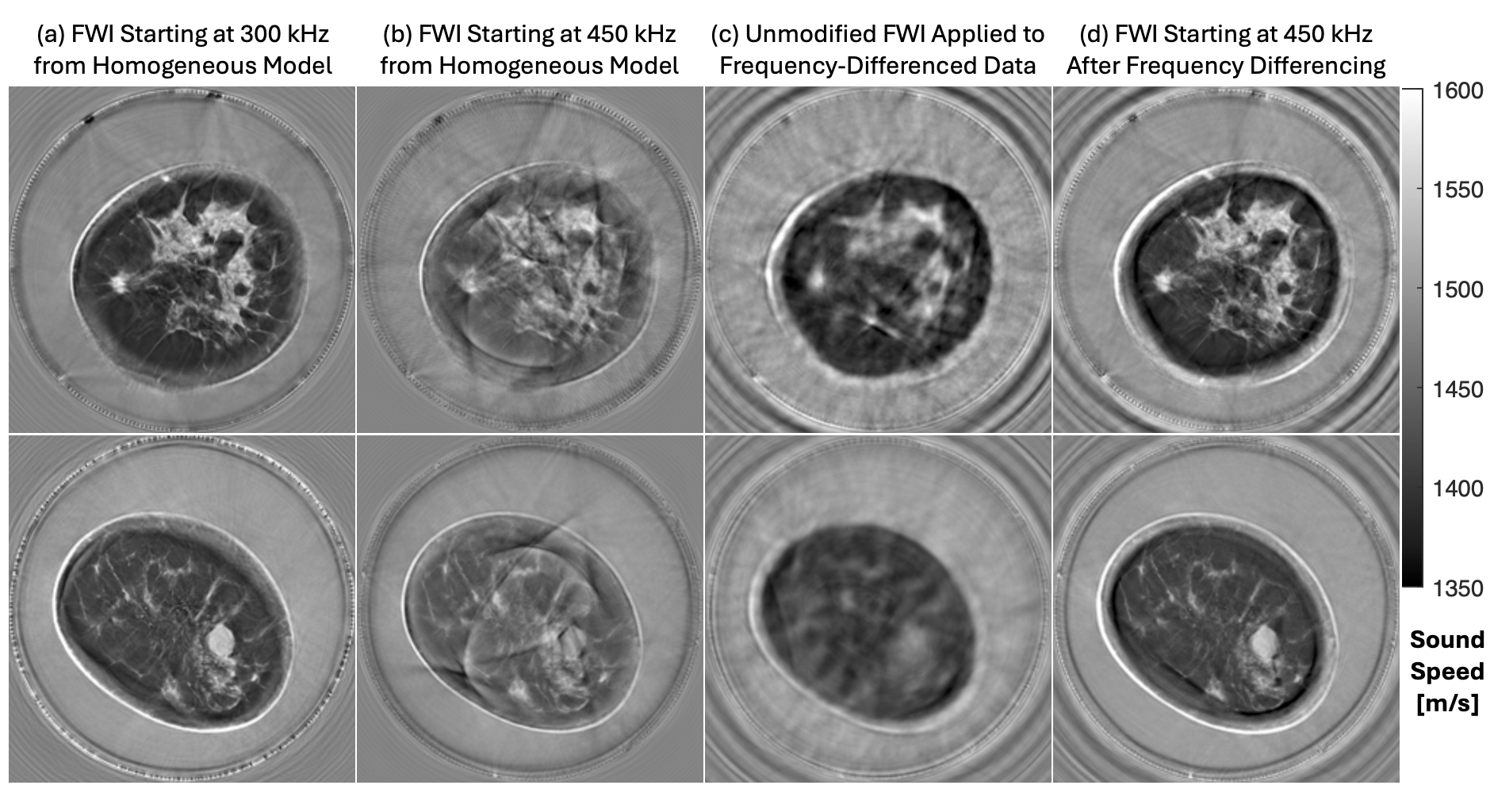
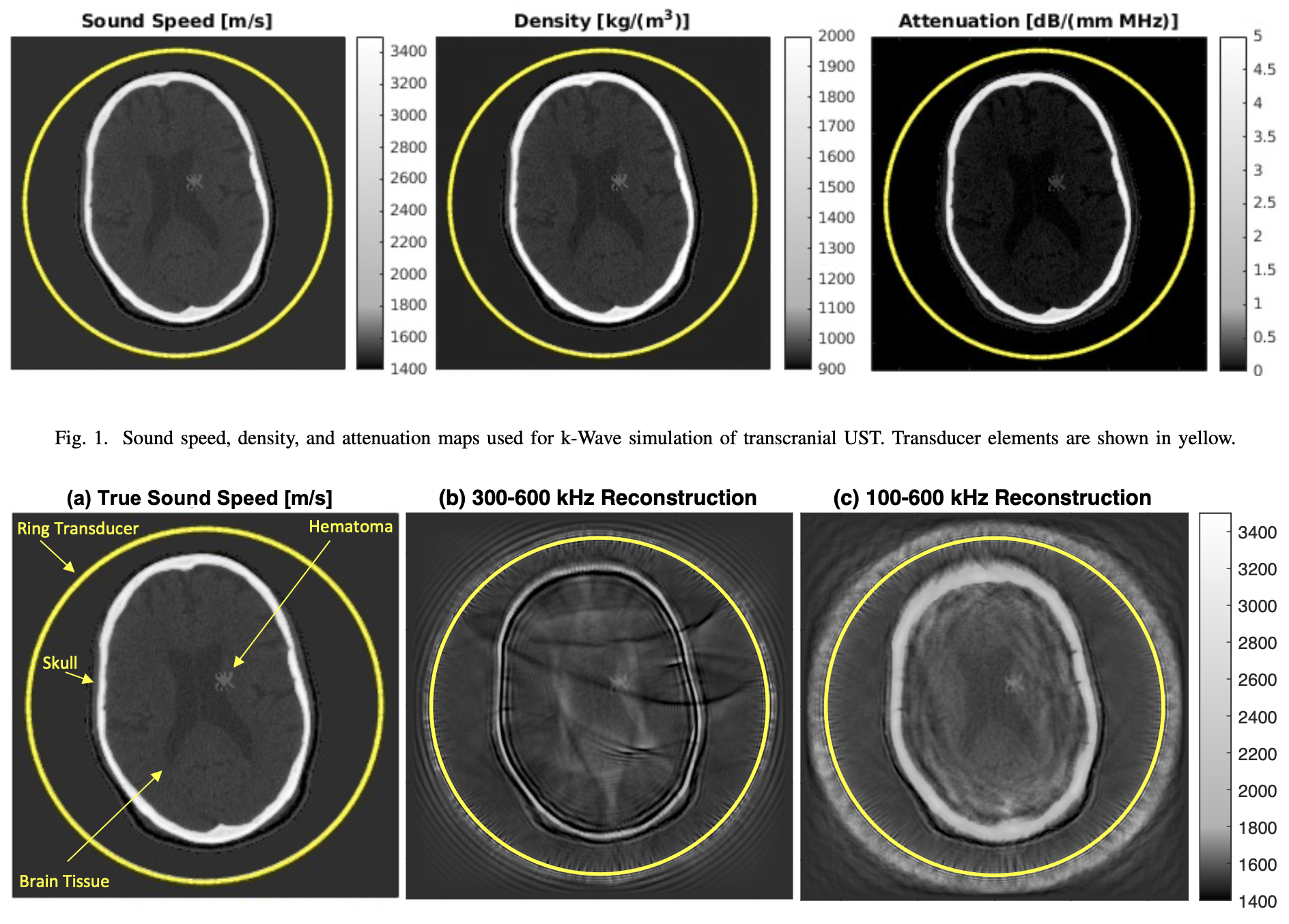
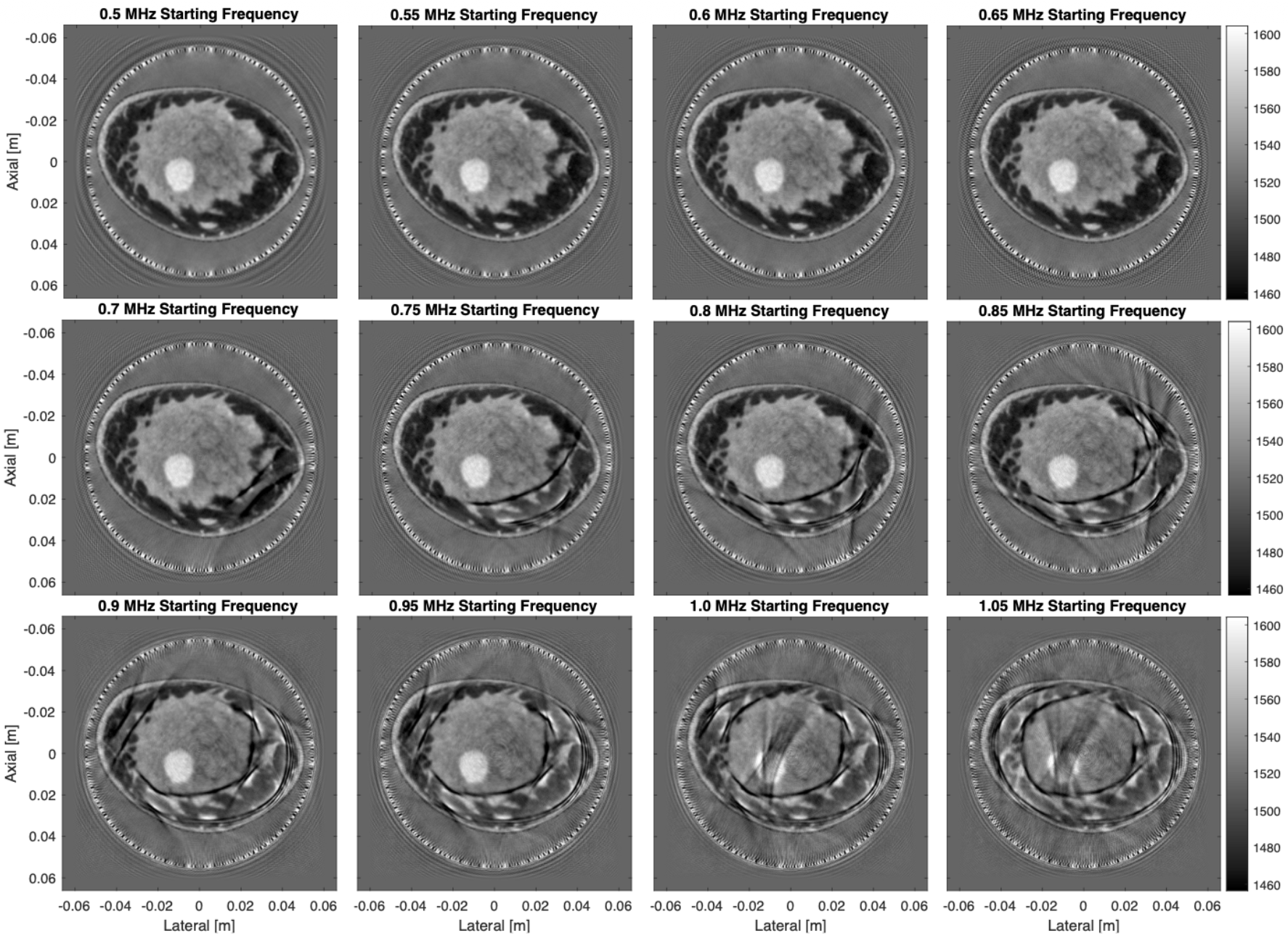
The standard way to reduce cycle skipping is to begin the inversion at low frequencies and progressively introduce higher frequencies. Low-frequency waveforms have longer periods, making the inversion less sensitive to the initial travel-time error. However, ultrasound transducers are often designed for higher-frequency imaging and may have insufficient bandwidth at the frequencies needed to initialize FWI. The examples below illustrate this problem. In transcranial ultrasound tomography, FWI can converge successfully when sufficiently low-frequency data are available, but starting at a higher frequency produces cycle-skipping artifacts. Similar artifacts emerge in breast ultrasound tomography as the starting frequency is increased.


Frequency-Difference FWI (FD-FWI)
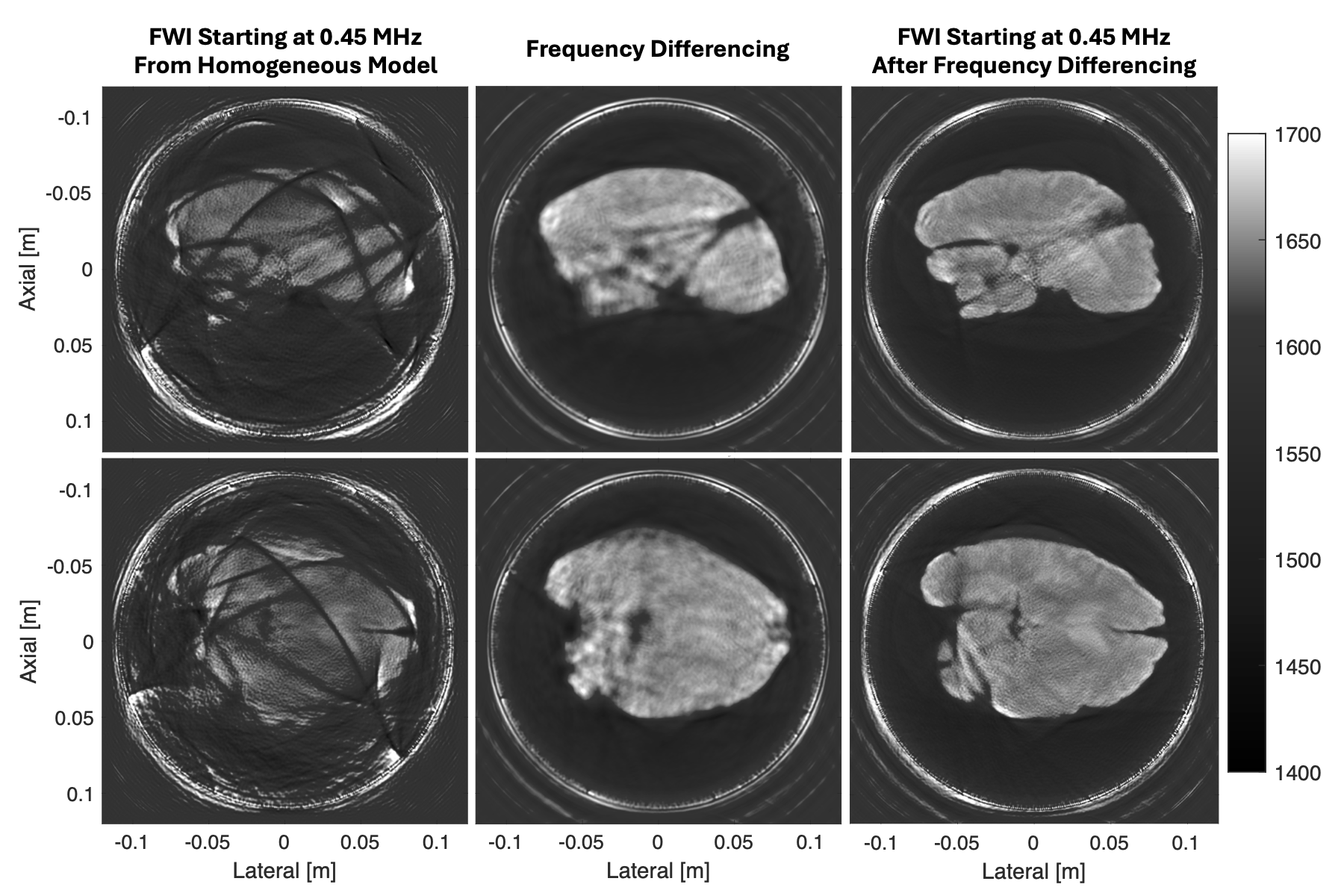
To overcome the lack of low-frequency measurements, I developed a frequency-differencing approach that synthesizes low-frequency signals from the available high-frequency data. The key observation is that signals at two different frequencies can be combined to produce a signal at their frequency difference (or beat frequency). When the two frequencies are close together, the difference frequency can be substantially lower than either measured frequency.These synthesized low-frequency signals can then be used to initialize FWI before progressively returning to the original measured frequencies. This approach effectively creates the low-frequency information needed to avoid cycle skipping without requiring the transducer to operate outside its normal bandwidth. In simulations and phantom experiments, frequency differencing produced substantially improved reconstructions compared with starting FWI directly from a homogeneous sound-speed model.


An important distinction is between data-domain and model-domain frequency differencing. In the data-domain approach, low-frequency data are generated from multiple frequency pairs in the measured signals and then supplied to an otherwise conventional FWI algorithm (Ali et al., 2025). In the model-domain formulation, also known as frequency-difference FWI (FD-FWI), frequency differencing is incorporated directly into the forward model used during inversion. The initial model-domain implementation was computationally limited to a single frequency pair, which reduced the stability of the approach (Ali et al., 2024). Subsequent work extended the formulation to multiple frequency pairs, providing a more stable implementation of FD-FWI while retaining the benefits of model-domain frequency differencing (Klaben et al., 2026).


A particularly useful application of frequency differencing is to use the synthesized low-frequency data only to generate a better starting model. FWI is first performed on the extrapolated low-frequency data, and the resulting sound-speed distribution is then supplied as the initial model for conventional FWI using the measured data. This separates the two roles of the inversion: the synthesized low frequencies provide the large-scale information needed to avoid cycle skipping, while the measured high-frequency data provide the resolution needed for the final reconstruction. In breast phantom experiments, this strategy substantially improved the recovered sound-speed values compared with FWI initialized from a homogeneous model. The reconstructed background, lesion, and cyst sound speeds were all brought much closer to their expected values. Importantly, the approach can be used with the transducer’s normal operating frequency. This avoids the practical limitations of deliberately exciting the transducer at frequencies far below its nominal bandwidth, while still providing FWI with the low-frequency information needed to initialize the inversion.
Low-Frequency Extrapolation Beyond Frequency Differencing


Frequency differencing is one way to overcome the lack of low-frequency information, but it is not the only possible approach. I have also explored low-frequency extrapolation using a least-squares autoregressive model, which estimates missing low-frequency content directly from the measured signal spectrum. The underlying goal is the same: construct a starting model that contains the large-scale structure before introducing the higher frequencies responsible for fine spatial detail.
FD-FWI vs. Adaptive Waveform Inversion (AWI)


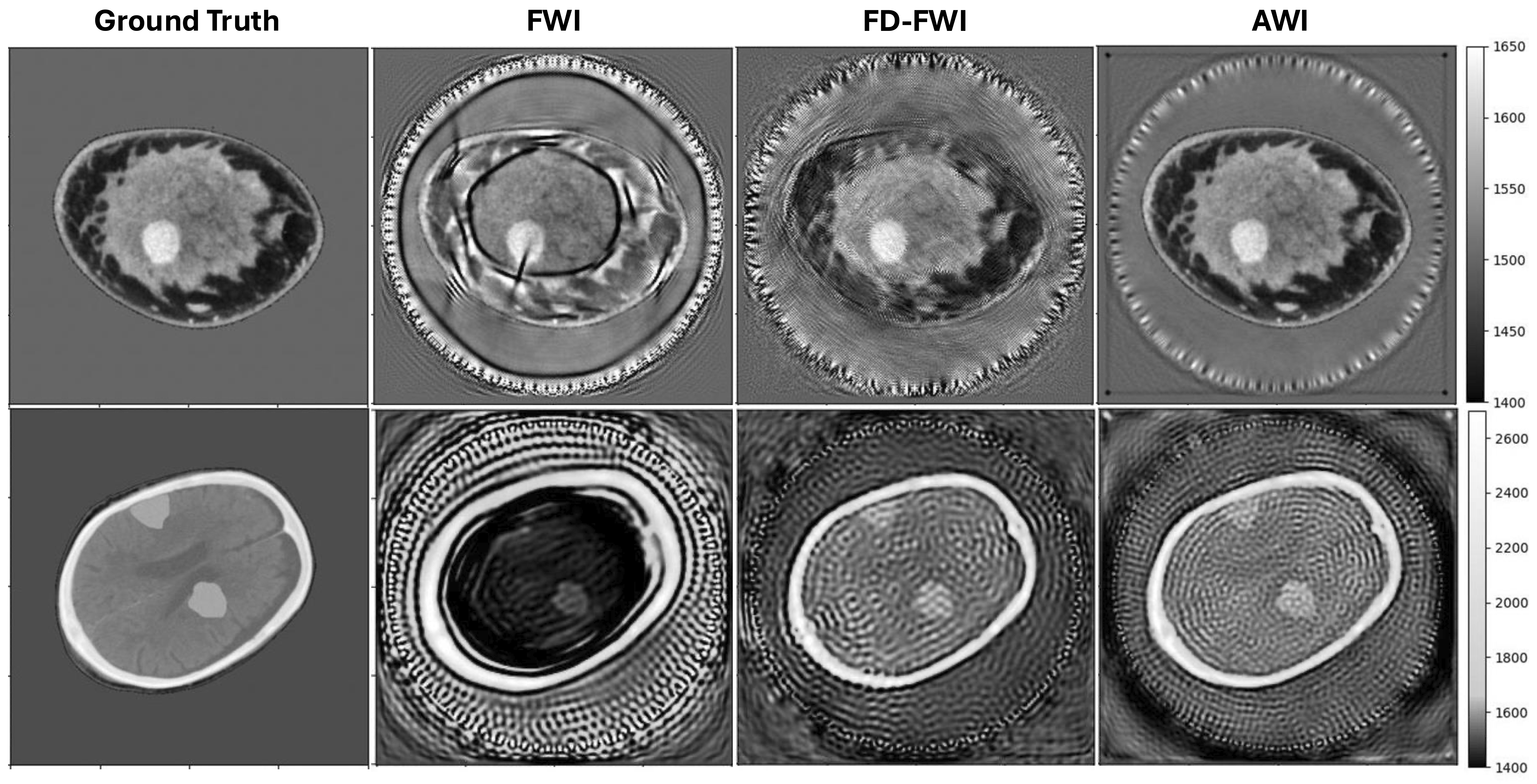
Adaptive waveform inversion (AWI) represents another strategy to overcome cycle skipping. Rather than focus on extrapolating low-frequency signals, AWI circumvents cycle skipping by modeling the transformation from measured to simulated signals as a filter. If the simulated and measured signals are correctly aligned, the filter should be an identity transformation—a delta function at zero time lag. Therefore, the goal of AWI is to drive that filter towards a zero-lag delta function. The AWI objective penalizes energy in the filter away from zero lag rather than directly minimizing the sample-by-sample waveform difference. This changes the shape of the inversion objective and makes it much less susceptible to the local minima caused by cycle skipping in FWI.

Here FD-FWI and AWI are compared with conventional FWI in numerical breast and transcranial imaging phantoms (Klaben et al., 2026). The comparison highlights two fundamentally different approaches to the same problem: FD-FWI constructs a low-frequency surrogate model to improve convergence towards the global minimum, whereas AWI modifies the data-matching objective so that inversion can proceed without requiring those low frequencies. AWI is ultimately the more robust strategy. We theorize that AWI better preserves the true global minimum of FWI while creating a cycle-skipping-free path to that minimum


Alternative and Future Strategies
In addition to AWI, optimal transport is another promising approach to overcome cycle skipping. Optimal transport essentially involves converting the measured and simulated waveforms into probability density functions (PDF), which are then converted to cumulative density functions (CDF). There are several ways to transform the waveforms into PDF, including using the absolute value, the envelope of the signal, separating positive and negative lobes of the signal, introducing a constant offset, exponentiation, etc. Similarly there are different norms that can be applied between the resulting CDFs such as the direct least-squares difference, Wasserstein-1, and Wasserstein-2 norms.
Other approaches include learned low-frequency extrapolation and learning the optimal transformation of the ultrasound waveform that best preserves the solution to the inverse problem while circumventing cycle skipping. Rather than requiring hardware capable of measuring sufficiently low frequencies, learned transformations could potentially extract or synthesize the information needed to constrain the long-wavelength structure of the sound speed reconstruction. Together, these approaches point toward a broader class of strategies for making FWI less dependent on low-frequency measurements and less sensitive to the choice of starting model.